
When one is around children on a daily basis, one hardly notices the changes in their development. Someone seeing them only once a year, however, often reacts at how much they have changed. Day to day, the growth is slow and so unremarkable that transformations are seldom noticed. In fact, one is often distracted from the overall development by sickness that brings weight loss or childish behavior that belies a growing maturity.
The events unfolding in the Middle East are much like the developing child. A weekly or monthly perusal of the news reports does not usually yield significant changes. In fact, there are times when events seem to reverse direction from the major flow of developments. Only when we step back and compare the situation now to what it was a few years ago do we get the full impact of what is happening.
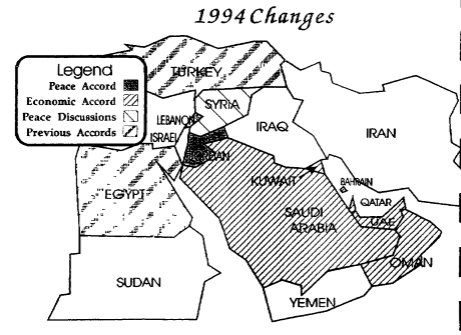
Below is a map of the area. A quick glance reveals that, of the 15 Islamic nations in the Middle East, nine have recently softened their political and/or economic position in regard to Israel. This trend represents a significant shift toward a pro-Israeli posture, which sharply differs from the traditional position. As many are aware, prior to 1994, the State of Israel did not appear on world maps published by the Arab nations. The close of 1994 brings to 11 (over 70%) of the Middle East Arab nations who, in varying degrees, have accepted the statehood of Israel. Those not joining in the movement are Sudan, Iran, Iraq and Yemen. Since we know from the scriptures that Iran and Sudan will be allied with the great Northern host, it is unlikely that they will make any satisfactory peace overtures toward Israel.
What’s going on?
Economic changes
Established in 1948, the Arab boycott of all Israeli products and all companies doing business with Israel created an economic hardship on the new nation. The oil-rich Arab states provide a lucrative market for a wide range of products. In addition to all goods related to the exploration, production, refining and transporting of oil, they have been building their infrastructures of roads, and sanitation, electrical, water and telephone systems. Virtually all of these have been contracted to foreign suppliers. As well, they have made vast purchases of armaments and the latest technological devices. Foreign companies trading with Israel were unable to sell their wares to the oil-rich Arab states. Most of them chose business with the Arabs over Israel as the Arabs provided a much larger market for their goods. This forced Israel to become self-reliant in many areas that normally would have been supplied by imported products.
Even when the indirect boycott was eased, it still applied to any Israeli-made product. Barred from selling to their neighbors, Israeli companies had to sell further afield in Europe or North America. Because of the cost of transport, Israeli companies were forced to develop small items with high technological value. This prepared Israeli industry for the 1990’s far better than any other nation. “Israel was forced into developing such things as communications technology, electronic imaging and biotechnology items; goods which are easy to ship and command a high price” (Toronto Globe and Mail, October 8, 1994).
Early in October, the 46-year-old Arab embargo ended. For the first time in nearly 50 years, flights will be able to land and ships able to dock in Israel on their way to or from the gulf states. More importantly, Israel is now able to sell any of its wares to most Arab nations. The lifting of the embargo, combined with some recent Arab/U.S. developments provide Israeli companies with the opportunity to gain significant trading advantages over companies in other nations.
Peace accords
In May, Israel and the Palestinian Liberation Organization signed a peace accord. This was followed in October by the peace agreement between Jordan and Israel. Talks are continuing with Syria although nothing has yet been firmed up.
These peace accords are a truly remarkable development. The Israeli war machine is second to none and their confidence in it has made them reluctant to make concessions. Israel is one of the few nations that can rightfully boast it has never lost a war since the country’s inception. This track record combined with the high technical level of the Israeli military made a peace initiative seem redundant.
The hand of God thus seems clearly evident in the changes that we are seeing.
We live in exciting times as the day for which we pray draws near. May it come soon and may we each be ready for it.
 The Origin of the Organic World – Part One