Soviet Union Seeks Middle East Peace Initiative
The course of history is often affected by seemingly insignificant events. The uproar that resulted from British author Salman Rushdie’s book “The Satanic Verses” seems out of all proportion to the importance of such a work of fiction.
Much speculation has appeared in the news media as to why a book that would normally be read by only a few people should have created such a furor. Some cynical commentators have suggested that the author, a former Moslem, included the controversial material for publicity purposes to help the sale of the book and got more than he bargained for.
Others have seen the escalation of threats as an opportunistic move by Iranian fundamentalists to regain leadership in the Islamic world after the disastrous eight-year war with Iraq. The threats of violence against the author and the breaking of diplomatic ties with most of Europe have served to further the radicals’ goal of isolating Iran from the West. American and British attempts of the past few years to improve relations with the Iranian moderates have been diverted for the present. Significantly, the Soviet Union has apparently stepped into the vacuum: “Persia (Iran), Ethiopia, and Libya with them (the Russian forces)” (Ezk. 38:5).
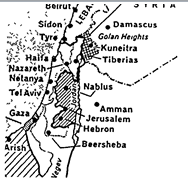
During his previously scheduled visit to Tehran, Soviet foreign minister Shevardnadze was granted a rare audience with the Ayatollah Ruhollah Khomeini. At the 90-minute meeting, the Ayatollah is said to have asked for closer ties with the Soviets whom he had previously condemned for their atheistic ideology. The Soviet minister’s tour included meetings with other middle east leaders whom he urged to move ahead with stalled peace negotiations. Shevardnadze offered full diplomatic recognition to Israel if it were to accept peace talks under United Nations sponsorship, an offer which the Israeli government is not likely to accept.
National Service Legislation Proposed
A plan has been introduced in Congress that would encourage young Americans to devote a year or two to military or social service in return for student aid and other federal benefits. The plan, officially called the Citizenship and National Service Act of 1989, is sponsored by Democrats in the Senate, but Republican support will be needed if the plan is to be enacted. President George Bush is said to favor a smaller scale program of this type.
Proponents see the act as providing low-cost volunteers for the military as well as many needed civilian projects. Eventually, almost all federal education aid, job training and housing allowances would be linked to service in the Citizens Corp for those able to serve. Although proposed as a voluntary program, the link to federal aid would make the program virtually mandatory for some segments of the population. In fact, some critics feel the program would have to be mandatory to benefit those for whom it is designed.
Social “Earthquake” Triggered by Austerity
Although Venezuela, with its massive oil deposits, is considered the richest nation in South America, it went bankrupt several months ago and suspended payments on its $33 billion foreign debt. As a condition of debt relief from the International Monetary Fund, the recently elected government of President Carlos Andres Perez imposed austerity measures allowing steep increases in gasoline prices and transit fares (both of which were cheap by world standards).
The suddenness of the arbitrary increases triggered an angry reaction that Perez called a “social explosion.” Mobs took to the streets, looting stores and methodically carting off the merchandise. Although the riots started spontaneously, activist leaders soon took advantage of the situation. When martial law finally brought control, over 300 were dead and 1500 injured.
Although the debt crisis may be the proximate cause of the trouble, the seeds of the nation’s problems were sown in the 1970’s. Windfall oil profits were squandered before it was apparent that they could not continue indefinitely. Venezuela, like Mexico, Nigeria and many other oil rich nations with burgeoning populations, has found their suddenly acquired wealth to be more of a curse than a blessing. The words of the spirit are again confirmed: “Put not your trust in princes nor in the son of man, in whom there is no help” (Psa. 146:3).
Afghan Capital Prepares for Siege
Although Soviet troops have left Afghanistan, the country’s troubles are far from over. As this is written, Kabul, the capital city, is reported to be in a state of siege. The Soviet installed government of President Najibulah controls only the capital which is surrounded by some 25,000 Mujahedin rebels. The rebels are preparing to attack from the outside and are confident of support from within the city from rebel sympathizers in the army and throughout the community.
Reports from the city of Kabul say the residents fear what will happen when the city does fall because of the lack of unified leadership among the rebels. If this continues, it is feared that a power struggle may turn the city into a battleground like Beirut, Lebanon. Another nation thus adds to the conditions that fulfill the prophecy that there shall be a time of trouble such as never was.
New Gallstone Treatment Reported
A new method of treating certain types of gallstones has been developed. If it proves to be as effective as experiments indicate, the need for traditional gallbladder surgery could be cut in half. Gallbladder surgery cases number about 500,000 a year, making them the second most common form of abdominal surgery next to Cesarean section.
In the treatment described in the New England Journal of Medicine, a chemical solvent related to ether is applied through a tube inserted through the abdominal wall and the liver into the gallbladder. With the new method, a patient can return to work in a few days rather than the six weeks required for conventional surgery. On every hand, knowledge increases at a rapid pace fulfilling the words of Daniel 12:4.
 The Origin of the Organic World – Part One