
It seems improbable, if not impossible, for the new Commonwealth of Independent States to exist harmoniously together. The republic of Georgia is in a state of virtual civil war. The New York Times January 5, 1991, reports that “heavy gunfire echoed through the Georgian capital of Thilisi as supporters of President Zviad Gamsakhurdia gathered in defiance of a rebel ban on demonstrations.” The same issue of the New York Times reports that the Ukraine ordered the Black Sea fleet, one of three major Soviet naval fleets, to take a loyalty oath. The “Ukraine has ordered the entire Black Sea fleet and all ground forces based on the republic’s soil to take an oath of loyalty to the Ukraine.” The commander in chief of the commonwealth forces, Marshal Yevgeny Shaposhinikov, himself a Russian, argued that the loyalty initiative would compromise the forces stationed in the Ukraine because 75,000 of them are Russians. This move by the Ukraine is disturbing as it is the second largest republic in the Commonwealth.

The obvious question that arises is: how can this commonwealth of nations, which finds it impossible to agree on the fundamental issue of military allegiance, plan and stage a coordinated and sophisticated attack on Israel?

The answer is they can’t and won’t.

Elpis Israel

Bro. John Thomas, writing in Elpis Israel gives this rendering of Ezekiel 38: “Thus saith the LORD God: Behold I am against thee, 0 Gogue, Autocrat of Russia, Moscovy, and Tobolskoi: and I will turn thee about, and put a bit into thy jaws, and I will bring thee forth from the north parts, and all thine army, horses, and horseman…” Bro. Thomas indicates that a coordinated Commonwealth

effort is not required to fulfill this portion of prophecy. There will certainly be other nations involved in the attack on Israel (Persia, Ethiopia and Libya), but only Russia, Moscovy and Tobolskoi will be involved from the north part. Modern Russia includes all three of the powers from the north. Thus our focus is to be on Russia. Not surprisingly, it controls most of the vestiges of power left by the USSR.

Russia today

The Associated Press reported on December 16, 1991 that “the new Commonwealth of Independent States would promise never to use its nuclear weapons.” Yet Russian President Boris Yeltsin said that there was no need to destroy the weapons. An obvious question arises: if they are never going to be used, why not eliminate them?

In June, 1982, the strategic arms reduction treaty (START) process began. Over nine years later, the negotiations were finalized and the treaty was signed between U.S. President George Bush and then Soviet President Gorbachev. The treaty, as described in the October, 1991 issue of The NATO Review, catalogs the nuclear arsenal into five unique categories and limits the total nuclear warheads to 15,140 for the Soviet war machine. This remains an impressive arsenal.

Although Boris Yeltsin has taken control of the Kremlin, including weapons and staff, he has yet to validate the START treaty. He cites more pressing issues on the home front as his reason. The New York Times of January 5 further reports that nuclear warheads currently located in Kiev, Ukraine, are being transported to Russia. This will add to the abundant supply of nuclear warheads currently in Russia (see below).
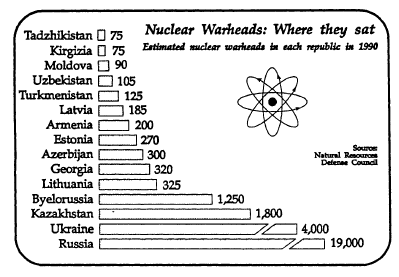
This new, powerful war machine has many people worried. The Toronto Globe and Mail reported on December 31, 1991 that Eduard Shevardnadze, the former Soviet foreign minister said, “In a situation of general instability, anything can happen.” Asked whether the West should be worried, Mr. S hevard­nadze replied: “Go ahead and say that I would be terrorized. I don’t rule out that nuclear warheads and even complete tactical arms can fall into the hands of some paramilitary formation.”

Russia currently has the tools required to dominate virtually any region in the world, including the Middle East.

The new Russia is now controlled by two men; Boris Yeltsin and Vice President Alexander Rutskoi. A book entitled “Boris Yeltsin, from Bolshevik to Democrat” provides a glimpse of both Yeltsin and Rutskoi.

Alexander Rutskoi is an air force pilot who won a Hero-of-the-Soviet-Union award for his exploits in the Afghan war. He is the son and grandson of professional soldiers; in 1988, he served as deputy commander in Afghanistan.

Less than 24 hours after Mikhail Gorbachev resigned and turned over power to Boris Yeltsin, Alexander Rut­skoi classified Yeltsin as a potential dictator. As reported by the Canadian press on December 27, Rutskoi told a news conference that “there is neither government nor democracy in Russia.”

The military tools and the leadership required to stage an invasion as described in Ezekiel 38 are in place in modern Russia.

God, through His angels, continues to work in the kingdom of men to fulfill His purpose. His plan will come to pass. Those who watch for this to take place will not be disappointed.

The Year of 1992

During this time of year, most publications reflect on the past and look forward to the future by publishing some terribly inaccurate predictions for the coming year. As Christadelphians, we realize we possess no special gifts that allow us to predict the coming year. What we do possess, however, is God’s word which foretells of some difficult times preceding the return of our Lord Jesus Christ. In particular, Luke 21 reveals that, “Men’s hearts will fail them for fear” (Luke 21:26).

While we don’t know which situations will worsen, one possibility is that we will experience trying economic times immediately prior to the return of Christ — times in which we are all concerned for the welfare of each other and ourselves. A brief survey of current economic conditions surely indicates as much.

Israel

The October 14, 1991 issue of U.S. News and World Report reported that in Israel the “annual inflation rate is starting to creep up to 30%, and the unemployment rate is 15%. The budget deficit has been running at 4% of GNP but will rise to 6% in the 1992 budget. In addition, a powerful trade union owns 25% of the country’s enterprises and employs 16% of the labor force. And the state government accounts for 20% of industrial production and employs 39% of the labor force. In addition, the country will allow their population to increase by an additional 8% this coming year through the means of immigration.”

Russia

No nation is exempt from some form of economic hardship. In the Soviet Union, as reported in the Toronto Star of November 18,1991, every day a “growing crowd of people pick through the garbage at Khmetvo, a dump 27 miles from Moscow. Enduring the stench, the scavengers search for edible food among the egg and milk cartons, cans and rotting cabbage, trying to avoid live rats and the dead underfoot.” The Associated Press reported on December 7, 1991 that “Soviet President Mikhail Gorbachev appealed yesterday to leaders of four republics to send food to Moscow, while the news media reported that hungry people in some areas have raided farms to steal livestock.” Meat, butter and sugar supplies in the Soviet capital are sufficient for only a few days and Muscovite’s are buying up all the city’s bread supplies. As we head toward the latter days, God’s creation struggles to survive.

North America

The situation in North America is itself alarming. The June 29, 1991 issue of the Economist magazine reports that there were around 600,000 homeless people in 1988. Since that time, a further 150,000 people have come to call the street their home.

The situation can only worsen as unemployment rates continue to climb and people’s financial reserves run dry. During December, 1991, IBM announced that it was streamlining its operation by reducing its work force by 20,000 individuals. PAN AM closed its doors forever, leaving an additional 10,000 out of work. The November 30, 1991 issue of the Economist reports that the unemployment rate in Canada is 10.3% and 6.8% in the U.S. Roughly speaking, this means that about 7,000,000 people are currently searching for work in North America.

These figures begin to hit home when you realize that there are likely 100 families within the brotherhood in North America currently without a source of income, and countless others are enduring economic hardship.

The well is running dry

The October 28, 1991 issue of U.S. News and World Report reports that 3,000,000 Americans have exhausted their unemployment insurance benefits. And a survey of 7,000 business owners across the country by the U.S. Chamber of Commerce indicates that most hiring freezes will remain in effect. The November 16, 1991 issue of the Toronto Globe and Mail reports that “despite a 6% rise in the unemployment insurance premiums paid by all working Canadians the fund will experience a $4 billion deficit. In the first four months since the beginning of the current fiscal year on April 1, the Unemployment Insurance Commission has sent out $6.17 billion in checks, up 40% over the same period last year.”

Dun and Bradstreet, a business information firm, reports that more than 50,000 America firms failed in the first seven months of this year. In addition to being a post-depression record, it is half as many again as in the first seven months of 1990.

An article that appeared in the New York Times Magazine on November 17, 1991 profiling one of New York city’s greatest philanthropists, Brooke Astor, summed up the current situation very succinctly. “When I drive through New York, my heart just sinks. I see all those burned out buildings, I see young men hanging around the streets without jobs and without hope And I think that there is not enough private money in all of New York to solve these problems.”

Ms. Astor falls short of the mark in describing the true remedy for the problems at hand. Divine intervention must occur in order to resolve problems of such magnitude. Believers look forward to such intervention and pray for it daily.

Until that day, the difficult times ahead require the brotherhood as a body to be increasingly sensitive to economic hardships affecting many of its members. This sensitivity may take a very practical form, such as food, clothing and financial assistance. Equally im­portant are the prayers of the brotherhood seeking God’s provisions for our community and spiritual strength for every individual.

Will current peace talks bring any progress toward achieving peace in the Middle East? Even the organizers of the talks are not expecting quick results. The entire process could take months or even years to accomplish, according to U.S. President George Bush. With the opening round completed, bilateral discussions are to be followed by further talks and compromises which will lead, it is hoped, to a true peace in the Middle East. That is the process that George Bush and Mikhail Gorbachev envisioned when they invited all participants to the talks.

As Bible students, we know that true peace will not occur until the Lord reigns who “will judge between nations, and render decisions for many peoples; and they will hammer their swords into plowshares, and their spears into pruning hooks. Nation will not lift up sword against nation, and never again will they learn war” (Isa. 2:4 NASB).

No matter how well the talks proceed, none of the nations in the Middle East would contemplate beating their swords into plowshares. On the contrary, as Israel, Syria, Egypt and Jordan are negotiating peace, each nation continues to increase their military machine and issues of real importance are not even open to discussion.

As interested observers of world affairs, we are not surprised that such would be the case. The current situation in the Middle East, however, is even more ironical in this regard than is normal amongst the kingdoms of this world.

Non-negotiable

As basic as water is to the survival of all peoples living in the Middle East, discussion of this item has been left out of the peace talks. The October 28, 1991

issue of US News & World Report comments on the critical nature of the situation: “In Jordan, Israel and the West Bank, the demand for water exceeds the supply by up to 50%, and populations are growing. Rationing has been imposed in parts of Jordan, and Israel has banned production of water-guzzling cotton.” Despite the seriousness of the current situation, on October 30, Israel adamantly refused to discuss water resources at the talks.

Arms getting out of control

While the nations talk peace, they continue to increase their military strength.

The September, 1991, World Press Review reports that, “Syria already owes Moscow about $16 billion for past arms supplies, with no immediate prospect of paying. As a result, Syria’s economy is severely strapped.”

It would be logical that if any coun­try or individual owed a debt of such magnitude and received a windfall of cash they would pay at least some portion of such a debt. But not Syria. The article continues, “Syria used the $2 billion check it received from Saudi Arabia (in exchange for services rendered in the Gulf War by Syria’s 9th armored division) to purchase Scud missiles from North Korea (which have a 300-mile range and a 1,000 kilogram warhead), 300 1072-M1 tanks from Czechoslovakia, and it is discussing the procurement of M-9 missiles from China.” On October 30, Syria purchased 50 M-9 missiles from China.

Israel

Israel has never been known as a country that would reduce its military might. And today the situation is no different. Recent publications have indicated that Israel is actually increasing its armaments, while talking peace. The October 29, 1991 issue of the New York Times reports that: “A secret project under which the German intelligence service was planning to ship tanks to Israel was disclosed today after tanks were found aboard an Israeli freighter docked in Hamburg, a government spokesman said today. The 12 tanks were Soviet-made and once belonged to the former East German Army.” Supposedly, the Israelis wanted the tanks for testing purposes, since many Arab armies are equipped with Soviet tanks.

The Toronto Globe & Mail reported on November 4 that Israel test fired a third U.S.-funded Arrow antimissile system: “The missile, a joint U.S.-Israeli project under the Strategic Defense Initiative was fired Oct. 30, 1991 from a ship in the Mediterranean.” On the very day the peace process was commencing, preparation was being made for war.

A recent publication by Random House, The Sampson Option: Israel, America and the Bomb, reports that Israel has about 300 nuclear warheads which include 100 tactical weapons as well as nuclear landmines. The author indicates Israel is vigorously working on the development of a low-yield neutron bomb, a bomb in which people are killed and property is left intact.

Mid-East weapons show

The Canadian Broadcasting Corporation world radio news reported on November 1 that, “one of the largest armament sales and shows was taking place in Dubai while the (peace) talks were in process. Over 400 military suppliers were represented at the exhibition which featured some of the most advanced and sophisticated hardware available in the world today.”

It was at this exhibition that Saudi Arabia placed an order with McDonnell Douglas Corporation of St. Louis for 72 F-15 jets. The New York Times of November 6 reports that, “The Saudi request will probably face intense opposition from supporters of Israel in Congress, which has rejected similar deals in the past. The economic pressures of the $4 billion deal will be extremely difficult for Congress to reject. Since last year, McDonnell has laid off 20% of its work force. This sale would allow the company to save an estimated 7,000 jobs over the next five years.

No mutual trust

The situation in the Middle East today is anything but peaceful. Trust between the nations is virtually nonexistent. In order to enter the peace talks in Madrid, all participants had to pass through a security check-point which included a weapons detector so that they could discuss peace. And Syria, Israel and Saudi Arabia all prepared for war on exactly the same day that the Madrid talks began.

The Economist of November 2 writes that from 1980-88, Iraq, Saudi Arabia, Libya, Syria, Iran, Egypt and Israel spent over $215 billion on importing arms. Each of these seven nations ranked in the top 10 of global arms importers. Throughout the region, for every dollar spent on arms, only $.52 was spent on health and education.

While these nations prepare for war, nonetheless they are discussing peace. If we view Ezekiel 38 as a pre-adventual prophecy, the Middle East is destined for a period of peace whereby arms will be controlled and the bars and gates of Israel’s defenses will be relaxed. Could the present peace talks be the beginning of an initiative which would lead to the fulfilment of the terms of Ezekiel 38? Once again, let us watch Israel.