
A few months after the first atomic bomb killed thousands, a world peace organization was formed in New York City. From money donated by the Rockefeller family, the United Nations officially came into existence on October 24, 1945 when the 51 original members ratified its charter.
The main goals of the organization were: 1) to save succeeding generations from the scourge of war; 2) to develop friendly relations among states so they could cooperate in solving international economic, social, cultural and humanictarian problems; 3) to promote respect for human rights and fundamental freedoms.
In order to achieve the goal of world peace, a powerful sub-organization within the UN was required; it was termed the Security Council. Under the charter, all members of the UN agree to accept and
carry out the decisions of the Security Council. While other organs of the UN make recommendations to governments, the Security Council alone has the power to make decisions which member states are obligated under the charter to carry out. As a result, the Security Council has directed the peacekeeping efforts for the UN, often imposing its will on reluctant participants.
UN peacekeepers
Like a good doctor, the United Nations cannot say “no” when it comes to administering the peace process to those in need. During its existence, the UN has mounted over 500 peace operations.
In 1950, 20,000 troops were sent to settle a dispute in Korea. UN troops are still there maintaining a de-militarized zone between north and south.
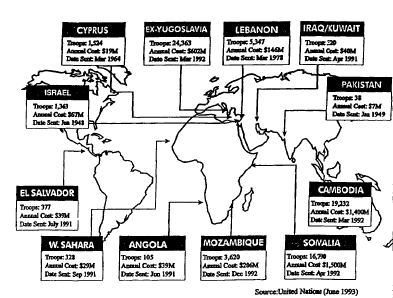
In 1964, 7,000 troops were sent to Cyprus to quell a disturbance between the Greeks and Turks. Thirty years later, the UN is still there.
Forty-five years after UN troops were sent to Israel to help in a border dispute with Lebanon and Syria in 1948, a UN presence is maintained.
A growing task
Clearly, since the UN’s inception, the job of maintaining peace throughout the world has greatly increased. In 1993 alone, the UN has had to increase its troop presence in all major locations of peace operations, the most notable of which are Cambodia, Yugoslavia and Somalia. Currently, one of the most significant operations ever undertaken by the UN is in Cambodia.
Today, maintaining peace in the world costs the UN some $7 billion a year. The UN would prefer to spend more on military tools and training, but the member nations of the UN are having economic difficulties of their own and have refused to increase their contributions. As reported by the Economist, “The UN must beg for money from all member nations in order to complete the work at hand” (June 12, 1993). The article continued, “Peacekeepers are sent off to make peace without the tools to enforce it. They are told to run elections, but not what to do when one side refuses to compete, or denounces the results. They are instructed to see that relief reaches the victims of war, but not what to do when fighters halt their truck.”
Prophecy fulfilled
The resulting lack of peace in the world and the futility of man’s attempts to solve his problems is wholly in accord with the words of our Lord: “And you will hear of wars and rumors of wars; see that you are not alarmed; for this must take place, but the end is not yet. For nation will rise against nation and kingdom against…All this is but the begging of sufferings” (Mt. 24:6-8).
Despite the forthright intentions and significant efforts of the United Nations, it is failing in its attempt to bring about world peace. The problems in the world are increasing at an alarming pace but, as witnessed in Korea, Cyprus and Israel, they remain unresolved by a manmade institution. The need for the intervention of our Lord Jesus is more dramatically evident than ever.
As followers of our Lord, we look with trepidation and fear toward the days that precede his return. Our fears are assuaged, however, for we are confident of his soon coming and the establishment of his Father’s kingdom on our war-weary earth. “Even so, come, Lord Jesus!”
 The Origin of the Organic World – Part One