More Precious Than Oil, and Maybe as Volatile – Water

Throughout history, God has used natural elements (fire, hailstones, water, etc.) to execute His judgments. Current events in the Middle East indicate that God will again use water as a tool in working out his plan.

A brief look at how this occurred in the past will set the stage for further examination of this pattern.

Background

Two familiar passages illustrate how God has used water in great abundance to destroy both land and human life.

  1. For forty days and forty nights, God brought water upon the earth to “destroy all flesh, wherein is the breath of life, from under heaven; and everything that is in the earth shall die” (Gen. 6:17).
  2. “Moses stretched forth his hand over the sea and the sea returned to his strength when the morning appeared; and the Egyptians fled against it; and the Lord overthrew the Egyptians in the midst of the sea. And the waters returned, and covered the chariots, and the horsemen and all the host of Pharaoh that came into the sea after them; there remained not so much as one of them” (Ex. 14:27-28).

While the destruction of the land and mankind occurred through the abundance of water, it is also prophesied that a scarcity of water will destroy the people and the land (Isa. 24). We are witnessing the fulfilment of this prophecy and will continue to witness it until the temple is established as described in Ezekiel 47.

Current situation

Looking at recent events in the Middle East one cannot help but make the connection that God is using this very basic, yet vital, element to exercise His will.

An article in the AWWA Mainstream periodical, April, 1991, reported that, “The Sea of Galilee has dropped to the lowest recorded level. Overuse and drought have drained the sea, source of about 25 percent of Israel’s water, to a danger point. Israel and Jordan are overdrawing their water resources by about 15 percent, experts estimate. And Israel will take in a million more immigrants, mostly Soviet Jews, in the next few years.”

The title for our article was taken from the March 17, 1991 issue of the New York Times. There it was pointed out that the Middle East, particularly Israel, is in a no-win situation trying to manage their water supply. “Populations are growing far more rapidly than aquifers can be replenished; rivers cross borders between states that put self-interest before sharing; rainfall in many places is scarce and capricious. And at the core of the Middle East’s problems is population growth. Arab populations in Syria and Jordan are growing at rates of 3 percent a year, while Israel bulges with the huge influx of Soviet immigrants. Whatever their faith, however, all are reliant on the same complex of limited water supplies – water that is not easily shared.”

Divine displeasure

Scripturally, we are told that a decline in the earth’s natural blessings is linked to a spiritual decline. For example, when the children of Israel were in the land and were at one with God, they were blessed. When they forsook God He punished them (Ex. 15:26, Deut. 7:9-11; 28).

Interestingly, in Israel today, individuals can worship the god of their choice.

An advertisement by the America-Israel Friendship League which appeared in the May 5, 1991, New York Times pointed out that freedom of worship in Israel is not just a luxury, it is the law. “When Jordan controlled the Old City from 1948-1967, Jews from around the world were not permitted to enter East Jerusalem, or pray at the Western Wall. Israel united the city in June, 1967, reopened the Holy places to all religions, and guaranteed freedom of access and worship.”

The Israeli declaration of independence states in part, “The State of Israel…will uphold the full social and political equality of all citizens, without distinction of race, creed or sex; will guarantee full freedom of conscience, worship, education and culture; will safeguard the sanctity and inviolability of the shrines and Holy Places of all religions.”

From a human perspective, the State of Israel is a secular state offering nothing more than freedom of religion. In God’s eyes, however, this is an abhorrence which cannot be tolerated. They are uniquely His people living in His land and should purge it, as will their Messiah, from idols of every form. Both Josiah and Elijah destroyed the idols of the land and were praised for their work.

By allowing and promoting false worship to thrive in Israel, the nation will incur the severe wrath of God.

In summary, we can expect that with further decline in the spirituality of Is­rael, God will use water to pass judgment. This time, evidence points to the withholding of water, and all the conditions that this brings, including the possibility of water management being the flash point in the Middle East. Let us continue to watch Israel and be ready for the return of Christ.

Earthquakes

An article that appeared in the New York Times, June 16,1991 stated that “a strong earthquake (6.3 on the Richter scale) had struck in the southern Soviet Union, close to the area that was struck by a quake in April (7.0 in strength). At least 3 other major earthquakes were reported on the same day, two in Japan and one in the South Sandwich Islands, 2000 miles southeast of the Falklands.”

During the last week of June, the Toronto Globe and Mail reported two earthquakes thousands of miles apart, “Mount Pinatubo [in the Philippines] spewed steam and ash more than 10 kilometers high yesterday and a series of earth tremors sent thousands of people fleeing from their homes.” At least five tremors occurred near the cities of Olon­gapo near Subic Bay, and Angeles, adjacent to Clark Air Force Base.”

“A strong earthquake rocked Southern California yesterday (June 28, 1991), killing one woman injuring 70 other people and damaging 300 buildings and homes in suburbs east of Los Angeles.”

“There will be famines and earthquakes in various places…” (Matt. 24:7 RSV).

Have you come to take a spoil?

Ezekiel 38:13 records that “Sheba, Dedan, the merchants of Tarshish and all the young lions thereof” will voice concern over the spoil that the invading forces have come to capture. It is interesting to note that their concern is over the “spoil” and they appear to have little interest in the safety of the Israeli citizens.

Many Bible students have offered suggestions as to the exact nature of the “spoil.” The following presents some new information regarding recent developments in Israel which may clarify our understanding of the spoil and why outside nations are concerned about it.

Why nations are concerned

If we knew that someone was going to break into our neighbor’s home, we would be concerned about their safety and welfare. However, if our neighbor was storing some of our material possessions, our concern would not only be for the safety and welfare of our neighbor, but also for the items stored in his possession.

Is it possible that Sheba, Dedan, etc. have possessions in Israel that they are concerned about? The drastic decline in the Soviet economic structure along with recent developments in foreign investments in Is­rael have combined to form an interesting prospect.

Blossoming high-tech industry

An advertisement by the America-Israeli Friendship League in the New York Times of April 28, 1991 pointed out the amazing high-tech industry that already exists in Israel. “The nation of not even 5 million people has more scientists doing research and development, per capita, than any country in the world. Israel publishes more scientific papers, educates more masters and doctoral students, and graduates more physicians, per capita, than any other nation.

“A single Israeli company provides almost one-third of the U.S. market’s surgical lasers used to open clogged arteries and cure eye problems. Another Israeli firm manufactures many of the world’s CAT scanners, which detect irregularities in the brain.

“The central processing unit for the IBM PC is an Israeli innovation. So is the remote control pilotless aircraft purchased by the U.S. Navy. And the automated page layout system used by major American news magazines is produced by an Israeli firm.”

This quote amply illustrates the strength of the existing high-tech industry in Israel. To further cement their position in this area, another phenomenon is occurring.

The brains are moving in

With the relaxation of Soviet Jewish emigration restrictions, many well-educated Russian Jews are settling in Israel. This brain power provides Israel with a major advantage in the high-tech industry.

The December, 1990 issue of “Business Week” magazine pointed out this fact. “The influx of Soviet Jews — now 2,500 a week– is adding scientists and engineers to what was already the highest concentration in the world: 30 for every 10,000 citizens, vs. 25 per 10,000 in the U.S.”

The July, 1990 issue of the “Economist” magazine notes that “Israel trains 260 doctors a year, 200 doctors arrive from the Soviet Union every month, along with hundreds of engineers, scientific researchers and musicians. Israel graduated 35 PhD’s in Physics last year, the Soviet Union provided them with 400 in the same period.”

Intel, Motorola, National Semiconductor and Digital Equipment all have chip design centers in Israel, and their engineers have played a major role in developing the microprocessors produced by all four companies.

Obviously, brain power is useless unless money is available to fuel the industry. In this regard, the Industry & Trade Ministry last year awarded more than $100 million in matching funds to 640 research projects. Additional funds for future high-tech development will be provided in a very unique way.

Israel set for massive privatization of banks

An article in the Toronto Globe and Mail of March 10, 1990 outlined Israel’s plans to generate funds for future developments. “Israel’s banking system is headed for its greatest transformation since the country’s birth 42 years ago — with four banks headed for the auction block. After almost completing the process of nationalizing the country’s four main banks, the government is now getting ready to sell them to the highest bidders. And because few Israelis have enough money to buy the banks, the government is looking abroad to the U.S., the U.K., Canada and Saudi Arabia. That’s right, Saudi Arabia.”

Although the privatization plan was stalled by the gulf war, once it proceeds as planned it will generate additional money for the high-tech industry in Israel. It will also mean that the U.S., Britain, Canada and Saudi Arabia will have significant financial interests in Israel.

Coming into focus

As the high-tech and financial industries increase in Israel, so does the potential “spoil.” Further, it is very understandable why “Sheba, Dedan, the merchants of Tarshish and all the young lions” will be concerned about the spoil that is to be plundered from Israel, for the spoil belongs to them! With the decline in Soviet fortunes hindering its ability to be a high-tech leader, Israel becomes increasingly attractive.

Ethiopian Jews returning to Israel

During the last week of May, 1991, 25,000 Ethiopian Jews were returned to Israel. We tend to underestimate God’s power to accomplish tasks quickly. In human terms, we could not foresee nor would we be­lieve it possible that 25,000 people of one faith could be transported 2600 kilometers in two days. “Therefore say, Thus saith the LORD God: I will gather you from the peoples and assemble you out of the countries where ye have been scattered, and I will give you the land of Israel” (Ezk. 11:17).

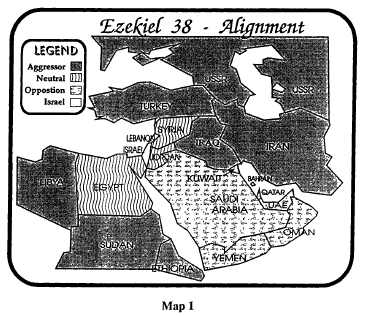
In order for Ezekiel 38 to be fulfilled, Tubal, Meshech, Persia, Ethiopia, Gomer, etc. must agree to attack Israel. Sheba, Dedan, the merchants of Tarshish and all the young Lions must stand united in their opposition to the attacking force. Egypt, Syria, Assyria, Ammon, Moab, Tyre and Sidon must be neutral to either coalition; they are in the geographical area but left out of Ezekiel 38.

Transposing these ancient names to a modern day map gives the following alignment:

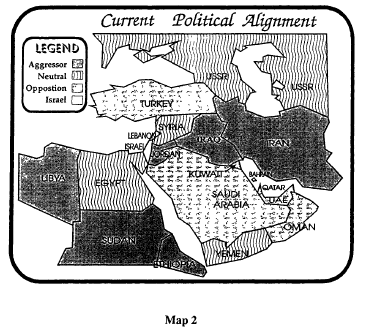
Alignment During Gulf War

During the Gulf war, hostility to Iraq, economic problems and pressure from the U.S. resulted in something different from that portrayed in Ezk. 38. (Map 2. Note that Yemen, Jordan, Turkey and the U.S.S.R. will eventually change from their current affiliations.)

If we were to compare map 2 with a similar map that was drawn just 18 months ago, we would notice that several political re-alignments occurred in that short time.

In May 1990, North and South Yemen merged to form the nation of Yemen. Although little to nothing was written about this amalgamation, it was truly nothing short of God’s hand at work. Prior to unification, South Yemen was aligned with the communist block nations, and North Yemen was aligned with Saudi Arabia and other capitalist countries. Since unification Yemen has taken an anti-Israeli stand. This hard line stand has been tempered by the fact that during the Gulf crisis Yemen abstained from voting on security council resolutions regarding embargoes to Iraq. Because of these abstentions, Yemen has incurred and continues to incur the economic wrath of Saudi Arabia.

In September 1990, Iran and Iraq came to terms on a peace settlement. Despite the fact that these two very different nations had been at war for the past 10 years, Iraq agreed to all of the terms that Iran placed before it.

In January of this year Kuwait was liberated and turned over to a thankful Emir.

Such changes indicate how rapidly the alignment of nations can change.

Near-term changes to expect Turkey

As a member nation in N.A.T.O., Turkey is required to tow the party line. This has been accomplished at considerable cost to the political leadership of President Ozal. Within the last year President Ozal has lost three key cabinet members including his Minister of Defense and Foreign Affairs Minister Ali Bozer. The cabinet ministers resigned because of Ozal’s staunch support of U.S. policies.

Ozal fully expects to be repaid by NATO nations for his support (against the popular will) in the Middle East. “Trade not aid” was his favorite slogan during the conflict. Now that the war is over, trade between Turkey and the U.S. has actually declined. Turkey was planning on exporting more textiles to the U.S. to compensate for embargoed-related losses to Iraq, but through the hand of God the exports have declined.

U.S.S.R.

The U.S is in the midst of a severe economic crunch. Any one of a number of items could cause the U.S.S.R. to become involved. in a Middle East conflict. Ezekiel 38 indicates they will become involved reluctantly and swiftly, “And I will turn thee back, and put hooks into your jaws, and I will bring thee forth” (v. 4) and for the purpose of obtaining wealth, “Art thou come to take a spoil” (v. 13). While their current economic situation forces them now to look abroad for financial help, if the situation worsens, they might possibly do more than look.

Yemen

It is only a matter of time before this tiny nation comes into alignment with Saudi Arabia, their closest neighbor and largest trading partner. This nation is insignificant in terms of their own military, political and economic might. Having recently undergone unification it will probably be just a short while before they become totally dependent on their northern neighbors.

Jordan and Syria

It is fascinating to watch the neutralization of these nations.

While Jordan has been greatly weakened by the recent war, Syria has been strengthened and was virtually given Lebanon as a gift for joining the allied coalition. Syria’s new power in the area may embolden her to attack Israel to Syria’s own destruction. We don’t know what will happen, but somehow Syria will not be a factor in the Gogian invasion.

Generally speaking, the people of Jordan are united in their hatred for the state of Israel but financially they are so dependent on the west that politically they must put on a face to tolerate Israel. Now that the U.S. has discontinued foreign aid and Saudi Arabia has cut off more than half of their oil supply, Jordan’s political leaders could shift their alliance and become united in thought with the Jordanian populace. They are no match for the Israelis, but fanatical action may lead to open warfare with Israel, a battle which Jordan would certainly lose.

Summary

We live in exciting times as prophecy is fulfilled before our eyes. While sometimes it is hard to see how events of today fit into the revealed framework, when we look back over 50 or 100 years, our perspective is clarified and we see the nations being aligned toward the great day of God Almighty.

The Lord will surely come! When he does, let us be ready to meet him with our lights burning brightly and our lives dedicated to his service.