Without natural affection

What is the world’s fastest-growing Christian denomination? Think about this one carefully before you hazard a guess.

If your guess was Mormon, Catholic, Jehovah Witness, Anglican, Methodist, Brethren in Christ, Presbyterian, Lutheran, Christian Reformed Church, Seventh-day Adventist or for that matter, Christadelphian, you would have been wrong.

The Toronto Globe & Mail of Oct. 1, 1991 reports that, “The Universal Fellowship of the Metropolitan Community Church is still small, but proportionately it is one of the world’s fastest-growing Christian denominations. Its membership still numbers only 27,000 worldwide, but since its founding in 1968 it has grown to 264 congregations in 16 countries, including Canada, Argentina, Denmark, the Philippines, Nigeria and Germany.”

Why is this church so fast growing? It ministers to the homosexual community.

God abhors homosexuality

As Christadelphians, we believe the Holy Scriptures are God’s inspired message. In His message, He has provided commandments and ordinances which we must follow. Whether or not we think homosexuals are kind, gentle and humanitarian is irrelevant to God’s extremely direct words concerning such behavior. He abhors it!

A clear illustration of the divine standard is seen in the following verses: “Before they lay down, the men of the city of Sodom surrounded the house, both young and old, all the people from every quarter; and they called to Lot and said to him, ‘Where are the men who came to you tonight? Bring them out to us so that we can have relations with them.”

The visiting angels made it clear to Lot that he should depart the city with all his family “for we are about to destroy this place, because their outcry has become so great before the Lord that the Lord has sent us to destroy it” (Gen. 19:4,5,13 NASB).

The situation today

As we look around us at the “Chris­tian” churches of today, we find a similar pattern emerging. They are ignoring God’s laws on sexual behavior. They not only allow practicing homosexuals to worship with them but they also allow them to lead them as ministers.

On August 21, 1990, The United Church of Canada’s General Council voted 302-74 to pass a motion which states, in part: “All persons, regardless of their sexual orientation, who profess faith in Jesus Christ and obedience to Him, are welcome to be or become full members of The United Church of Canada. All members of The United Church of Canada are eligible to be considered for ordained ministry.”

United Church not alone

The United Church in Canada is not alone in welcoming all persons, regardless of sexual orientation, into their congregation. The June 2, 1991 issue of the New York Times reports that many other denominations are studying whether to allow homosexuals to become full members. The newspaper reports: “The United Methodist Church’s Special Committee to Study Homosexuality will complete work on a report that will be used to make recommendations to the General Convention next May (1992). A straw vote taken last winter indicated 17 of 21 members of the United Methodist committee agreed that their church should drop its condemnation of homosexual behavior.”

The article goes on to report that the Presbyterians, Episcopalians and Evangelical Lutheran Churches all now have working committees evaluating how the homosexual community can be integrated with mainstream believers.

The Presbyterian report, as quoted by the New York Times states, in part, that: “sexual intimacy is a human need and right that should not be restricted by ‘formal criteria’ like marital status or sexual orientation or by ‘so-called’ respectability.” And the report asks the “patriarchal ethic of gender oppression’ (which includes much of the church’s inherited teaching) be replaced by an ‘ethic of gender justice’ and respect for sexual diversity. What counts is not ‘who sleeps with whom,’ the report says.”

God’s commands ignored

God’s true commandments have consistently been rejected by the mainstream religious organizations.

Jeremiah stood in the Lord’s house and spoke directly to those who had come to worship hoping that they would listen and turn from their evil ways. For this, God’s people tried to kill him (Jer. 26:1-8).

November, 1991 is no different from Jeremiah’s time. People, who have the Word of God available to them, continue to defy His commandments.

A sign of the last days

The apostle Paul warns us of this: “For the time will come when they will not endure sound doctrine, but wanting to have their ears tickled, they will accumulate for themselves teachers in accordance to their own desires; and will turn away their ears from the truth, and will turn aside to myths” (I Tim. 3,4 NASB).

Twenty years ago, the mainstream religious organizations would never have dreamed of allowing a homosexual to worship with them, let alone minister to them. But today, they are welcomed.

Christ told us plainly that such things would be. “It was the same as happened in the days of Lot: they were eating, they were drinking, they were buying, they were selling, they were planting, they were building; but on the day Lot went out from Sodom it rained fire and brimstone from heaven and destroyed them all. It will be just the same on the day that the Son of Man is revealed” (Luke 17:28-30 NASB).

The current situation within the Soviet state is a perplexing one. It not only puzzles Christadelphians, it also baffles many western “experts” in foreign affairs. Although the situation changes on a daily basis, one element has remained constant since August 19, 1991: no one knows who is really in charge of this powerful new confederacy of nations once known as the U.S .S .R.

As Christadelphians, we know that the “Most High is sovereign over the kingdoms of men and gives them to anyone he wishes and sets over them the lowliest of men” (Dan. 4:17 NIV). But on another level, we desire to know through whom God’s plan will be fulfilled. We wonder whether Mikhail Gorbachev, Boris Yeltsin or another leader will lead the charge toward the Middle East as God pulls the confederacy of nations toward the promised land.

We do not know how the events in the Soviet states will play out over the coming months or years, nor do we know who will emerge as the true leader of this powerful military machine. What we do know is that the people of that area will invade the Holy Land in conjunction with a multinational force (Ezk. 38:15). In order to accomplish an invasion of such magnitude, a very powerful army is required.

Mighty army still exists

Interestingly enough, and contrary to what we may think, the Soviet military machine has become stronger during the last decade while the western powers continue to disarm. Here are the facts as quoted from the May, 1991 issue of Midstream magazine.

  • “The Soviet output of long-range submarine launched cruise missiles has increased from the annual average of 35 in 1982-84 to a steady annual 200 under Mr. Gorbachev.
  • “In 1989, the Soviet Union outproduced the United States in short-range submarine launched cruise missiles by 1,100 to 180.
  • “The Soviet output of submarine launched ballistic missiles has, under Gorbachev, been a steady 100 a year while the United States output in 1988, for example, was zero.
  • “In 1988, the Kremlin began the deployment of the world’s largest bomber, whose speed exceeds 1.6 times that of the United States’ largest bomber, the B-1B. The payload of the new Soviet military transportation plane, An-255, is twice that of its American counterpart.
  • “Between 1972 and 1990, the Soviets developed 28 new types of strategic missiles, 7 new classes of submarines, and 3 new strategic bombers, while the respective figures for the United States are 4,1 and 1.
  • “The most important development in global Soviet weapons is the rapid growth in 1990 of reload-refire and mobile intercontinental missiles of which the west has deployed none. In 1989, the Soviet output of intercontinental ballistic missiles was 140, while the United States output was 9.
  • “Since 1978, the hulls of Soviet ALFA class submarines have been manufactured out of titanium, which has made them the world’s fastest and deepest diving. On the other hand, the Pentagon cannot afford such submarines even 12 years later.”

U.S. cutbacks

The August 30, 1991 issue of The Wall Street Journal reports that the Navy, Air Force and Army face big hits in the budget meltdown. In particular, “The Navy’s Seawolf nuclear powered attack submarine and Arleigh Burke class guided missile destroyers stand to be cut from the Navy budget. The Air Force’s hopes for 75 B-2 Stealth bombers are out the window. The Army’s next generation armored vehicles, the upgrading of nuclear plants and development of long-range, mobile ballistic missiles also face significant cuts.”

As NATO forces continue to disarm (albeit reluctantly), the Soviet nation continues to increase militarily. Soviet military superiority does not come cheaply. The New York Times reports that basic consumer products like soap and flour are virtually unavailable in Soviet stores. The fact that the Kremlin could afford such military spending is because it has been able to save on the production and distribution of basic consumer goods and services. The con­sequence is, however, that today the Soviets have the military might neces­sary to invade the promised land.

Impact of independent republics

Currently, we are led to believe, through media reports, that the inde­pendence of the Soviet republics is well underway. As a result of this form of thinking, we may theorize that Moscow does not have control over the decisions and actions of the republics. Therefore, a coordinated Soviet invasion of Israel is virtually impossible given present circumstances.

The Sept. 8 edition of the New York Times reports that although independ­ence has occurred in the U.S.S.R., it is currently a very superficial independ­ence. Moscow is still firmly in control. The center still controls the three major aspects of Soviet life: food production, transportation and finance. In June, 1991, the United States loaned Moscow $1.5 billion for food purchases. “All of the American loan guarantees are for borrowing by the central government in Moscow and cannot be used by the republics” (Sept. 8, 1991).


Hard winter ahead

A long, cold winter has always been the norm in the Soviet Union and 1991 will be one of the most difficult. “Even with last year’s record harvest, the trans­portation and distribution problems endemic to the Soviet system created local shortages as grain, fruits and vege­tables never made it from regions of surplus to areas that grow little of their own food. And Russian officials of the largest grain producing republic said they will insure that their own popula­tion will be fed before allowing food to go to other republics” (N.Y. Times 9/8/ 91). Republics will be forced to rely on Moscow to import grain for survival.

In summary, although the political

character of the Soviet state is changing, the area remains a strong military power. While we may see a change in the character of this country, we know its nature has not changed. Remember that the center still has firm control of the food supply, the finances and the military. Let us, therefore, continue to watch, listen and pray that God’s plan and purpose will shortly be fulfilled.

“But understand this: If the owner of the house had known at what time of night the thief was coming, he would have kept watch and would not have let his house be broken into. So you also must be ready, because the Son of Man will come at an hour when you do not expect him” (Matt. 24:43-44 NIV).

A land of Promise, A land of Contrasts

Once Christ has returned and established his kingdom, the first resurrection will be history. Those who have been found faithful will be ruling the world with the Lord Jesus Christ

Ezekiel 47 provides for us a description of the temple and the area that surrounds it. Although this chapter is only 23 verses long, the words water, waters and river are referred to 25 times in the chapter. An obvious conclusion is that not only has there been a resurrec­tion of people there has also been a resurrection of the land of Israel.

Agricultural deterioration

The prophecies concerning the promised land indicate that the region which was once a land flowing with milk and honey (Deut 8:8) will deteriorate until the entire creation groans (Romans 8:22) for the promises to be fulfilled.

The deterioration of the region is occurring today and will continue to transpire, until such a time that mighty rivers will be crushed and that men will be able to walk across the portions of the Red Sea.

“And the Lord shall utterly destroy the tongue of the Egyptian sea; and with His mighty wind shall shake his hand over the river, and shall smite it in seven streams and make men go over dryshod” (i.e. in shoes) (Isa 11:15).

The power of this prophecy is best illustrated by comparison. An area that was once capable of destroying the Egyptian army (Ex 14:29) by the sheer volume of water, will be rendered useless.

The Situation Today

Everything that lives and breathes requires water to survive. Water is vital, fundamental and currently in short supply in the Middle East. Within the next two years, the population of Israel, Jordan, Egypt and Syria is forecasted to grow by 4.5 million people. The population boom will only exacerbate an already critical situation.

The New York Times reports (April 21, 1991) “Israel, having made the desert bloom, a proud early achievement, is now counting the costs of its remarkable development of agriculture. It finds this symbol of national success withering.”

Israeli reservoirs are at their lowest levels ever, and increasingly, top officials blame the abundant availability of cheap water to farmers for what is described in terms ranging from crisis to catastrophe.

Yoram Avnimelech, chief scientist at the Environment Ministry indicated that Israel meets its present water needs from three sources – the Sea of Galilee, known as lake Kinneret, and two aquifers, geological formations that supply ground water. “Kinneret is practically empty,” said Mr. Avnimelech, its level is at the “red line” beneath which no water should be pumped. To do so, he said, allows salt water to seep in from salt deposits.

“The aquifers are at the same level of danger,” the scientist said, “and the sea water is already beginning to seep into the coastal water reserves.”

The Solution ?

The April, 1991 issue of World Water and Environmental Engineer reports that “underground salt water springs were capped back in the 1960’s to pump their water into the Salt Water Carrier, which drains the salty effluent into the lower Jordan. The low water level is causing concern among some scientists, for the consequent lower pressure may allow the salt water to ‘explode’ and increase the salinity.” As more and more aquifers are drained of their fresh water, the probability of salt water penetration increases.

As the current ground water supplies become exhausted in the area, the governments have two possible solutions. The first method, which is the most economical, is to drill for water in unreplemshable aquifers. The second method which is currently reserved for oil rich nations is to turn to the oceans.

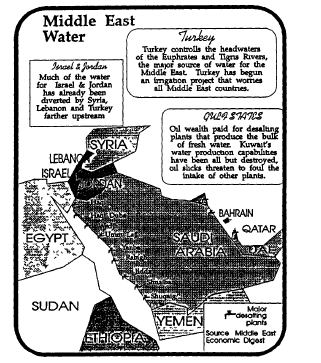
Desalmation projects are under way in all regions of the Middle East. As a result of the Gulf crisis, and the resulting water pollution, Saudi Arabia has placed particular emphasis on desalination plants located on the Red Sea. (See diagram below) This is the same sea that the Lord has prophesied He will smite.


The Only Solution

The need for fresh water increases with each birth. Thus the fruitless search continues. As believers in God’s coming kingdom, we look forward to the day that water will be plentiful not only in the Middle East but throughout the world. We eagerly anticipate the geological transformation in Jerusalem when “…living waters shall go out from Jerusalem: half of them toward the former sea and half of them toward the hinder sea: in summer and winter shall it be” (cp. Ezk. 47:1-12).

Then shall all who seek both natural and spiritual water be satisfied.