
In our last Article, we noted some important patterns in Book IV, Psalms 90-106. It was suggested that these 17 psalms were arranged to be sung at the Feast of Tabernacles, with psalms for the mornings (odds) and evenings (evens) of each of the eight days, from sundown of Tishri 14 to sundown of Tishri 22. Besides the basic alternating pattern, we identified a number of Tabernacles themes. In particular, Book IV has many allusions to: (1) the exodus, (2) Solomon and the temple, (3) the Lord reigning on earth, (4) the subjugation of the Gentiles, (5) creation, (6) the history of Israel from Abraham to the exile and (7) the joy of worshipping God.
Moreover, the allusions to the exodus are in the same order as recorded in Exodus, and the allusions to Solomon and the temple are in the same order as recorded in II Samuel-I Kings. As mentioned in the earlier article, these links suggest that the psalms in Book IV were sung along with readings from the earlier histories.
The readings and the psalms together likely formed a week-long cantata celebrating the themes of the Feast of Tabernacles. Each morning and each evening, the worshippers at Jerusalem would read a sequential portion from the Torah and a sequential portion from the Former Prophets, then, following these two readings, they would sing a psalm commemorating the events in the readings and the general themes of Tabernacles. The following table is a possible reconstruction of this reading plan.
By following such a plan, the annual gathering of faithful Israelites would reinforce its confidence in Yahweh as Creator, Deliverer, and Judge, and in the current king as God’s chosen representative in the earth. They would long for the day when these precious promises would be fulfilled in earnest.
Let us put ourselves in their shoes as we work our way through this wonderful sequence of psalms.
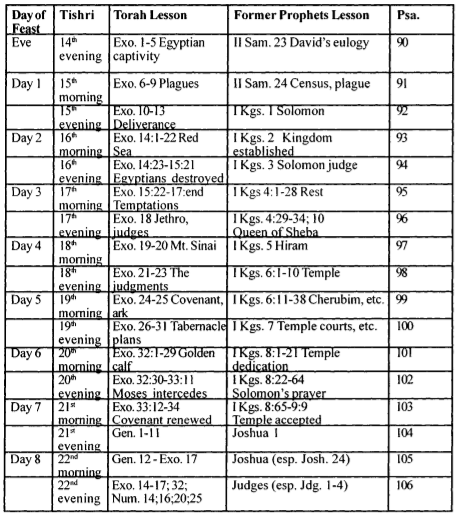
Psalm 90 (Readings: Exodus 1-5; II Samuel 23)
We begin with Psalm 90, a lament. We have sinned and God has punished us. We are ready to return to the dust. We have come to the close of a long day at the end of a hot summer. Like grass, we grew up in the morning, but have been cut down and withered now that it is evening. We pray that God might show us His mercy in the morning. We have been counting the days of our affliction, asking God to make us glad for at least as long. Such are our words as we prepare our minds for the upcoming week of festal rejoicing.
We remember the affliction of our forefathers in the bondage of Egypt, and God’s anger toward Moses for failing to circumcise his son. Our prayer is filled with the words of Moses the man of God before his death.
But most important, we pray to our Lord, who is from everlasting to everlasting, who formed the earth. To Him a thousand years are as yesterday, as one of our night watches. He has been our dwelling place. How long, 0 Lord? Let thy works appear. Establish the works of our hands.
Psalm 91 (Readings: Exodus 6-9; II Samuel 24)
It’s the morning of the 15th. We open our readings with the plagues upon Egypt. God brought pestilence and destruction upon our captors. Thousands fell around us, but we were left unscathed. Next we read about the plague that came upon Israel when David numbered the people. Seventy thousand died at David’s right hand, but it did not come near him.
This morning’s psalm begins with a theme of Tabernacles: we celebrate God’s blessings on our king. Our king is God’s chosen ruler, the one who dwells in the secret place of the Most High. Our king trusts in the Lord that God will deliver him from snare and pestilence. Like Israel in the wilderness, God will protect him under His wings. Just like Israel in Egypt and David during the plague, even though destruction of the wicked might be all around him, no evil will befall our king. God’s guardian angels will protect him, just as they protected Israel and David.
In confirmation of our words, God announces His promise to save our king and give him long life, because our king has set his love upon God and he has known God’s name. Our king will call upon God for help in time of trouble, and God will deliver him.
Psalm 92 (Readings: Exodus 10-13; I Kings 1)
Later that evening we read first about the destruction of Egypt’s firstborn, then about Adonijah’s failed attempt to usurp the kingdom from his father David, and the anointing of Solomon as the true successor to the throne. Like the celebration at Solomon’s anointing, this evening’s psalm is sung with musical accompaniment.
Throughout this week we will sing praises to the Lord in the morning and every night. We celebrate the works of our Lord’s hand, reminding us of His works of creation. Like the Egyptians, our enemies — brutish, foolish, wicked, workers of iniquity all of them — have had their temporary victories over us, but they shall be destroyed for ever, they shall perish. Like Adonijah’s guests, they shall be scattered.
In contrast, our king, like Solomon, shall be exalted. Like Solomon, our king is the true anointed one. The righteous, Solomon and those loyal to him, will be like the palm trees and cedar in the house of the Lord. Unlike the wicked, they will bring forth fruit in old age. In all things they declare the righteousness of the Lord.
Psalm 93 (Readings: Exodus 14:1-22; I Kings 2)
It’s now the 16th of Tishri, the second day of the feast. We read of God’s control over the waters at the Red Sea so that Israel crossed on dry ground. This reminds us of His control over the floods of chaos at creation and at the time of Noah. We also read about the establishment of Solomon’s kingdom, and the executions of Adonijah, Joab and Shimei, who had risen up in rebellion against him. This morning’s psalm is the first of several morning hymns celebrating the Lord’s holiness and His reign on the earth. Like Solomon’s kingdom, God’s throne is established, it cannot be moved. Our God is clothed with majesty and strength. He is from everlasting. We think of the pillars in the Temple where we are standing, of Jachin (“He shall establish”) and Boaz (“In it is strength”). Besides establishing His throne, our God has overthrown our enemies. Like Israel’s enemies at the Red Sea and Solomon’s enemies at the time of his anointing, the floods lift themselves up in our own day, but our God, the Lord on high, is mightier than them all. God has proven that His promise to David is sure. David’s seed was established upon his father’s throne, and David’s seed would indeed build a house for God’s name. To this day, David’s seed is still sitting on his throne, and this temple is still filled with holiness. These are major themes of our Tabernacles.
Psalm 94 (Readings: Exodus 14:23-15:21; I Kings 3)
This evening we read about the Egyptian army being completely destroyed in the Red Sea. We also read about Solomon’s prayer for wisdom to judge the people, illustrated in the case of the two harlots.
Like last night, we pray for God to execute vengeance upon the proud, the wicked, the workers of iniquity, the brutish, the evildoers, those that gather themselves together against the righteous, those who condemn innocent blood. We know that the Lord, who created man, is witnessing the persecution. Soon judgment shall return to righteousness. God has blessed us by chastening us; He has taught us out of His law; He is our refuge. He will cut off our enemies.
Psalm 95 (Readings: Exodus 15:22-17; I Kings 4:1-28)
It’s the 17th and we read about the wilderness temptations of our forefathers, including the episodes at Massah (“Proving”) and Meribah (“Strife”). We remember the later episode recorded in Numbers 20, in which God declared to Moses that he would not enter into the land of promise because he had not believed the Lord.
We also read of the period of peace enjoyed in the reign of Solomon.
This morning’s psalm opens in typical Tabernacles style, celebrating the joyful noise we make unto the Lord as we come before Him to offer songs of praise and thanksgiving. The Lord is a great God. He is a great King above all gods. He is the creator. We worship Him, bowing down unto our Maker. He is our God and we are His people.
We must listen to the lesson for today. We must avoid the unbelief of our fathers in the wilderness. They hardened their hearts, murmuring against our God. They grieved Him for forty years. Because they did not follow the ways of the Lord, He did not let that generation enter into the rest of the promised land. In contrast, we want to enjoy the Kingdom of God as in the days of Solomon, when Judah and Israel dwelt safely, from Dan even to Beersheba, every man under his vine and under his fig tree. “Blessed be the LORD, that hath given rest unto his people Israel, according to all that he promised: there hath not failed one word of all his good promise, which he promised by the hand of Moses his servant.”
Psalm 96 (Readings: Exodus 18; I Kings 4:29-34; 10)
At the close of the third day of the feast, we read about Moses appointing judges to help him, following the advice of his father-in-law. We also read about all people coming to hear the wisdom of King Solomon, from all the kings of the earth, with the Queen of Sheba being a primary example.
This evening’s psalm begins by acknowledging what we have been doing, singing songs from day to day, declaring God’s glory. Now the emphasis is on declaring His marvelous works among the Gentiles, as all the earth joins in our celebration.
Jethro and the Queen of Sheba, both Gentiles, rejoiced when they heard of all the goodness the Lord had done to Israel. Jethro blessed the Lord because He had delivered Israel out of the hand of the Egyptians, and he acknowledged the Lord is greater than all other gods. The Queen of Sheba blessed the Lord because He set Solomon on the throne of Israel to do judgment and justice. We also remember Hiram, King of Tyre, who will bless the Lord tomorrow morning in our readings. So we invite the nations to sing with us: “The Lord reigns…he shall judge the peoples with equity…he comes to judge the earth: he shall judge the world with righteousness, and the peoples with his truth.”
 The Origin of the Organic World – Part One