
I Love the Psalms! I wish we had more in our hymn book. I’ve always been amazed how many times God inspired the New Testament writers to teach first principles using the psalms. What would the letter to the Hebrews be like if there had been no psalms? Or what would Peter and Paul’s preaching in the Acts and their letters have been like?
We learn so much from the psalms about God’s words to His beloved son, and about the often-unspoken thoughts of Christ. “Thou art my son; this day have I begotten thee.” “The zeal of thine house hath eaten me up.” “My soul is also sore vexed.” “For thou wilt not leave my soul in hell; neither wilt thou suffer thine Holy One to see corruption.” “My God, my God, why hast thou forsaken me?” “Therefore God, thy God, hath anointed thee with the oil of gladness above thy fellows.” “The Lord said unto my Lord, Sit thou at my right hand, until I make thine enemies thy footstool…Thou art a priest for ever after the order of Melchizedek.” “I will give thee the nations for thine inheritance.”
But how much of the psalms themselves can we remember? Can any of us rehearse the contents of a sequence of even a half-dozen psalms? If not, why not? Perhaps because, when we study the psalms, we tend to take each one in turn, slide it up and down the life of David, for example, trying to discover its historical origins. Then we find its application to the life of Christ. Finally, we apply it to ourselves. When we’re finished with one psalm, we go to the next, and start all over again from scratch. There is nothing wrong with this process, but it does not encourage us to remember the sequence of psalms. In short, we tend not to study the Book of Psalms as a book, but rather as a collection of individual “chapters.”
Collections and patterns
In contrast, this series presents patterns in the Book of Psalms. The focus is on collections of psalms rather than individual psalms. The studies will explore the themes and sequences of psalms within collections. In some cases, parallels will be found between collections of psalms and sequences of chapters in the law and/or the prophets. We will also discover parallels between different collections within the Book of Psalms.
One well-known example of a collection is the Songs of Ascents (Psalms 120-134). It is common for these 15 psalms to be studied as a group. Some commentators suggest that they are associated with Hezekiah; others suggest they should be aligned with Nehemiah. In either case, this group of psalms is usually studied as a unit. Decisions about the group as a whole influence how individual psalms in the group are interpreted, and vice versa. I suggest that we would benefit from studying other groups of psalms as units.
Another famous collection is the Hallel (Psalms 113-118), which is also called the Egyptian or Common Hallel to distinguish it from the Great Hallel (Psalms 120-136). Since at least the time of Christ, the Hallel has been sung at the Jewish Feasts of Passover, Pentecost, Tabernacles, and Hanukkah (see Edersheim, for example).
An example of parallels between two collections of psalms is shown in Table 1.
Table 1. Parallels Between Psalms 105-119 and Psalms 135-150,1
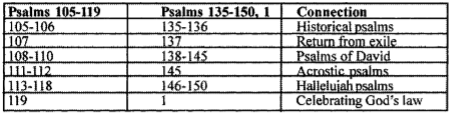
Identifying such parallels can help us to remember the content of whole sequences of psalms. At least it has been helpful to me.
The title of this series has been taken from Chapter 10.13 of Bible Studies: An Anthology by Bro. Harry Whittaker. Among other ideas, Bro. Whittaker observed, “Psalm 99 begins with ‘The Lord reigneth’ and ends with ‘The Lord our God is holy.’ Psalms 97 and 93 turn out to have just the same characteristics. So these three psalms would appear to be in the same family. Furthermore, they seem to have inter-married with another family, for Psalms 98, 96, and 95 all begin with ‘A new song’ and all end with judgment. Is there any significance here? And yet there are problems. If only Psalm 93 came in between Psalms 95 and 96, there would be a delightful ABABAB arrangement. Why doesn’t it? And what about Psalm 92? It appears to begin with a ‘new song’ (or is it an old song?), but the ‘judgment’ theme comes in the middle. Is there a reason for this? Can an answer to these problems be found? Are there more patterns of this sort in the Book of Psalms?” (Bible Studies: An Anthology, p. 217).
This is the sort of pattern we will explore in this series. Lord willing, we will present results on Book IV (Psalms 90-106) next month.
150 Psalms divided into five books
All of us know that there are 150 psalms divided into five books. Table 2 lists some facts about the five books.
Table 2. 150 Psalms Divided into Five Rooks
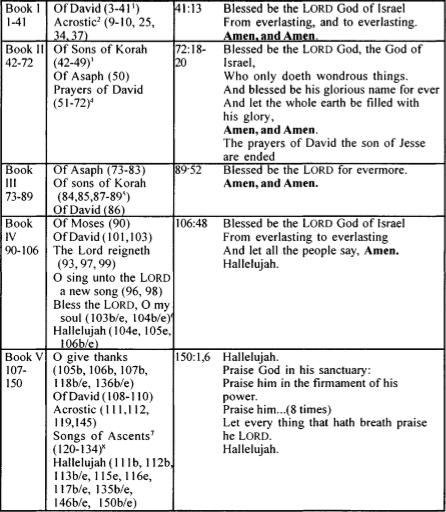
- Psalms 10 and 33 have no heading Each of them should be combined with the psalm preceding it That is, Psalms 9 and 10 form a single psalm and Psalms 32 and 33 form a single psalm.
- Acrostic psalms are aligned with the Hebrew alphabet In a complete acrostic psalm, each of the 22 Hebrew letters begins the lines in a “stanza ” A stanza may contain anywhere from half a verse (e g Psalms 111 and 112) lo eight verses (Psalm 119), each beginning with the appropriate Hebrew letter
- Psalm 43 has no heading It is combined with Psalm 42, with a common refrain in 42 5, 11, and 43 5
- Although Psalms 66 and 67 have no author in their heading and Psalm 72 is “Of Solomon,” these three psalms seem to be part of the Prayers of David
- Although Psalm 89 does not mention the Sons of Korah, its heading “Maschil of Ethan the Ezrahite” links it with the phrase “Maschil of Heman the Ezrahite” in the heading of Psalm 88 As we shall see in a future article, there are other connections between Psalm 89 and the Psalms of the Sons of Korah.
- Here “b” stands for “at the beginning of the psalm” and “e” for “at the end of the psalm.” ‘ “Ascents” comes from the RV. The KJV has “Degrees.”
- Psalms 122, 124, 131, and 133 are “Of David,” and Psalm 127 is “Of Solomon.”
Observations
Let’s make some quick observations based on this information.
First, each of the first four books ends with a doxology of praise to God and a concluding “Amen!”
Second, the last two books end with Hallelujah psalms. Psalms 146-150 provide a fitting conclusion to the whole Book of Psalms. These Hallelujah psalms are prefaced by David’s words in Psalm 145: “My mouth shall speak the praise of the Lord: And let all flesh bless his holy name for ever and ever” (145:21).
The psalms of David
Third, almost half (73) of the psalms are identified in the headings as being “of David.” And there’s more than that! Psalm 10 together with Psalm 9 form an acrostic (alphabetic) psalm, so Psalm 10 is a David psalm. Psalm 33 should be combined with Psalm 32, so Psalm 33 is a David psalm. And Psalm 2 is attributed to David in Acts 4, “Who by the mouth of thy servant David hast said, Why did the heathen rage…” (Acts 4:25-26, citing Psa. 2:1-2).
The New Testament also authenticates Davidic authorship for five of the psalms attributed to him in the headings. Psalm 16 is attributed to David by Peter (Acts 2:25-31) and by Paul (Acts 13:35-37). Psalm 32 is attributed to David by Paul (Rom. 4:6-8). Psalm 69 is attributed to David by Paul (Rom. 11:9-10). Psalms 69 and 109 are attributed to David by Peter (Acts 1:15-20). Psalm 110 is attributed to David by Jesus (Mt. 22:41-45, Mk. 12:35-37, Lk. 20:41-44) and by Peter (Acts 2:34-35).
David’s psalms are scattered throughout the Book of Psalms. All five Books have at least one psalm of David. David is such an influence on the Book of Psalms that Psalm 95 is said to be “in David” (Heb. 4:7) as if “David” were the title of the Book of Psalms. Even those psalms that are written by others use phrases and concepts from David’s psalms.
Differences between Books I-III and Books IV-V
Fourth, there are differences between Books I-Ill and Books IV-V. The psalms in the first three books almost all have headings and almost all identify their authors to some extent. On the other hand, very few of the psalms in Books IV and V have headings and most of them are anonymous.
The psalms in Books IV and V are identified in other ways. There are “The Lord reigneth” psalms; “0 sing unto the Lord a new song” psalms; “Bless the Lord, O my soul” psalms; “O give thanks unto the Lord” psalms; Psalms of Ascents and three sets of “Hallelujah” psalms each closing a group of psalms.
Collections in the Book of Psalms
Fifth, the Songs of Ascents (Psa. 120-134) divide Book V into three major sections: Psalms 107-119, Psalms 120-134, and Psalms 135-150.
Sixth, Psalms 105-106 not only conclude Book IV, they also preface the first section of Book V. Psalms 106 and 107 both begin, “O give thanks unto the Lord; for he is good: for his mercy endureth for ever,” and Psalm 105 begins, “O give thanks unto the Lord.” Furthermore, Psalm 107 continues the historical themes developed in Psalms 105-106: Psalm 105 celebrates God’s faithfulness from Abraham to the Exodus, Psalm 106 recalls Israel’s rebellions from Egypt to the Exile, and Psalm 107 continues by celebrating the redemption of Israel from the Exile.
Seventh, a number of collections of psalms can be easily identified: Book IV (Psa. 90-106), the Passover Hallel (Psa. 105-119), the Songs of Ascents (Psa. 120-134), the Finale (Psa. 135-150), the Prayers of David (Psa. 51-72), the Psalms of the Sons of Korah (Psa. 42-49; 84-85; 87-89), the Psalms of Asaph (Psa. 50; 73-83), and Book I: Psalms of David (Psa. 3-41). These will be the topics of our studies, together with a discussion of the final shape of the whole book.
Eighth, the number of psalms in some of these collections is significant. Books III and IV have 17 psalms each, the Songs of Ascents has 15 psalms (17 if Psalms 135-136 are added as in the Great Hallel), and the Finale has 16 psalms. These numbers suggest a connection to the Jewish feasts. Future articles will provide details. For now, note that there are 17 evenings and mornings for an eight-day feast from sundown to sundown, and 15 for a seven-day feast.
 The Origin of the Organic World – Part One