
Doctrine to Be Rejected # 7: “That man has an immortal soul” Introduction
This doctrine to be rejected is closely associated with two others: 8. That man consciously exists in death.
- That the righteous will ascend to the kingdoms beyond the skies when they die.
It can be restated in a positive way: The soul of man defines his being, his life, his existence; and is related to his attitude and emotions. As such, it ceases to exist when the breath of life departs.
This particular doctrine is interesting, because it is almost always phrased as a negative when we describe our beliefs, as in: “we do not believe in an immortal soul”. In addition, we rarely focus on this aspect of our faith: a quick glance at a sample of accounts of “what Christadelphians believe” from the Internet finds no explicit mention of this doctrine. This is despite the fact that it is one of the aspects of the beliefs, in which we differ sharply from most other Christian denominations.
The immortal soul and the early church
The concept of the soul’s supposed immortality was first taught in ancient Egypt and Babylon. “The belief that the soul continues in existence after the dissolution of the body is . . . speculation . . . nowhere expressly taught in Holy Scripture . . . The belief in the immortality of the soul came to the Jews from contact with Greek thought and chiefly through the philosophy of Plato, its principal exponent, who was led to it through Orphic and Eleusinian mysteries in which Babylonian and Egyptian views were strangely blended”.1
Plato, the Greek philosopher who lived 428-348 B.C., as a student of Socrates taught that the body and an “immortal soul” separate at death. One major source comments on ancient Israel’s view of the soul: “… We are influenced always more or less by the Greek, Platonic idea, that the body dies, yet the soul is immortal. Such an idea is utterly contrary to the Israelite consciousness, and it is nowhere found in the [Old Testament]”.2
Similarly early Christianity, after the age of the apostles, was influenced by Greek philosophies even as the gospel of Christ was being preached to the Greek and Roman world. By A.D. 200 the doctrine of the immortality of the soul became a staple of the beliefs of the established church. It is often argued by Christadelphians that these beliefs came in much later, but much of this is based upon ambiguities of language. What is certain is that such beliefs are not to be found in the Bible, neither the Old Testament nor the New Testament.3
Since the Reformation
Although scattered groups held the truth about the immortal soul, it was only with the reformation in the 16th Century that many came to the correct understanding. Of the well-known names, perhaps Isaac Newton and the Anabaptists are the most worthy of mention. By the 19th Century, belief in “soul sleep” or “Conditional Immortality”, two terms for this doctrine, became widespread, and to this day such groups as the Jehovah’s Witnesses and the Seventh Day Adventists are strong believers in “sleeping in the dust”.
In addition, many mainstream theologians have come to deny the traditional view on Hell, so the old “hell fire and damnation” form of preaching has almost disappeared. The denial of the immortality of the soul has gone from being a minority view in the 19th century to part of main stream Christianity, at least among the theologians and thinkers of the churches.
John Thomas
John Thomas started off his new-found Christian faith in the USA as a Campbellite, being baptized as such in 1832. His stay in that denomination was not long, for one of the causes of division between himself and the Campbellites was over the doctrine of the immortal soul. He gives in several places the account of the origin of his beliefs, perhaps the most interesting being in The Herald for 1859. It is as follows:
We proceed then to remark, that in 1834, while residing in Richmond, VA., we started two questions in this country, which may be presented in the form of the following propositions, namely, that
- No person destitute of the “One Faith” previous to his immersion is the subject of the “One Baptism.”
- The animal man is in no sense immortal.
When we started the questions, it was more in the spirit of inquiry than of perfect conviction; and it is also probable that, if we had not been violently opposed, and bitterly persecuted, the matter would have dropped…
The second proposition is self-evident to those who know the truth, and it was not long before we came to be certain of its verity. From 1835 to the present time we have never wavered in our conviction;4
So, apart from a prior dispute over exactly who needed to be baptized, the recognition of the falsehood of the doctrine of the immortal soul has been one of the distinguishing hallmarks of the Christadelphian faith, as it was so called in 1864, thirty years later. This statement, or one like it has been consistent, for example:
Man, an immortal ghost, tabernacling in an animal body. (John Thomas, as perverted by the apostasy, synopsis of the one faith, 1867).
That the immortality of the soul is a pagan fiction, subversive of the first law of the Deity’s moral government, viz. that the wages of sin is death. (Robert Roberts’ Statement of 1871).
“Soul” in the Bible means, primarily, creature; but it is also used of the various aspects in which a living creature – man or beast – can be contemplated, such as person, body, life, breath, mind. It never expresses the idea of immortality. (Christadelphian Declaration — recent)
In our preaching
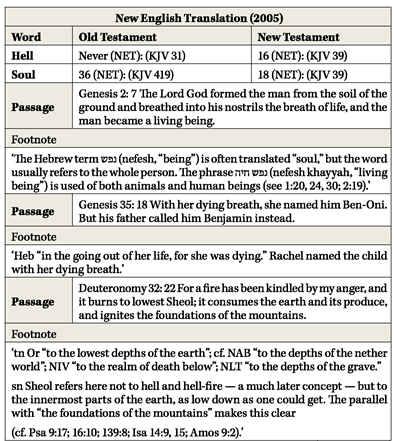
There are a few pamphlets available that offer guidance5, and the section in Wrested Scriptures6is useful. In addition, the New English Translation (the NET) Bible with its notes is most helpful. For example7:
- Jewish Encyclopedia, 1941, Vol. VI, “Immortality of the Soul,” pp. 564, 566.
- International Standard Bible Encyclopedia, 1956, Vol. II, “Death,” p. 812.
- See “Sleeping in the Dust” by Jonathan Burke (A Christadelphian). An older work from the 1950’s, “The Conditionalist Faith of our Fathers”, By Leroy Froom, an Adventist, has much information, but some seems to be a little overstated.
- Herald of the Kingdom and Age to Come, 1859, p. 66.
- “After Death What.” (Fred Pearce.) CMPA Publication
- Wrested Scriptures (Ron Abel) July 2011, edited by John Allfree.
- Derived from “Sleeping in the dust”, Op Cit.
 The Origin of the Organic World – Part One