
Doctrine to Be Rejected # 8: “That man consciously exists in death.”
This can be positively stated as: At death, man ceases to exist in every respect. He has no consciousness in death.
Traditional statements and Biblical proofs
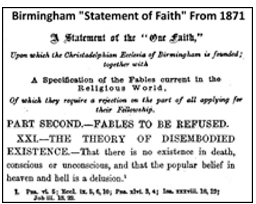
The early statement of faith by bro. Roberts, in 1871, has a similar thought:
- The Theory Of Disembodied Existence. — That there is no existence in death, conscious or unconscious, and that the popular belief in heaven and hell is a delusion.
The following Biblical references are cited:
“For in death there is no remembrance of you; in Sheol who will give you praise?” (Psa 6:5).
“For the living know that they shall die: but the dead know not any thing, neither have they any more a reward; for the memory of them is forgotten. Also their love, and their hatred, and their envy, is now perished; neither have they any more a portion for ever in any thing that is done under the sun… Whatsoever thy hand findeth to do, do it with thy might; for there is no work, nor device, nor knowledge, nor wisdom, in the grave, whither thou goest” (Eccl 9:5,6,10).
“For the grave cannot praise thee, death can not celebrate thee: they that go down into the pit cannot hope for thy truth. The living, the living, he shall praise thee, as I do this day: the father to the children shall make known thy truth” (Isa 38:18-19).
“For now should I have lain still and been quiet, I should have slept: then had I been at rest… Which rejoice exceedingly, and are glad, when they can find the grave?” (Job 3:13,22).
“Put not your trust in princes, nor in the son of man, in whom there is no help. His breath goeth forth, he returneth to his earth; in that very day his thoughts perish.” (Psa 146:3,4).
Note: the last reference was given in 1871 as Psa 46:3-4, and this was repeated in at least the 1868 through 1877 versions, but The Declaration has the (presumably) correct version.
Other references often cited are:
“For that which befalleth the sons of men befalleth beasts; even one thing befalleth them: as the one dieth, so dieth the other; yea, they have all one breath; so that a man hath no preeminence above a beast: for all is vanity” (Eccl 3:19).
“For when he dieth he shall carry nothing away: his glory shall not descend after him. Though while he lived he blessed his soul: and men will praise thee, when thou doest well to thyself. He shall go to the generation of his fathers; they shall never see light. Man that is in honour, and understandeth not, is like the beasts that perish” (Psa 49:17-20).
Daniel has a remarkable statement on this subject. It is especially significant because of the use made of the same idea in the New Testament. His prophecy contains this reference to events in “the last days”, when God will show His power once more in the earth, at “a time of trouble such as never was
“Many of them that sleep in the dust of the earth shall awake, some to everlasting life, and some to shame and everlasting contempt” (Dan 12:1-2).
It is noticeable that all these references are from the Old Testament, and as we showed in the last article, (#11, The Tidings, May 2016), in fact a belief in the immortal soul is absent from the Old Testament.
New Testament
The situation is different when we look at what the Jews of Jesus’ time believed, particularly the Pharisees and Essenes1. It is clear that there was much effect of the Greek or Hellenistic views on the Immortality of the Soul, and such beliefs appear to have become part of the beliefs of many Jews by the time of Christ. So to be realistic, we need to turn to what Jesus and the apostles taught about the afterlife. The teachings about resurrection at the return of Jesus is clear, but as we know from many of those around us, this does not preclude the idea of some sort of afterlife.
To answer this question it is essential to understand what the attitude of Jesus, and the Apostles after him, to the writings now known as the Old Testament. The facts are clear and beyond question: they all accepted “the law, the psalms and the prophets”, as the inspired Word of God. They quote from them constantly in support of their preaching; they never contradict or cast doubt upon any Old Testament passage, but rather seek to draw out the true significance of what was written. You would thus expect the New Testament writings to agree in their teaching with the Old, and so it proves. Here are a few examples.
There had been a tragedy in Galilee. Roman soldiers had killed a number of Jews in a religious riot. Some Jews came to Jesus to tell him of it. His response is very significant. Do you think, he asked, that those Galileans who died were greater sinners than all the other inhabitants of Galilee, because they suffered such a fate? Not at all, he said, but I tell you this:
“except ye repent ye shall all likewise perish” (Luke 13:1-31)
Now “to perish” in the Bible means just what it means to us: to cease to exist with no suggestion of survival. There is no escaping the teaching of Jesus here: all mankind will perish, unless they repent. This is just like Psalm 49: man is like the beasts that perish, unless he understands. Here we have the first hint of the answer to our question, “Understand what?” It has evidently something to do with repentance.
Jesus also agreed with Daniel, who had declared that “many of them that sleep in the dust of the earth shall awake” (12:21). This is how John’s Gospel records his saying:
“. . . The hour is coming, in which all that are in the tombs shall hear his (Jesus’) voice, and shall come forth; they that have done good unto the resurrection of life; and they that have done evil unto the resurrection of condemnation” (John 5:28-29).
Look where the dead are: “in the tombs” (“sleep in the dust of the earth”, Daniel); they “come forth” by resurrection (“they awake”, Daniel); they come forth either to life or to judgement. The harmony between Jesus and Daniel is complete; the Lord is endorsing the teaching of the Old Testament on this important matter of the place, the state, and the fate of the dead.
The Apostles uphold the same teaching. John, in the best-known verse of the New Testament, declares:
“God so loved the world, that he gave his only begotten Son, that whosoever believeth on him, should not perish, but have everlasting life” (3:16).
The words we have emphasized are frequently ignored, but there is no escaping the verdict that those who do not “believe on” Jesus (in the way the Scriptures explain) will perish, that is cease to exist.
The Apostle Paul has the same message. Writing to the believers in Ephesus, he tells them that before they came to know and believe in Christ, they were “without Christ having no hope, and without God in the world” (Eph.2:1,2). This is a shattering saying. It tells us plainly that if we are not related to God through Christ, in the way He requires, we are “without hope”. How precious must be that “understanding” that can save us from such a fate!
The Apostle James tells his readers not to make too confident assertions of what they will do at some future time. You never know what will happen tomorrow, he says; and then adds:
“What is your life? For ye are a vapour that appeareth for a little time, and then vanisheth away” (James 4:14, RV).
Daniel’s description of the dead as “sleeping” in the grave is reproduced by the Apostle Paul. The believers at Thessalonica were mourning the death of some who had believed in Christ:
“I would not have you ignorant, brethren, concerning them which are asleep (he means in death), that ye sorrow not, even as the rest who have no hope …. For the Lord himself shall descend from heaven … with the voice of the archangel and the trump of God, and the dead in Christ shall rise . . .” (1 Thess 4:13,16)
Notice what this passage is saying: the faithful believers who have died are “asleep”; those who do not believe have “no hope”; Christ personally (note “himself”) will descend from heaven; and the faithful dead will rise-from the grave of course. Paul uses the same idiom elsewhere: “After that, he was seen of above five hundred brethren at once; of whom the greater part remain unto this present, but some are fallen asleep” (1 Cor 15:6). Here are basic teachings which are found throughout the New Testament. They are foundation truths of the Gospel.2
Conclusion
The “proof texts” used by many are ably dealt with in the book Wrested Scriptures.3However, I belief we need to be careful about relying solely or too heavily on the Old Testament references when we consider this topic. The certainty of the doctrine is not in dispute: but to rely on specific passages from Ecclesiastes is somewhat dubious. For example, we cited Eccl 3:19: but you can glance down and see “Who knoweth the spirit of man that goeth upward, and the spirit of the beast that goeth downward to the earth?” (Eccl 3:21). In the context of the book, what is this whole passage teaching? Only that Solomon was searching for the meaning of life, and having difficulties in coming up with a satisfying answer.
So as we work our way through these “doctrines to be rejected”, we need to be careful to avoid merely repeating the standard Christadelphian “proof texts”, without considering the background to the New Testament. There was a long time, 400 years, between the close of the Old Testament and the time of Jesus.
- “Two independent doctrines of the afterlife for the individual emerged in Judaism, probably during the last two centuries BC: the doctrine of the resurrection of bodies and that of the immortality of souls. In time (probably the first century AD), these two doctrines became conflated so as to yield the theory that, at the end of days, God will resurrect dead bodies, rejoin them with their souls, which never died, and the individual human being, reconstituted as he or she existed on earth, will come before God in judgment.” Cited from the Wikipedia article on Christian Mortalism, May 2016.
- Cited from “After Death, what?” By Fred Pearce (Pamphlet available from the Christadelphian office and on-line.)
- Wrested Scriptures (Ron Abel) July 2011, edited by John All free.
 The Origin of the Organic World – Part One