
Introduction
In the first of this series (The Tidings, June 2015, p 223), we considered some of the objections to the inclusion of the “Doctrines to be Rejected”, and the reasons for their continuing inclusion. It must be emphasized that, indeed, these are a vital part of the glue that binds are community together by defining, in many areas, doctrines and teachings that are not part of our beliefs, and must specifically be excluded. They also include several commandments that echo some of the Ten Commandments of the Old Testament: Thou Shalt Not: (For example, join the armed forces).
It must also be stressed that there are three sections of our Statement of Faith: (1) The Truth to be received, (2) the doctrines to be rejected, and (3) the Commandments of Christ. Together, these three parts form “A Statement of Faith Forming the basis of Our Fellowship.” As it is this Statement that holds the Christadelphian Community together, the three parts are inseparable. There are reasons as well as Scriptural Precedents for a set of negative as well as positive statements:1
- The Ten Commandments summarizing the Law God gave to His people Israel is possibly the best illustration to be found anywhere in Scripture. The last five commandments are all straight negatives, introduced by the chilling phrase, “Thou shalt not…” But the other five are by no means wholly positive, even though the effect of all ten should have been both positive and beneficial to the believing Jew. He was told, for example, to “Remember the sabbath day, to keep it holy”, and that this could only be achieved if “in it thou shalt not do any work”. God also declared that He is“the LORD thy God who brought thee out of Egypt”, therefore “thou shalt have no other gods”.
- After the Law had been given through Moses to the infant nation, the implications of obedience were also emphasized. If God’s people obeyed His commands, they would receive abundant blessings, “in the city … in the field … when thou comest in … when thou goest out”. However, if they disobeyed, not only would the blessings be withheld, but “cursed shalt thou be in the city … in the field … when thou comest in … when thou goest out” (Deuteronomy 28).
- The examples are not limited either to the Law of Moses or to the Old Testament. When the Apostle Paul listed the attributes that should flow from a believer’s association with the Lord Jesus Christ, calling them “the fruit of the spirit”, he set forth the positive outworking of the gospel, saying that “against such is no law”. But this list is immediately preceded by another containing activities wholly incompatible with the new life in Christ. These, by contrast, are “the works of the flesh”. Only by placing side by side these contrasting ways of life could the Apostle declare so forthrightly the positive and constructive conclusion that must be drawn: “They that be Christ’s have crucified the flesh with the affections and lusts. If we live in the Spirit, let us also walk in the Spirit” (Gal 5:19–25).
- One final example, taken from the Lord’s own final message, must suffice in making the point that the Scriptures abound in negative definitions to strengthen and define positive truths. In summarizing the message of the Apocalypse, the voice from heaven revealed to John that, “he that overcometh shall inherit all things”. The measure of those who are the heirs of God’s eternal promises is shown by describing who will not inherit: “the fearful, and unbelieving, and the abominable, and murderers, and idolators, and all liars, shall have their part in the lake which burneth with fire and brimstone” (Rev 21:7, 8).
Relationship to “Truth to be Received”
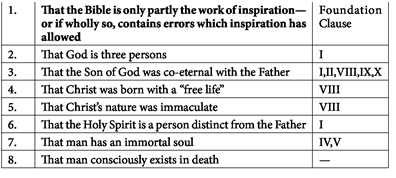
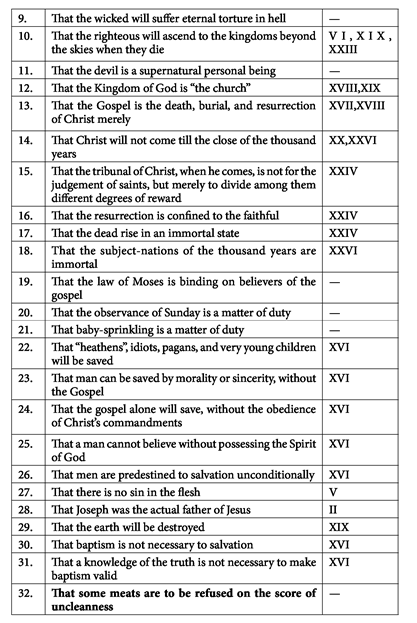
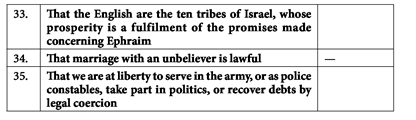
The ones in bold were added after 1883: one was dropped, which read “That Christ was of a different nature from other men”. It will be discussed later along with the previous one, #4, “That Christ’s nature was immaculate”.
This list shows that some crucial teachings, necessary for belief and fellowship, only occur explicitly in the list of Doctrines to be Rejected. And just because the doctrine refers to a clause in the “Truth to be Received”, does not mean it merely repeats it. For example, we reject in #17 that “That the dead rise in an immortal state”, but the clause 24, the “amended” clause says “That at the appearing of Christ prior to the establishment of the Kingdom, the responsible (namely, those who know the revealed will of God, and have been called upon to submit to it), dead and living—obedient and disobedient — will be summoned before his judgement seat ‘to be judged according to their works’ ”. It does not explicitly cover the state of the resurrected, and this was a subject of controversy and division in the 19th century, and still has echoes today as will be covered when we discuss it in due course.
Strong objections have also been made to the somewhat archaic language, particularly to clause #22, “That ‘heathens’, idiots, pagans, and very young children will be saved”. We will cover this topic in its turn, but we must realize that this simply reflects the belief we have, that understanding of the Gospel message is essential to salvation. Those totally incapable of rational thought (“idiots” in the language of #22) are, of course, incapable of understanding: it should be noted that this wording does not restrict the Father’s power to save whomsoever He chooses.2
 The Origin of the Organic World – Part One