
That God is three persons
This is an example of a doctrine not really dealt with in the “Truth to be received”, but which is a doctrine that fundamentally separates us most of the Christian Churches around us. John Thomas appears to have discarded the orthodox doctrine of The Trinity early in his studies of the Truth, perhaps influenced by Elias Smith, who preceded him in the Disciples Church in Philadelphia. However, his full mature view of God was not developed until around 1847, when, as a result the views of Dr. Lara, a Jew, John Thomas wrote a series of articles later reprinted as Phanerosis. Some of this is represented in the first section of the “Truth to be received”. However, the doctrine of the Trinity is not specifically rejected in it, but that erroneous belief is, and always has been, specifically rejected by all Christadelphians. The form of words has changed, as below, but the idea has remained.
- Current Doctrine to be Rejected # 1: “That God is three persons”
- Synopsis of the One Faith by John Thomas 1867: (As Perverted By The Apostacy): “A triply-compounded God, without body and parts, defined as “Father Son and Holy Ghost.”
- Fables to be Refused (Robert Roberts), 1870 till 1883: “The Trinity.—That God is not three, but One, out of whom are all things—even the Spirit and the Son”. This has the following references:
a. “But to us there is but one God, the Father, of whom are all things, and we in him; and one Lord Jesus Christ, by whom are all things, and we by him” (1 Cor 8: 6).
b. “One God and Father of all, who is above all, and through all, and in you all” (Eph 4:6).
It can be restated, perhaps, in a positive way: “The doctrine of the Trinity being false, it remains that God is a Being of Spirit; the Lord Jesus Christ is His Son, born of the Virgin Mary; the Holy Spirit is His power.”
“For there is one God, and one mediator between God and men, the man Christ Jesus” (1 Tim 2:5).
“And the Word was made flesh, and dwelt among us, (and we beheld his glory, the glory as of the only begotten of the Father,) full of grace and truth” (John 1:14).
And, behold, I send the promise of my Father upon you: but tarry ye in the city of Jerusalem, until ye be endued with power from on high” (Luke 24:49).
The Trinity
We need to be careful in discussing the Trinity, because we often attack the Trinity on the basis of the Nicene Creed, which says Christ is “God of God, Light of Light, very God of very God, begotten, not made, being of one substance with the Father”.
Rather, we ought to discuss it in terms of modern day beliefs, which say:
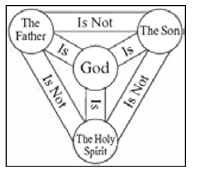
- The Trinity is One. We do not speak of three Gods but of one God. Each of the Persons is fully God. They are a Unity of Persons in one divine nature.
- The divine Persons are distinct from each other. Father, Son, and Holy Spirit are not three appearances or modes of God, but three identifiable persons, each fully God in a way distinct from the others.
- The divine Persons are in relation to each other. The distinction of each is understood only in reference to the others1.
Brief history of the doctrine of the Trinity
According to almost all Biblical scholars, Scripture does not contain a formulated doctrine of the Trinity. Although there is much debate as to whether the beliefs of the Apostles were merely articulated and explained in the Trinitarian Creeds, or were corrupted and replaced with new beliefs, all scholars recognize that the Creeds themselves were created in reaction to disagreements over the nature of the Father, Son, and Holy Spirit. These controversies, however, were great and many, and took some centuries to be resolved. Of these controversies, the most significant developments were articulated in the first four centuries by the Church Fathers in reaction to Adoptionism, Sabellianism, and Arianism.
Adoptionism was the belief that Jesus was an ordinary man, born of Joseph and Mary, who became the Christ and Son of God at his baptism (c. AD 269).
Sabellianism taught that the Father, the Son, and the Holy Spirit are essentially one and the same, the difference being simply verbal, describing different aspects or roles of a single being (c. AD 220).
In the fourth century, Arianism, as traditionally understood, taught that the Father existed prior to the Son who was not, by nature, God, but rather a changeable creature who was granted the dignity of becoming “Son of God”.
In AD 325, the Council of Nicaea adopted the Nicene Creed that described Christ as “God of God, Light of Light, very God of very God, begotten, not made, being of one substance with the Father”, as mentioned above.
Discussing the Trinity2
What do theologians mean when they affirm that the one who so lived and so died was “very God,” co-equal with the Father from all eternity? To one who has not been cradled in Trinitarian belief such propositions seem self-destructive. Surely, if God required us to believe in the Trinity, He would teach the doctrine in plain language.
Even the fact of the Creator’s existence is taught plainly and reiterated in the Bible. “I am the Lord.” “I am God and there is none beside me” (Isa 44:21). Such expressions are frequent in Scripture. The greatness, power, and knowledge of God are all emphasized in language that cannot be mistaken. If we are to believe that God, supremely great, wise and powerful, in some way became a human baby and was born of a woman, we may surely expect that the doctrine be taught in plain language. We may not reasonably expect to understand the details, but where is a plain affirmation of the fact?
All Bible students are aware that the Bible does not contain any such affirmation of the doctrine of the Trinity. There is no language used in any way comparable to that of the Athanasian Creed, or the creeds of modern Catholicism. When a supporter of the Trinity is challenged to defend his belief from Scripture, he quotes passages from which inferences may be drawn in harmony with his creed, but which, certainly, played no part in forming it. The favorite passages for such a purpose are those in which a form of language is used agreeable with the idea that Christ existed as a person, previous to his birth. The same form of language is often employed, however, where no such doctrine is involved. When we read in the book of Genesis: “Kings shall come out of thy loins,” everyone understands the sense in which the words are used. When, however, the Lord Jesus expresses the truth of his divine origin in similar language, “I came forth from God,” it is regarded as proof that he came as a personality before being born as a baby. There is nothing to favor such a construction except the natural prejudice of opinions in which people have been nurtured.
Most of the passages quoted by Trinitarians are of this character. Often there is a companion passage that might have been designed to correct misconceptions and show the true meaning.
Thus, the Lord Jesus said: “I and my Father are one,” (John 17:11), but he also prayed that the disciples might be one, even as he was one with the Father. He spoke of “Glory I had with thee before the world was,” (John 17:5), but the Apostle Paul also used the same language regarding the brethren, (Rom 8:30) showing that it was in the foreknowledge of God that Christ and all his disciples lived before the foundation of the world. The Apostle Peter so speaks regarding Christ: “Who, verily, was fore-ordained before the foundation of the world but was manifest in these last times” (1 Pet 1:20).
Jesus said: “I have power to lay down my life and I have power to take it again,” (John 10:18) but he also added, “This commandment have I received of my Father” (also John 10:18). He said: “I am from above,” but he immediately added, “ye are from beneath.” Their life and character was from beneath, so that they were entirely earthly; his life and character were direct from God, so that he was the Lord from Heaven. Jesus said that the Father had sent him into the world, but he added “even so, have I sent you into the world.” In neither case are we to suppose the existence of the personality previous to birth.
Reading the Bible
Try, for a little while, to imagine the case of a man who has no prejudices studying the Bible to find the truth revealed regarding God and Jesus Christ. Surely he would study the law given to Israel as the first step towards finding the true God. He would read the records of the birth of Christ to find exactly who Christ was.
This is only common sense. If we have a reliable biography of a man, we can soon ascertain who his parents were if we will consult the chapter dealing with his birth. We must not bring a theory from outside and then try to find odd passages in the book that can be made to harmonize. Consult the first proclamation of a law to find the authority of the law-giver. Go to the account of a man’s birth to find a plain statement of his ancestry.
If we adopt such a method with the Bible we are left in no doubt as to the only true God, and Jesus Christ whom He has sent. God made proclamation to Israel: “Hear, O Israel, the LORD your God is one LORD” (Deut 6:4). This doctrine was supported by all the prophets. There were many angels, who, being sent by God, could speak the words of God, but it is always made clear, that, above them all, was one supreme God and Creator. The Jews recognized no Trinity.
If we turn to the record of Christ’s birth, the account of his ancestry is as explicit as anything that has ever been written. “The Holy Spirit shall come upon thee,” said the angel to Mary. “The Power of the Highest shall overshadow thee, therefore that holy thing that shall be born of thee shall be called the Son of God” (Luke 1:35).Even a man who holds the doctrine of the Trinity may well pause at these words. Why should the third person of the Trinity come upon Mary so that the second person of the Trinity should be born of her? And why is that word “therefore” there? Try, however, to put yourself in the place of a man with no pre-conceived opinions to defend, searching the Scriptures in the pursuit of truth. In the Old Testament it is made clear that God is One. By the power of His Spirit He knows all and can perform all according to His will. In Psalm 139 there is a wonderful description of the Spirit filling the universe, and in its penetrating powers being equal to the actual presence of God. This Spirit came upon prophets to make them speak divine truth. It is constantly referred to as the “Word of the LORD.” But, although God’s word was spoken, men all sinned, and no one was found to carry out God’s will perfectly. The word became articulate, the word became writing, but in Old Testament times it was never made flesh.
The student passes on to the New Testament Scriptures to read of the Savior provided by God. He learns there, that the Holy Spirit came upon a chosen virgin of the house of Israel, not merely to make her speak the words of God, but to make her conceive a son without ever having known man. The child born was, therefore, to be called the Son of God. He was born as a babe, nourished according to nature, and as he grew he increased in wisdom and in favor. Early he showed his superiority to other children. He grew to manhood and constantly proclaimed his dependence on the Father who had sent him.
“The words that I speak. I speak not of myself. The Father that dwelleth in me, He doeth the works” (John 14:10).
“My Father is greater than I” (John 14:28).
“Of that day and hour knoweth no man, no not the angels which are in Heaven, neither the Son, but the Father” (Mark 13:32).
Even after his resurrection from the dead, when the days of fleshly weakness were over, he speaks of ascending “to my Father and your Father, to my God and your God.” Even after the ascension, the book of Revelation is described as “the revelation of Jesus Christ which God gave to him.” In that book we still have the expression, “My God.” (Rev 4:12)
If the student pursues the matter further, studying the writings of the apostles, he will find the plainest of re-affirmations of the truth. “There is one God and one mediator between God and man, the man Christ Jesus.” (1Cor 11:6).
These statements are in harmony with Christ’s own presentation of the matter. He addressed the Father as “the only true God.” In claiming power over all flesh, he made it clear that this authority was given him by the Father. In harmony with this, the Apostle Paul, in writing of the time of the end when death shall be finally vanquished, states that God will put all things under Christ. He points out a truth that should be manifest, that God, being the giver of this subjecting power, is obviously excepted from the “all things” that are to be subjected. When all the works of creation are finally subdued by Christ, then, the Son shall be subject to the one who put all things under him, that “God may be all in all. (1 Cor 15:28). Study these words of the Apostle. They cannot be harmonized with the Trinitarian view, but they blend perfectly with the true doctrine of the Bible.
Summary
A man who could study the Word of God entirely without prejudice would assuredly find no difficulty in grasping its teaching. One God with supreme power and understanding. One spirit or emanating power of God, carrying the searching knowledge of the Eternal to the desert, to the grave, or to the uttermost part of the sea, filling even the darkness with a divine light of knowledge and power as if the very presence of the Creator were there (Psa 139).
By His Holy Spirit, God made chosen servants speak His Word. By the same Holy Spirit He made a chosen virgin give birth to a Son who was, therefore, called the Son of God. By the in-dwelling power of His Spirit, He gave the Son wisdom and strength, so that he became a perfect manifestation of the divine character, the Word of God in the form of a man. By the same power He will put all things under the feet of this perfect mediator until the time when the last enemy shall be destroyed.
When we recognize the truth that Christ was begotten by the Holy Spirit of God as taught in the Gospel narrative of his birth, all that is written regarding him becomes intelligible. He was the living Word, as the Bible is the written Word. He was the perfect expression of the will of God in the form of a man. He was “God with us,” — a manifestation of the character (Luke 1:80), of the Father in a living conscious being, who really grew in knowledge and increased in wisdom, (Luke 2:52), who really suffered and overcame, really died and was raised to life again.
Beware of any doctrine that shall, in effect, deny that the Father is the only true God, and that Jesus is the Son who can reveal the Creator to us. Remember that the Lord Jesus, in praying to the Father, said, “This is life eternal, that they might know Thee, the only true God, and Jesus Christ, whom Thou hast sent”.
Conclusion
The Lord God of heaven and earth stands behind all the teaching that has been revealed to us, from the creation of the world and of mankind, to the final phase of the Kingdom of God. For the faithful He has been the source of all light in their native darkness. The thought of Him has been their consolation and faith in Him has been their strength in times of trial. The knowledge of Him, made clearer to them in the Person of His Beloved Son, has been a guide and an inspiration in their life of service.
Sources
Pamphlets (Some available on the Internet)
- Jesus, son of God or God the son (Fred Pearce) (Christadelphian Office)
- Doctrine of the Trinity (EJ Newman) (Old Pamphlet series)
- One God or a Trinity? (James and Deb Flint) (Printland Publishers) Books (available from most Christadelphian book Suppliers)
- Trinity, The Doctrine Of (P E White) 226 pgs.
- Trinity, True or False? (Broughton/Southgate) 407 pgs.
 The Origin of the Organic World – Part One