
Development by Robert Roberts
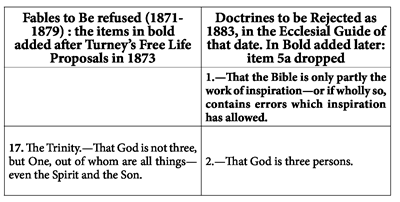
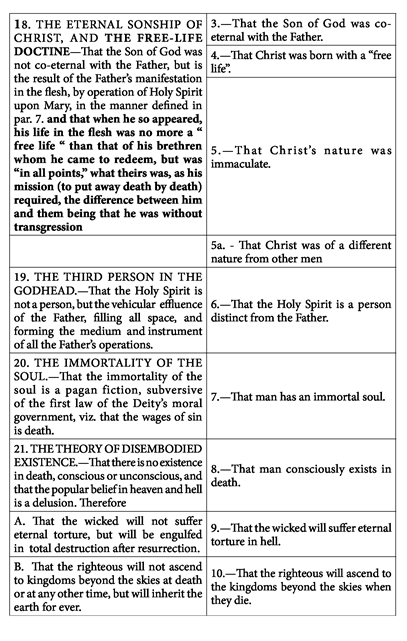
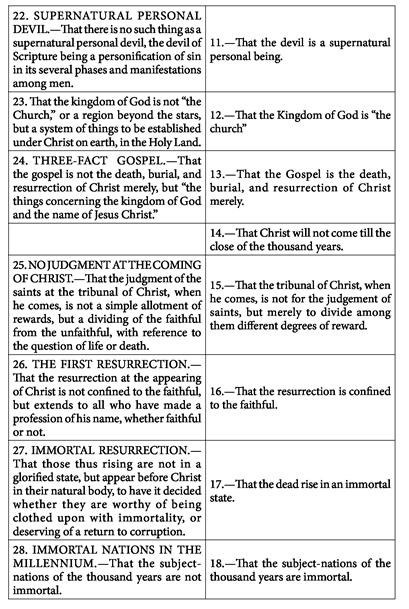
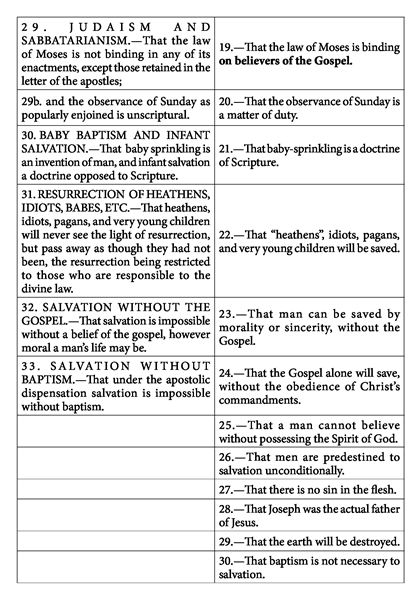
It is to Robert Roberts we owe the development of our Statement of Faith, with its associated Doctrines to be Rejected and Commandments of Christ. In this, he largely followed the efforts of his mentor John Thomas, and as we saw in the first installment, Thomas had published a “synopsis” in 1867 divided into two parts, “truth to be believed” and “fables to be refused”. The first recorded “Statement of Faith”, which, of course, was written in the first instance for the Birmingham Ecclesia, appears to have been published in 1868, as shown in notes in The Christadelphian. Whether this differs from the earliest one we know of from 1871 is not clear, but what is clear is that the statement was changed quite frequently in ways both minor and major over the next almost 50 years, but after 1919 not at all. Many of the changes were due to the various controversies that troubled the community over this time, although the major structural change in 1883 appears with the issuance of the ecclesial guide, again by Robert Roberts.
We will deal with some of the modifications, the reasons behind them, and their implications for today, as we deal with the individual statements in their turn. But the changes can be considered in broad-brush terms. Specifically
- The arguments over the nature of Christ presented by Edward Turney in 1873 caused a controversy that has had ripples down to this day, and caused several changes
- The “partial inspiration” dispute that was initiated by Robert Ashcroft in 1885 also caused the introduction of the “foundation” clause to the statement of faith, and a corresponding clause added in the doctrines to be rejected.
- Of course, another discussion related to the atonement, but customarily related to the question of judgment responsibility, was initiated by John James Andrew in 1894. However, this only caused a modification to the statement of faith in 1898, after the death of Robert Roberts, but there was no resultant change to the “doctrines to be rejected”.
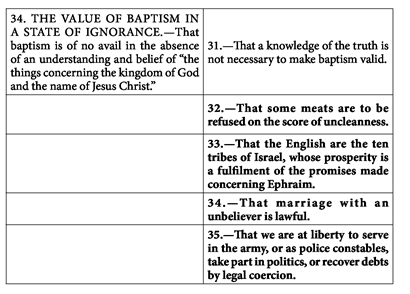
- There were also several other changes generated by basically life issues: jury service, military service etc. which were added at various times from 1883 on, as the number of doctrines to be rejected grew from the 31 in the 1883 version, to 32 by 1891, and the current number of 35 by 1911. The last change in 1919 was a modification of # 35, when phrase “or as police constables” was passed in a failed attempt to head off what became the “Berean” division. Note that one of the clauses “5a. – That Christ was of a different nature from other men” was dropped.
Before and after 1883
One major change after 1883 was that no Scriptural references were ever added to the “Doctrines to be Rejected”. The reason for this is unclear, although it must be pointed out that John Thomas’ “synopsis” of 1867 included no Scriptural references at all, although perhaps this was because he wanted to produce a one page “Statement of Faith”. Quite why references were added after 1883 to the “Truth to be Received” but not for “Doctrines to be rejected, formerly “Fables to Be Refused” we will have to ask Robert Roberts in the Kingdom.
I do not know quite when the Scriptural references were added: certainly they were present by 1898, when the amendment concerning who was responsible to resurrection was added.
Note the current BUSF (Birmingham Unamended Statement of faith) is slightly different from the one listed, but the differences will not be covered in this series.
 The Origin of the Organic World – Part One