
Introduction
This is the first of what is intended to be a systematic study of that section of our communities’ Statement of Faith known as “Doctrines to be Rejected”. There are, of course, three sections: “Truth to be Received”, “Doctrines to be Rejected”, and “Commandments of Christ”. Most of the focus of the discussions and writings concerning this Statement of Faith, or BASF as it is normally referred to, concerns the first of these areas. There are quite a few books on the topic, and even the major one that is entitled “Studies in the Statement Faith”1only devotes one chapter out of 12 to doctrines to be rejected, and it is really only a summary. In fact, there does not appear to be any systematic consideration in our literature of the individual doctrines, much less of their origin and development.
In this series, we hope to remedy this deficiency, and put this area of our statement of faith in its true context. We hope to emphasize the importance of the doctrines, especially as they relate to our present day situations. It must be admitted some of the topics covered have, perhaps, little direct relevance to our challenges in our days (who lately has been troubled by “British Israelitism”!), but the importance of this section and concerns and areas covered are still relevant.
Our approach will be
- Consider the history and development of the doctrines to be found in our current document.
- Present an overview of the main areas covered, and identify those areas that extend, amplify, or illustrate those doctrines covered in the area of “Truth to be Received”.
- Present the “Doctrines to be Rejected”, as grouped in common areas, not necessarily in their normal numerical sequence.
- Emphasize their relevance to our faith and our life as we search to discover the Truth as revealed in the Bible, both as relevant in our common walk and our struggle against the false doctrines common around us.
The origin of this series, as can be seen by the byline, is twofold:
- A long interest in the current and past statements of faith
- A study extending over many weeks, at the Adult Sunday School at the Ann Arbor Ecclesia, Michigan.
I leave it to our readers to discover which author was involved in which area! Why the study
The significance and importance of our Statement of Faith is undoubted. Our community is largely we are bound together by the Biblical Principles to be found in the Bible, of which the BASF is regarded as a true account. It is not necessarily the only true account: many ecclesias have adopted their own “Statement of Faith”, but all acknowledge the validity of the BASF. In areas of dispute we tend to strongly emphasize a few phrases or sections. Many of these phrases are to be found in these doctrines to be rejected, for example:
- That the dead rise in an immortal state
- That we are at liberty to serve in the army, or as police constables
- That marriage with an unbeliever is lawful
These and many more were added to clarify the position of the community in times of dispute. And if fact, many of these additional doctrines help clarify the doctrines held by our community in several areas that are still to this day the subject of internal controversy, although often overlooked, ignored, or explained away.
Objections to the studying doctrines to be rejected
There have been several objections raised against the current listing of “doctrines to be rejected” from inside our community, for example:
- It is suggested that the list grew up in an age when the community was growing and evolving significantly, so many of the doctrines to be rejected are not current today, or are worded in ways that are not understood or are offensive to the modern ear.
- Clauses utilizing language whose meaning has not changed, but that would not be used today because of certain sensibilities or associations: however these should also not be discarded if they relate to important truths.
- In the early days of our community there was a greater awareness of the need to define the differences between our beliefs and those of others who also claimed to rest their faith on Bible teachings, so why still use them?
There are two reasons why the situation is somewhat different today.
- It the days the BASF was being developed, during the late nineteenth century in England, many newly baptized members were converts from one of the sects of ‘Christendom’ and it was necessary to highlight the errors of any former denomination they might have belonged to.
- Also, there was at that time much greater knowledge of the Scriptures and a wider acceptance that they should form the basis for belief.
However, we believe their inclusion helps clarify our position in many areas, and should not be ignored just because some situations and areas of controversy are no longer current.
In an ideal world, perhaps it would be best to re-write some of the clauses, and perhaps indeed re-cast the whole document in modern language. But there is absolutely no prospect of this happening, and no mechanism extant. When it was written, and modified, it was almost entirely drafted2by Robert Roberts, the dominant figure in the community and the acknowledged leader of both the largest segment and the largest ecclesia by far. No such leader or ecclesia exists today.
The beginning
The “Synopsis of the One Faith” was written by John Thomas, true founder a of the Christadelphian community, in 1867. It included one section on “As Believed by Christadelphians”, and a second section entitled “As perverted by the Apostacy”, both of which are as reproduced here.
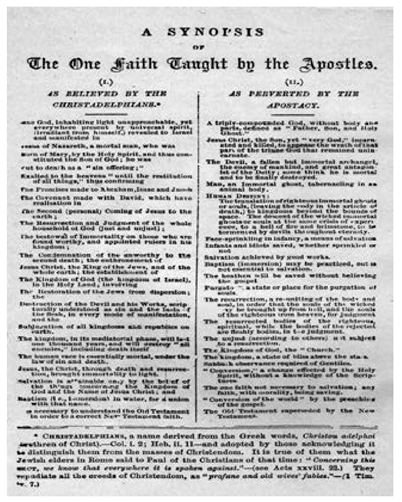
The second section is as reproduced below. (II) AS PERVERTED BY THE APOSTACY.
- A triply-compounded God, without body and parts, defined as “Father Son and Holy Ghost.”
- Jesus Christ, the Son, yet “very God,” incarnated and killed, to appease the wrath of that part of the triune God that remained unincarnate.
- The Devil, a fallen but immortal archangel, the enemy of mankind, and great antagonist of the Deity; some think he is mortal and to be finally destroyed.
- Man, an immortal ghost, tabernacling in an animal body.
- HUMAN DESTINY: The translation of righteous Immortal ghosts or souls, (leaving the body in the article of death,) to kingdoms beyond the bounds of space. The descent of the wicked immortal ghosts or souls at the same crisis of experience, to a hell of fire and brimstone, to be tormented by devils throughout eternity.
- Face-Sprinkling in Infancy, a means of salvation
- Infants and Idiots saved, whether sprinkled or not
- Salvation achieved by good works.
- Baptism (Immersion) may be practiced, but is not essential to salvation.
- The heathen will be saved without believing the gospel
- Purgatory, a state or place for the purgation of souls.
- The resurrection, a re-uniting of the body and soul, in order that the souls of the wicked may be brought up from hell, and the souls of the righteous from heaven for judgment.
- The resurrected bodies of the righteous, spiritual, while the bodies of the rejected are fleshly bodies, in the judgment.
- The unjust (according to others) not subject to a resurrection.
- The kingdom of God, the “Church.”
- The kingdom, a state of bliss above the stars.
- Sabbath observance required of Gentiles.
- “Conversion,” a change affected by the Holy Spirit, without a knowledge of the Scriptures.
- The one faith not necessary to salvation; any faith, with morality, being saving.
- Conversion of the world, by the preaching of the gospel.
- The Old Testament superseded by the New Testament
The historical development of these “Doctrines to be Rejected” will be briefly covered in the next article in the series, God willing, before we pass on to consider the individual items.
 The Origin of the Organic World – Part One