
In The Previous article (Article 16, May, 2002) we posed the question:
What is gained for the edification of our discipleship from a gospel patterned after the creation sequence?
It does indeed seem, at surface consideration, unlikely that the creation sequence would provide exhortation to the disciple, yet, once translated into its spiritual components, there is a clear developmental guide present for the individual believer. Observe the spiritual creation model, shown in Table 1, and consider how the believer is best advised to follow the steps in sequence. (Justifications establishing the spiritual equivalents themselves have been formulated in the preceding articles and are not repeated here.)
Table 1: The natural components of the creation sequence listed alongside their spiritual equivalents.
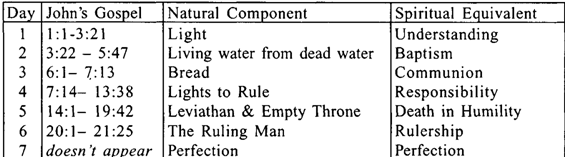
Disciple’s Day 1: Understanding
This is the necessary precursor of all. As an immediate caveat it is clear none of us fully fathom any aspect of God’s plan: either the depth of the sacrifice that God has made in giving His Son, the depth of the love that Jesus felt for those he came to save, or the plan God has for our future. So it is not possible to legalistically prescribe what level of understanding must come first — nor would we desire to do so, particularly given the experiential knowledge of the disasters that transpire every time humans set about translating the spirit of God into a set of legalistic requirements. Nevertheless, John’s creation pattern assures us that the beginning of a walk on the path with Christ cannot begin at birth, or as an infant, but only with a degree of enlightenment to the situation of the sinner and the Saviour, and the necessary relationship they must go on to develop.
Disciple’s Day 2: Baptism
The illumination of understanding will draw the true disciple of Christ toward Day 2: the waters of baptism. If one is to be part of the New Creation, of those things above, then one must enact the ‘drawing above’ of Day 2 in the baptismal resurrection. The association must be made of one’s initial state with the waters beneath and the death they hold, and the drawing out to the life above that is achieved through the sacrifice of Jesus Christ.
It is instructive that baptism is stage two in a creative series of six: i.e. very early on in the sequence. All too often baptism is seen as an “end”: a state of achievement in discipleship. The creation pattern demonstrates that the majority of the disciple’s work (four days of six) lies beyond this point; thus it is advisable for the disciple to consider that baptism should not be overly delayed. It is best that we remember our Creator, and what He has done for us, in the days of our youth (Eccl. 12:1); and that remembrance be shown in the positive response of baptism, since there is so very much to be done in His service beyond this point.
Disciple’s Day 3: Communion
Day 3: Bread to feed the world, and again the order of days is instructive. First understanding, then baptism, then communion: two lessons emerge. Firstly, the sharing of the memorial bread is an essential part of the disciple’s creation: it is not a voluntary practice. Creation shows us why: the works of day 3 sustained all life on Earth (Gen. 1:29), and those who do not frequently eat grow malnourished and weak. Thus the sharing of memorial bread, in a spirit of penitence and thankfulness to the Father and love to one’s siblings, is an essentially restorative function to the character God would have us be. It is a function from which those who would grow strong cannot turn away.
Secondly, communion’s appearance on Day 3 demonstrates fellowship only exists between those who have seen the light and passed through the waters of baptism. We do not ourselves determine with whom we have communion. We might like to expand our community to include any we consider a ‘nice’ or ‘Christian’ person; or we might like to reduce our community to those baptised of whom we personally approve. Yet this is not a matter determined at our discretion: communion (Day 3) can only exist — and conversely must always exist — between all those and only those who have walked the path through illumination and baptism.
End of the first cycle
With the completion of Day 3, we arrive at the end of the first cycle of Heaven, Sea and Earth. With understanding; baptism and communion, the disciple’s universe is complete — just as the physical universe was established with the first three days of the natural creation. But this universe is unpopulated! Through illumination, baptism, and communion, the structure of the disciple’s world has indeed been built. Now Days 4 to 6 are essential to populate the universe that the disciple, through God’s grace, has constructed.
Disciple’s Day 4: Responsibility
Responsibility is the necessary and inevitable consequence of illumination (Articles 10-11, Nov-Dec 2001). While life in Christ is varied, we can crystallise the single directive: one is called to forego self-service and serve the needs of others for the glory of God. In short, the disciple is no longer to be the center of his own universe, but to center himself around the service of his God and his fellow servants. This statement is easy to acknowledge, but to perform it in the reality of everyday life is the hardest task we face, and a level from which all of us frequently fall.
Partly this is because it is a calling contrary to all the philosophies of this present world that influence us daily, that invite us to focus upon ourselves, meditate within ourselves, study ourselves, challenge ourselves, better ourselves and endlessly absorb ourselves within ourselves. From the puerile ’20-question’ test of the popular magazine to the furthest depths of modern philosophy, the object of all these exercises is inevitably the same: to attend oneself— and that is the secret of popular appeal, for man has always been, and remains to this day, self-fascinated. But the message of the true God, the One God, invites and commands the disciple to set self-focus aside and focus upon, deduce, and respond in loving service towards, the needs of others.
Failures in this department can exist on the scale of a church, as well as the individual. Often the church recognises the importance of preaching, and non-members feel highly valued with attention. Upon joining the church in baptism those same individuals can sadly be wholly passed over, no longer holding the high status of a ‘targeted acquisition.’
Conversely new members may be immediately pressured into working toward the various efforts of the church itself. While new members of the body of Christ do indeed need to recognise that they have undertaken a life in service to others, not themselves, it is also a certainty that the existing ‘older’ members of that church have every responsibility in allowing and enabling new members to effect that transition for themselves, while providing the caring support of a loving family throughout. For all of us, the execution of service to the needs of our brethren will populate the heaven we established with our understanding of the Gospel. These will be, indeed must be, the sun, moon and stars that govern our night and day.
Disciple’s Day 5: Death
Day 5 is once again the most intriguing: the disciple must die. We do not refer to the mortal collapse of the human frame, for here we traverse the spiritual creation, we refer to a spiritual death. We might suppose that this `death’ has already been covered in the baptism of Day 2, and indeed Days 2 and 5 are partnered in the creative cycles (Article 3, Apr. 2001). What this creation structure suggests is that even the aspects of death experienced in the baptism of Day 2 must be developed at a later point in the discipleship. Alas, since sin itself continues beyond the point of baptism, this is not a surprise. The key component is humility. The day of baptism carries a joyful spirit – as well it should – and a spirit of elevation, for the new life embarked upon is from above. But for these reasons baptism cannot always carry the full spirit of humility, understandably, seeing it is such a joyful day. This abject spirit must come to complement the uplifting spirit of Day 2’s baptism, and it can only come later, for a true understanding of the weight of sin is required, and this comes with years, not moments.
The death itself is an absolute rejection of one’s nature, a realisation that, contrary to all human philosophy, we are not ‘good’ after all and those who would see ‘good’ prevail must ultimately suffer, and applaud, destruction of the human spirit. Paul’s impassioned cry: “0 wretched man that I am! Who will deliver me from this body of death?” (Rom. 7:24 RSV) shows true discernment of this thought, and is a far deeper cry from the heart than can be appreciated by cursory reading. It is significant that this writing is not from a new convert; the letter to the Romans is one of Paul’s last writings (exact dating varies between AD 56-59, but all agree the letter was written during his last missionary journey).
For those in Western civilization, this is a particularly hard development because it requires an emotional response to the call of Christ. Western civilisation is currently steeped in the worship of the brain, being happily drawn toward, even worshipping, anything with the scent of intellectualism. Intellectualism can pose a dangerous spirit in the disciple’s life, and over-focus thereon will stunt the growth of the necessary humility and devotion of the heart toward his Maker. Discipleship requires the abandonment of the reliance upon all the tools of man to solve his own manifold problems: for spiritual locks will not be turned with natural keys. One cannot be reborn with the Spirit in one’s heart until it is cleared of self-reliance, so that the regenerate may truly “Abba” “Father” cry (Rom. 8:15).
Disciple’s Day 6: Rulership
The disciple lives a life of submission: to the authorities (Rom. 13:1-2), to his friends (John 13:14-15), and even to his enemies (Matt. 5:39-45). Yet without all contradiction, the disciple is also called to rule — both in present and future roles. There will come a time in the future when the call “Come and dine” (John 21:12) will be made again — a beckoning to the wedding supper of the Lamb, as he comes to claim his Bride. From John’s creation we have learned that this call to dine is a signature of Day 6: the New Man, The Premier, and we can anticipate a ruling role for the believers. But there is also a present role of rulership for the disciple, and one that fully emulates the submission we have mentioned. The Bible portrays the relationship between God and ourselves using the metaphor of a father and his children: the father providing constant, attentive care toward their every need, while never expecting, or needing, reciprocal attention. Here indeed is the spiritual ruler, and such is the disciple called to be.
Once again the order of days is essential: Day 6 can only follow Day 5. The disciple can only rule in the spiritual community if he has truly “died” to Christ, a condition easier to recognise than to describe. The disciple who has undergone the elevation of baptism, but not the later counterpart of death in the humbling waters beneath, is not well equipped to rule in God’s house.
Disciple’s Day 7: Perfection…
For this Day the disciple must certainly wait, for perfection comes at God’s provision and not with the disciple’s efforts. One can certainly appreciate the beauty of this earth, and bask resplendent in the joys that both the natural and spiritual creation have to offer now. In so doing we can grasp a cameo facsimile of the Kingdom’s glory, which is to be encouraged. The full experience of the bounty God’s Hand has prepared the disciple, however, must happily and excitedly wait. Nor do we advance the notion that we can extrapolate our highest joys of this present age to gain an accurate measure of the Kingdom’s joy. This is evident from a parallel argument: Paul rebukes those who postulated the physical form of the resurrected from regarding only the mortal frame:
How foolish! What you sow does not come to life unless it dies. When you sow, you do not plant the body that will be, but just a seed, perhaps of wheat or of something else… (I Cor. 15:36-37)
It is a futile, even misleading, exercise to attempt to predict the form of the plant from the physical characteristics of the seed. One could never look at an acorn, for example, and deduce the form (or the size!) of the oak tree that would subsequently appear! The acorn does not bear the slightest resemblance to the tree in either its size, constituents or complexity. Similarly, we regard only acorns (our mortal selves, with our finite, human minds), and God has promised that from the acorns that faithfully die in the soil of His love and goodness, some new thing will grow. But we can no more hope to deduce or extrapolate what form that final joy will take than we could deduce the size and shape of an oak tree from seeing only the acorn.
…and beyond
Then the end will come, when he hands over the kingdom to God the Father… When he has done this, then the Son himself will be made subject to him who put everything under him, so that God may be all in all (I Cor. 15:24-29).
Finally, the ultimate completion: God is all, and in all. We shall not pretend to have an explicit understanding of what that means but we shall look toward it in all hope and joyful expectation!
What more need we say? May God be praised in all those good things He has planned for us.
 The Origin of the Organic World – Part One