
Asic Premise For Day 5 In the natural creation, we noticed that Day 5 focused on the “waters beneath” and their population, including tanniyn, the leviathan. Unlike Days 4 and 6, there is no natural ruler mentioned; Day 5’s throne is vacant until its ruler comes in Day 6. Day 5 is also counterpart to Day 2 in the “Sea” section of Creation (Article 3); the creative act was a “drawing above” of life-giving water from the dead (saline) waters beneath. In Day 2, we saw a series of acts that well reflected the drawing up from the dead human state toward the life-giving waters above (Articles 5-6). By contrast, in Day 5, we anticipate seeing the dead elements of the waters that were left beneath, and all that populate them.
The water separates — division
One of the principal elements of these chapters in John is the growing separation between Jesus and his disciples. They are unable to “go where he is going” in both the physical sense, to the cross, or the spiritual sense, in being able to truly grasp what he is telling them. Read John 14 and see the evidence from the discourse. Here are a few examples:
Thomas: “Lord, we don’t know where you are going, so how can we know the way?” (v. 5).
Philip: “Lord, show us the Father and that will be enough for us” (v. 8). Judas: “But, Lord, why do you intend to show yourself to us and not to the world?” (v. 22).
The lack of understanding is broad. Philip does not recognize the Master whom he sees. Even though Jesus has plainly told him, “I and the Father are one” (10:30), Philip cannot observe the character of the Almighty Father when regarding the Son. Thomas shows that he does not understand Jesus’ intended direction, either spiritually or physically, and Judas cannot grasp the strategy of the revelation of Jesus Christ. This lack of comprehension culminates in the beleaguered expressions:
Some of his disciples said to one another, “What does he mean…?” They kept asking, “What does he mean…? We don’t understand what he is saying” (16:17-18).
Notice how the gospel writer evidences the contrasted coupling between Days 2 and 5, by contrasting the confusion that Jesus’ words cause here in Day 5 with the inspiring effect the words of this same man have in Day 2:
And because of his words many more became believers (John 4:41).
Comfort across the divide
It is not possible to include Jesus himself as part of the elements of the waters beneath (because they represent things “deathly”), although he will bear the ultimate burden of them as he is “brought beneath” in what follows. Thus we necessarily anticipate a division between the Lord Jesus and all others —akin to the “expanse” originally created (Gen. 1:6). We have already seen the spiritual and intellectual separation between Jesus and his disciples, but here Jesus also talks of the necessary physical separation as he departs; first to the grave and then to his Father. Nevertheless, such is the attitude of the Lord Jesus that these comments do not contain sadness or self-sympathy; rather they are an expression of the fullness of the love of his Father in the actions he will shortly perform. He is being drawn above, in the true enactment of the creation process of distilling life from that which is dead, and yet his concern is only for those he leaves below:
“Do not let your hearts be troubled. Trust in God; trust also in me…I will not leave you as orphans; I will come to you…Peace I leave with you; my peace I give you. I do not give to you as the world gives. Do not let your hearts be troubled and do not be afraid” (14:1,18,27).
The end of chapter 14 sees Jesus leave the upper room and walk across the city of Jerusalem with his disciples. John 15-17 records their conversation as they progress from the supper room to the Eastern gate of the city by the Temple. Throughout this walk both the evidence of widening expanse between Christ and his disciples, and his comfort and love for those who cannot “follow him now,” becomes increasingly evident.
“My command is this: Love each other as I have loved you. Greater love has no one than this, that he lay down his life for his friends” (15:12-13).
“I came from the Father and entered the world; now I am leaving the world and going back to the Father… I have told you these things, so that in me you may have peace. In this world you will have trouble. But take heart! I have overcome the world” (16:28,33).
“I will remain in the world no longer, but they are still in the world, and I am coming to you. Holy Father, protect them by the power of your name the name you gave me — so that they may be one as we are one” (17:11).
Jesus is preparing the disciples for the time when he will no longer be with them. His pioneering work is done, and he is to depart. This forms a further attractive comparison with Day 2 in John’s Creation. Day 2 records the completion of the preparatory work of John the Baptist; in Day 5 Jesus speaks of the completion of his work. Both John and Jesus speak of the completion of their work using the same idea: the completeness of joy (note that these are the only times this phrase is used in John).
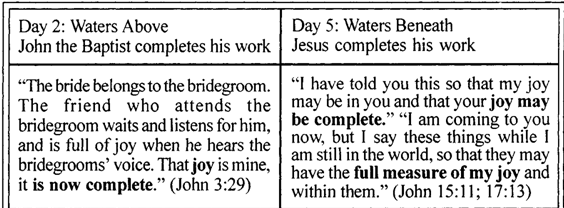
Table 1: Comparison of the words of John the Baptist (Day 2) and Jesus (Day 5) on completion of their role in the Father’s plan.
Those drawn above — those cast beneath
Chapter 18 sees Jesus leave Jerusalem, and cross the Kidron Valley to enter the Garden of Gethsemane on the lower slopes of the Mount of Olives. Yet the tranquil picture of Christ with his faithful is to be shattered. The waters beneath contain leviathan, whose ugly head rears from the text. Judas Iscariot, into whom Satan has entered, arrives in the olive grove with an armed brigade, and has Jesus arrested. Note one particular detail, exclusive to John’s gospel, that accompanies the arrest:
When Jesus said, “I am he,” they drew back and fell to the ground (18:6).
There is no known commentary concerning this verse, yet it fits beautifully into the pattern of John’s Creation we are considering. Day 2 emphasizes the characters who are seeking those things above. In that section we see that the presence of Jesus causes men to be physically uplifted (e.g. the drawing above of the nobleman’s son, John 4:47-53; the raising up of the impotent man at Bethesda, John 5:8-9; and the resurrection of all, John 5:28-29). Day 5, by contrast, emphasizes the worldly characters of those who are at home below, and therefore we see how the presence of Jesus causes them to collapse down to the Earth (John 18:6). The Word of God is indeed a two-edged sword.
Leviathan strengthens — desertion and denial
The strengthening serpent’s power is clearly illustrated in the denial of that one impassioned disciple whose earlier faithful declarations had so well glorified his Lord: we speak of Simon Peter, of course. Once able to walk on water, we see Peter sink no further beneath the waves than this. The simple cowardice that so besets us all creeps to the fore as, in one of the saddest parts of scripture, Peter denies any discipleship to, association with, or even knowledge of, the Lord Jesus.
“You are not one of his disciples, are you?” the girl at the door asked Peter. He replied, “I am not”…One of the high priest’s servants, a relative of the man whose ear Peter had cut off, challenged him, “Didn’t I see you with him in the olive grove?” Again Peter denied it, and at that moment a rooster began to crow (18:17,26-27).
The crow of the rooster — a signature moment. It marks Peter’s stark realization of the totality of the failure of his human spirit. He has denied Jesus, the very man of whom hours earlier he swore he would never be ashamed. It is without doubt the darkest moment in Peter’s spiritual life, and how typical of scripture that the spiritual world is shown to stand in contradiction of the natural world, for in the natural world the rooster marks the dawn, the promise of the return of light in a new day, and not the darkest hour. Perhaps this moment does indeed form a spiritual dawn for Peter, born from the waters of total humiliation, but for now we must follow the narrative. Leviathan has reared from the text to claim his victims. Judas Iscariot has lost faith and Peter, brave Peter, has lost heart.
And worse is to come.
The “gifts”
The worse that comes, of course, is the trial, and death by scourging and crucifixion (John 19). What forms an interesting prelude to that event is the “gifts” that Jesus is brought prior to crucifixion. Jesus was brought gifts at his birth; this chapter reveals that he is brought gifts at the end of his life also (Table 2).
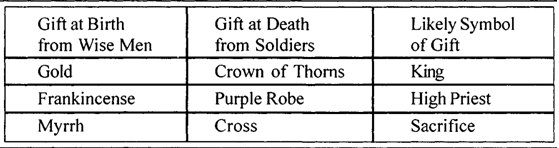
Table 2: Gifts for the Messiah: Those gifts presented in praising celebration at his birth (Matthew 2), and those presented in mocking derision at his death (John 19).
In each case there are three gifts and in each case the symbology seems to be the same: one gift for a King (gold/crown) one for the high Priest (incense/ purple robe) and one for a sacrifice (myrrh/cross). What forms the striking comparison is the opposed nature of the spirit in which they are offered. Whereas the gifts presented at his birth are offered in a humble spirit of praise to worship the newborn King, it is equally clear that those presented by the soldiers in John 19 are “given” in ridicule and hatred. The crown is made of thorns, and will cut the head of the wearer as it is pressed into place. The robe is given to mock his high status, for whilst he wears it he is beaten in the face. The cross does not only symbolize his death, but forms the very mechanism by which that death is brought about. (On this latter point note that John is the only Gospel writer to emphasize that Jesus carried his cross: the other records indicate that it was carried by the Cyrenian Simon. Doubtless both are true, but John chooses to emphasize that the cross is a “gift” to Jesus.)
The conclusion is evident: the spirit of man toward Jesus Christ has utterly changed, from reverence to revulsion. Man has seen the miracles, has been healed by the spirit, has eaten his fill of the bread from heaven, and now turns with violence on the gentle Son of Man and kills the very one from whom all these good things were distributed. What a chilling insight this provides into the nature of every human soul!
Worship of the beast
So what has gone wrong? How can the Saviour who was once so loved now be so reviled, particularly after all the love that he has shown? Day 1 of John’s Creation illuminates the matter (as was always its purpose):
“This is the verdict: Light has come into the world, but men loved darkness instead of light because their deeds were evil” (John 3:19).
Ultimately, “Truth will out:” man’s true colors will always be seen. The heart of man loves darkness, and not light. Thus the world is united — Jew and Roman stand together — in the hatred of Jesus Christ. This is an ugly truth, and some might find the phrasing offensive, but in that it is true it is doubtless best acknowledged as such. The father of all human men is not The Father, but rather the devil; so much is made clear at Gabbatha (the Pavement) where the King of peace was brought before them.
It was the day of Preparation of Passover Week, about the sixth hour. “Here is your king,” Pilate said to the Jews. But they shouted, “Take him away! Take him away! Crucify him!” “Shall I crucify your king?” Pilate asked. “We have no king but Caesar,” the chief priests answered (19:14-15).
Their King is Caesar, by their own declaration. Their King is Rome, for that is Caesar’s realm. Their King is the Beast, and they fall to worship him. Note that this last statement is not made purely for the impact of anaphoric rhetoric, but rather as an explicit observation of fulfilled prophecy entirely pertinent to leviathan. It stands in prophecy that the Beast/Serpent is the one who wars against the children of God (Rev. 13:4-8) — with particular emphasis that “All inhabitants of the earth will worship the beast” (Rev. 13:8). Now we do not attempt exposition of the apocalypse here, (nor do we even ascribe the primary fulfillment of these apocalyptic words to the crucifixion), but we cannot ignore the primary, chilling observation that “all the inhabitants of the earth” consciously ally themselves in war against Christ. Jew and Gentile, soldier and civilian, proletarian and Pharisee unite to cry: “Away with him! Crucify him!” — to worship the beast. They do this for the simple, irresistible reason that it is their nature. Ultimately their father was not The Father, and thus they could never know the Son. Judgement falls from Day 4 of John’s Creation:
“You belong to your father, the devil, and you want to carry out your father’s desire. He was a murderer from the beginning, not holding to the truth, for there is no truth in him” (John 8:44).
Their father was the devil, the murderer from the beginning. Thus they unite to free their brother, Barabbas, and reject the Son of Man, fulfilling the genetic inheritance of their father in committing a murder of their own.
And with that rejection the seed of the woman, the man child, is led away to be crucified.
 The Origin of the Organic World – Part One