
We Have Concluded our detailed study of the Gospel of John in the light of the proposed model of the spiritual creation sequence, and seen ample evidence to support the pattern. We now approach the broader picture to enquire why John would present the gospel in this manner. Specifically, we ask two questions (the former we address here and the latter we consider in the following article):
- What is gained for the glory of the Father and Son from a gospel patterned after the creation sequence?
- What is gained for the edification of our discipleship from a Gospel patterned after the creation sequence?
From our studies thus far we have seen how this model explains the choice and order of material that is included in John’s Gospel, and how it enhances our appreciation of the spiritual messages in the text. But we find four explicit answers to this first question above. The first comes from a consideration of the seventh day. Remarkably, even though we have reached the very last word of John’s Gospel (Article 15), the message of John’s testimony is not completed. Even the silence at the end of his gospel speaks a message as powerful and as thought provoking as any of the portions that preceded it.
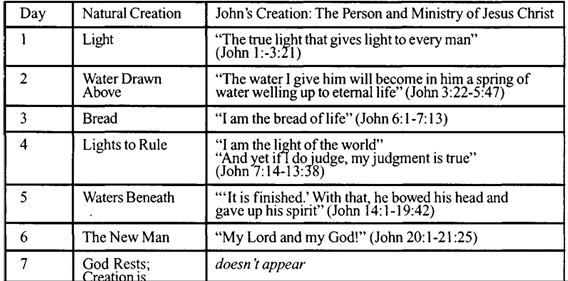
Table 1: Comparison of the physical and spiritual creations, emphasising both the relationship between the respective components, and the absence of Day 7 in the latter cycle.
The Absent Day (Day 7)
The seventh day, the day of rest, is absent from the record of John’s Gospel: this is emphasised in Table 1.
By the seventh day God had finished the work he had been doing; so on the seventh day he rested from all his work. And God blessed the seventh day and made it holy, because on it he rested from all the work of creating that he had done (Gen. 2:2-3).
God attributes special importance to the seventh day precisely because there was nothing created on it — it was the day on which He rested in the completed beauty of His flawless world. God created each of the components on each Day precisely so that He could enjoy them in His rest on the seventh Day. Thus all the six days existed for Day 7: Day 7 was their culmination, their justification, quite literally, their raison d’etre.
Why then is this most important of Days missing from John’s record? From Table 1 the spiritual seventh Day equates to the time period in which all is complete and God dwells harmoniously with His whole spiritual creation. This refers to the Kingdom era, a future event which naturally does not appear in John’s historical Gospel. But the strength of the argument is how loudly the creation pattern emphasises that the Kingdom is “missing” and required to complete the picture. Table 1 resembles a jigsaw puzzle with a piece missing! Such is the beauty and intelligence of the design: the blatant nature of the Kingdom’s omission is emphasised by the seven day pattern and thus proclaims irresistibly the surety of its coming, as certainly as there are seven days in the week. Additionally, John’s creation pattern evidences that only one additional piece is required for culmination: not three, or four; promulgating decisively the finality of God’s kingdom in His plan for this earth.
The pre-eminence of God’s kingdom from John’s Creation
A recurring theme of all six creative days in John’s Gospel is the superiority of the spiritual creation’s component to its natural counterpart; and always for the same reason: where death is found in the natural form, life is seen in the spiritual. This is not a vague generalization, but explicitly justifiable in each instance (Table 2).
The momentum of the common pattern completes the last row: the Kingdom of God will stand in excellence above Eden, because the blessed will live for evermore, unlike Eden’s generation. This is an insightful teaching: commonly God’s Kingdom is spoken of using phrases such as ‘Eden Restored’ or ‘Paradise Regained.’ John’s Gospel reveals the shortcoming of this thinking as it vastly underestimates the quality of the kingdom age. God’s plans never project backward: we are not directing our lives backward to the time of Eden, but forward to a new and unprecedented future in God’s hands. The Kingdom is not to be Eden restored, it is to be Eden excelled, and how exciting it is to discover that! This provides additional value to, and justification for, the arrangement of creation within John’s Gospel: the unparalleled emphasis of
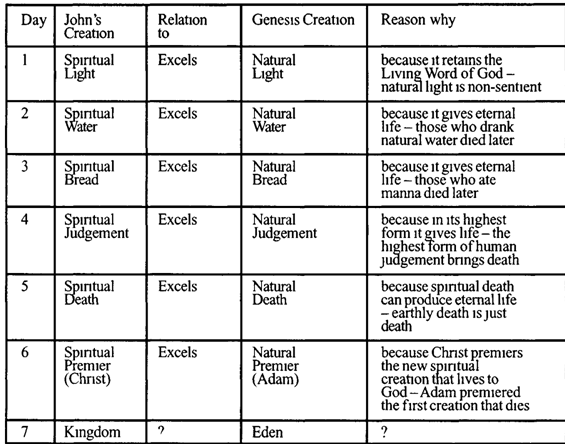
Table 2: The relationship between each spiritual component of John’s Creation and its respective natural component the pre-eminence of the Kingdom over and above even the ‘goodness’ of Eden.
The pre-eminence of Jesus’ sacrifice from John’s Creation
As we considered above, Day 7 forms the justification for the preceding days. This too underscores the kingdom’s pre-eminence; that everything in the spiritual creation exists for the purpose of the coming kingdom. Thus, Day 1: Jesus shined as a light in the world, partly to illuminate us, but ultimately so that the kingdom might come (and there be some granted with the gift of life to govern it). Likewise Days 2, 3 and 4: Jesus drew some up toward the Living Water; Jesus provided — indeed formed — the Living Bread, and Jesus became the Light to Rule all primarily for the Kingdom.
It is when we strike Day 5, that darkest of days, we gain a new shade to our understanding of Christ’s sacrifice. Jesus died: resigning his life of flawless obedience to the Father in death through the ignominious and agonisingly painful method of flagellation and crucifixion. Some scriptures teach us that Jesus died for our sins (I Cor. 15:3), others that it was part of his Father’s greater design (Phil. 2:8).
John, in combination with these, guides our thoughts to an intimate understanding. His Creation pattern shows us that Day 5, as all other Days, was for Day 7. Jesus died primarily for the kingdom to come, that the world might be made perfect! That it might have a living population, cleansed of sin, which could begin to share the harmony and fellowship of the Father and all the world be filled with the knowledge of His glory (Hab. 2:14). What a very different sacrifice that now makes the crucifixion of Christ, and how much a better sacrifice!
This is our third answer to the question of why John would design his Gospel according to the creation framework. It was to exemplify the Kingdom age as the reason for the preceding ages, and to see Jesus’ awareness of that in his ministry all his acts deliberately pointing toward that greater, final goal.
The pre-eminence of Jesus Christ’s authority from John’s Creation John’s creation pattern teaches fundamental truths about the pre-eminence of Jesus Christ, and in so doing, explains some verses of scripture that would otherwise remain indecipherable. Here are just two examples:
[Jesus] was in the world, and though the world was made through him [by him, KJV], the world did not recognize him (John 1:10).
For even if there are so-called gods, whether in heaven or on earth (as indeed there are many “gods” and many “lords”), yet for us there is but one God, the Father, from whom all things came and for whom we live; and there is but one Lord, Jesus Christ, through whom all things came and through whom we live (I Cor. 8:5-6).
These verses state that Jesus is either the creator, or at least the conduit of creation. How are we to understand this? We know the Son was not yet born at the time that the world was created (Gen. 1:1-2), and yet these verses claim that Jesus was an instrumental part of the creation.
Some Bible students have interpreted the Bible phrase “through whom” as “for whom,” therefore reading the above as “the world was made for [Jesus]” and: “Jesus Christ, for whom all things came.” This subtle exchange of the word ‘for’ in place of ‘through’ [or ‘by’] circumvents the problematic implication that Christ was instrumental in the creation process, giving the new tone that declares Jesus’ “presence” during creation only in the thoughts of the Almighty.
But this answer is more convenient than tenable. That the Almighty was mindful of the pre-eminence of His beloved Son as He formed the world is doubtless true, nevertheless the word exchange on which this proposed solution rests is not justifiable from the Greek. For example, John 1:10 (above) has “through him” (NIV) and “by him” (KJV). Although these translations are taken from different Greek texts — the King James is based on the ‘Textus Receptus,’ whereas the newer NIV is drawn more from the Alexandrian scripts — both Greek versions list the primary preposition as dia — translated ‘by’ (KJV) or ‘through’ (NIV). Attempting to substitute the word ‘for Jesus’ to avoid the problem of Jesus as the conduit of creation is stretching the use of the Greek word dia beyond its limits and is therefore linguistically unacceptable. This is not the answer.
So how are we to understand these quotes? The Bible is unambiguously stating that the creation came through Christ — a puzzling teaching. Yet with John’s creation pattern we are illuminated as to how Jesus acts as creation’s conduit. It is the spiritual creation, alluded to by a number of New Testament writers (e.g. II Cor. 5:17, Gal. 6:15), and here in the Gospel of John it is expounded to its fullest and most explicit (six-day) level.
Now we are perfectly placed to understand the quotations about God performing the whole spiritual creation through/by His Son the Lord Jesus Christ. Indeed, recollection of the Biblical description of even the physical creation well illustrates the eminence of Jesus Christ. For while human thinking might evoke the creation as an unending series of differing species, cats and dogs and pigs and cows ad infinitum, the Bible records a more philosophically segregated picture.
In the scriptures creation is: a light that shined in darkness (Christ!); life-giving water drawn out of water that could not sustain life (Christ!); the earth bringing forth bread as food (Christ!); a light that shined to rule (Christ!); death, who lay in the waters beneath (Christ!); and a man in a new form, designed to care for it all (Christ!). Christ both created and epitomized all of these things in his ministry, albeit this creation still came, as all good things come, from the Father of lights Himself (James 1:17). Thus God did indeed create all these things, the whole creation by and through His Son, the Lord Jesus Christ. It is the latter creation, the spiritual creation, to which these verses refer; so much becomes apparent from the Gospel of John, where the notion of Christ as the conduit of creation is so powerful (John 1:1-10).
Finally, notice the corroboration from Hebrews:
In the past God spoke to our forefathers through the prophets at many times and in various ways, but in these last days he has spoken to us by his Son, whom he appointed heir of all things, and through whom he made the universe (Heb. 1:1-2).
In the former times (“the past”) God spoke to the prophets in diverse ways, and in the latter days He created the universe through His son. The structure of the sentence places the ‘making of the universe’ in the ‘latter days’ confirming, as we learned from John’s Gospel, to which creation this refers. Thus we gain a fourth reason why John composes his Gospel according to the creation model. When the model is tied to the Lord Jesus Christ, it teaches us the unparalleled pre-eminence which Jesus holds in the eyes of the Father: that he has been the one through whom, by whom, all things that exist have come to be. Once again, John has extended our understanding of the scriptures with his breathtakingly simple, yet profound, description of the person and ministry of Jesus Christ.
 The Origin of the Organic World – Part One