
Here We Consider the principal story of Day 4’s light and judgement theme: the restoration of sight to the man born blind (John 9) Day 4 is the beginning of the repeat cycle of heaven-sea-earth covered in Days 1-3 (article 3), and thus is the development of Day 1
Day 4: reintroduction to the Light (Jesus)
In Day I, Jesus was introduced as the Light and Israel as the darkness, characterized by a series of 12 questions which indicated their complete lack of understanding (article 4). How fascinating that we see a resurgence of both characteristics in this very chapter! Read through John 9. Firstly notice the (re)introduction to Jesus
Light…
“While I am in the world, I am the light of the world” (9:5).
…and Judgement
Jesus said, “For judgement I have come into this world, so that the blind will see and those who see will become blind” (9:39).
Reintroduction to the darkness (Pharisees)
The reintroduction to the Jews, the darkness, is again characterized by a series of questions (Table 1). How exciting to behold the consistency of the patterns that the Bible lays before our eyes! Once again the Pharisees (the spiritual leaders of God’s people), are entirely bereft of any understanding of what has taken place, or how, or why.
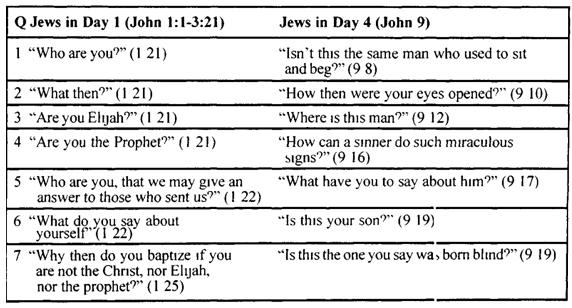
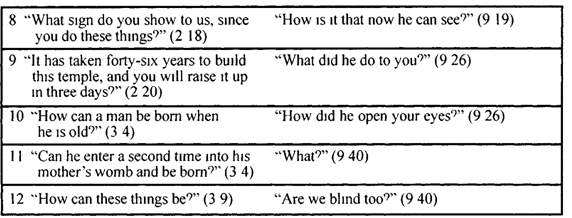
Table 1. The list of questions (NKJV) asked by the Jews in the discrete sections of Day 1 (John 1.1-3.21) and in the case of the man born blind (John 9).
In both Day 1 and Day 4 the final question is almost comical, revealing the total incomprehension of what has been witnessed. Yet there is no humor here; rather these words betray genuine sadness that God’s own people were too far astray to even recognize the very things they should have been longing to behold.
Yet can we berate the Pharisees for their lack of perception? Rebuke is well deserved, but are we in the position to deliver it, as we read John’s Gospel from two thousand years downstream? Before we risk such an enterprise, perhaps we should consider that the events of the last days preceding the return of the Bridegroom should be equally long-awaited by ourselves. Are we fully confident that we know exactly what we should be looking for, and what it is that we shall see? Or do we still have a lot of questions?
Mindset of rejection
As general prelude to the miracle, we notice that the Pharisees’ downfall was orchestrated by the mindset they had already adopted prior to investigating the facts of the miracle. It is evident from what unfolds that, in their hearts, they had chosen to reject the miracle at any cost, regardless of what they witnessed. Table 2 reveals this in their dialogue: after each of their rejections is disproved, they find a different way in which to reject the evidence before them.
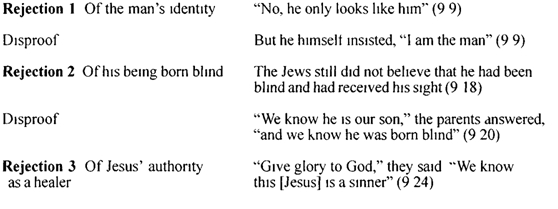
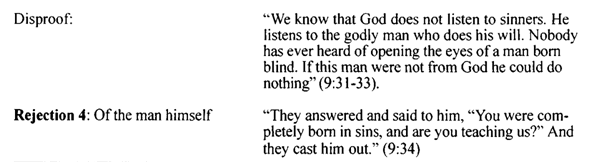
Table 2: Catalogue of rejection of the evidence of the miracle Jesus performed in restoring the sight of the man born blind.
To see or not to see?
This is the mentality with which Jesus contended: the closed minds of those who would not see, and therefore could not see. John parallels them alongside a man who had been physically blind all his life. The beauty of the passage is that where Jesus can, and ultimately will, heal physical blindness even if it has been present all of our life — no cure can be found for willful, spiritual, blindness. For those who have eyes and will not see, they must remain in the darkness. The reason is evident: those who are blind by birth are blind by the hand of time and occasion, which time and occurrence lend themselves for the evidencing of God’s will, as Jesus explained:
“Rabbi, who sinned, this man or his parents, that he was born blind?” Jesus answered, “Neither this man nor his parents sinned, but that the works of God should be revealed in him” (9:2-3).
Contrastingly, those who are blind by choice are those who have seen the light and chosen to hide in the darkness where they believe their evil deeds will not be seen. Once again, the actions of the individual determine his judgment:
Jesus said to [the Pharisees], “If you were blind, you would have no sin; but now you say, ‘We see.’ Therefore your sin remains” (9:41).
Double vision: spiritual and natural
Once again in John’s Creation, we see the combining of a natural and a spiritual miracle. Jesus addresses the blind man:
“Go,” he told him, “wash in the Pool of Siloam” (9:7).
The dismissal is made to the man who is blind (see Article 7, pp. 345-346, table on “come” and “go,” and remember that no blind sacrifice was acceptable on the altar of the Living God, Deut. 15:21; Mal. 1:8). But notice the power of God’s mercy invested in Jesus Christ: Jesus rejects the blindness, without having to reject the man who bears it. A blind man is sent away from the Lord, but a sighted man returns:
So the man went and washed, and came home seeing (9:7).
Yet, and here is an interesting development, can the man who returns from the Pool of Siloam really see? After his return he is asked where Jesus is pay attention to his reply.
“Where is this man?” they asked him. “I don’t know,” he said (9:12).
On the physical plane this is obvious: the man has never been in Jesus’ presence with the power of sight and therefore doesn’t even know what Jesus looks like. At the risk of overextending interpretation, we suggest that this verse (12) is recorded for its spiritual testimony, rather than the physical. The man’s eyes have been opened, for sure, but Jesus is still not in sight. This observation is underscored, for emphasis, by the later exchange:
Jesus…said, “Do you believe in the Son of Man?” “Who is he, sir?” the man asked. “Tell me so that I may believe in him” (9:35-36).
This also provides an interesting precursor in the Gospel to the broader case of spiritual blindness affecting most in Israel who, John shows us, are also unable to see the Son of Man:
The crowd spoke up, “We have heard from the Law that the Christ will remain forever, so how can you say, The Son of Man must be lifted up? Who is this Son of Man?” (12:34).
Here is the double power of the miracle: the benevolent gift of spiritual sight to follow the natural. Note that this sight is given to the blind man in John 9 who desired to believe, but not to the correspondingly blind Israelites in John 12, who had no such desire.
Jesus said, “You have now seen him; in fact, he is the one speaking with you.” Then the man said, “Lord, I believe,” and he worshipped him (9:37-38).
The man’s physical blindness has been taken away as he washed in the Pool of Sent: a baptism for the eyes, if you will. But even after his eyes have been “immersed,” he cannot spiritually perceive (believe in) the Son of Man. Thus, he also receives spiritual enlightenment—the revelation ofJesus Christ. As always the spiritual excels the natural, for while the natural eye-opening provided him sight with which to conduct his natural life, his spiritual eye-opening provided him with a sight that will provide eternal life.
Conclusions from Day 4
Again we ask ourselves: Have we seen events within this section that allow us to strengthen our proposal of the model of creation within John’s Gospel? Indeed we have: there is a healthy presence of Light and Judgement, the principal elements of creation’s Day 4. We have seen that Day 4 does indeed follow as a logical development of Day 1: in the same way that the natural creation of the sun, moon and stars follow as a development of light, (providing both a source and a focus), the same is true in the spiritual creation.
Judgement, and culpability, is a necessary consequence of illumination. One who stands in the light is responsible for all those actions he performs because he can see what he is doing. Even a return to the darkness from this position cis itself an enlightened decision, although such a decision — to knowingly depart from the Light of the world back into the darkness — is utterly fatal, as John graphically illustrates (John 13:30).
It is wonderful to see the inescapable logic of the train of thought John follows in his Gospel, presenting Jesus in Day 4 as the ruling light, covering the absolute nature of the power Jesus owns: to prescribe — though he does not deliver — death to the living (John 9:41) and prescribe and deliver life to the dead (John 11:43-44). This thought extends into the natural conclusion of absolute authority: Kingship, and here in Day 4 John has shown us the triumphal arrival of the King in Jerusalem (John 12:12-13).
Once again, we also notice the superlative nature of the spiritual creation in excellence over the natural creation. In the natural world the height of judgement, the highest level of authority attainable, is to hold the power to sentence a man to death. But in the spiritual Creation, here in John’s Gospel, we learn there is a higher level of authority — the authority to give life out of death.
This gives an excellent introduction to mercy; for it is only by mercy that a man, who has no right to life, can be granted life. It is obvious from observations of the natural world (the animal kingdom) that animal behavior is entirely devoid of mercy. Animals behave very logically; and in addition to logic they also evidence elements of loyalty, loving care and even altruism. But there is no mercy within the natural creation, nor can there be. Mercy is an element that derives solely from an understanding of the Almighty, and is only seen in those who reflect some portion of His mind. The presence of mercy is another reason why spiritual ruler ship far excels natural ruler ship.
We also learn that those who are brought into the Light, and become aware of the spiritual implications of the lives that they lead and aware of the directions that they can choose, are not made complete by this illumination alone.
Being brought into the Light is a beginning and not an end. The blind man (John 9) returned from the Pool with the capacity of sight, yet he was still unable to recognize Jesus when he saw him until a separate revelation was made. Thus the lesson comes home to us that spiritual growth must continue beyond the baptismal event — no resting place is to be found for the true disciple on the land beyond the water, for perceiving the company of Jesus Christ does not necessarily follow merely because one has returned from the baptismal pool, and any assumption that it does is made in error.
It is from the point of illumination that we can begin to look for the Lord, and begin to learn those things most necessary to be his disciple. Those who have come to the land beyond the water do not necessarily have Jesus in sight: a journey still needs to be embarked upon, an eye-opening walk of discovery still lies ahead.
 The Origin of the Organic World – Part One