
Day 6. the second cycle of Heaven, Sea and Earth draws to its final component as we arrive back at the Earth portion. In the natural creation, Day 6 sees the Earth populated, the principal feature is the man Adam is a new man created in the image of God to govern, tend and care for all of the Earth From this we formulate our expectations for Day 6 of John’s Creation
Basic premise
We expect to find Jesus presented as the authoritative figure within a new Creation, in a similar role to the position of Adam in Eden We also expect an echo of Day 3, because Days 3 and 6 are partners in the “Earth” section A brief appraisal of this section in John (the last two chapters) yields clear supporting evidence Read through John 20-21 The first thing we encounter is the empty tomb (20 1) — a clear declaration that a man has been raised (created) to walk the Earth in a new form, already realizing a strong echo of the Adamic creation As we turn to a more detailed assessment of these verses, we will see how this thought is ratified with Jesus’ authority as the premier man above all men coming clearly to the fore
Names above names
There are very important patterns embedded in John’s Creation with regard to the titles that Jesus wears We concentrate on two titles in particular. “Rabbi” (a transliteration of a Greek word meaning “Teacher”) and “Son of God ” What we witness is that both of these titles are attnbuted to Jesus throughout Days 1-4 of John’s Creation (Table 1). Interestingly, both titles disappear in Day 5. indicative that this really is the day of the empty throne — the absence of the Lord Jesus Chnst from the living world What is exciting and revelatory in our study here is that both these titles subsequently reappear in Day 6: and do so to a superior format.
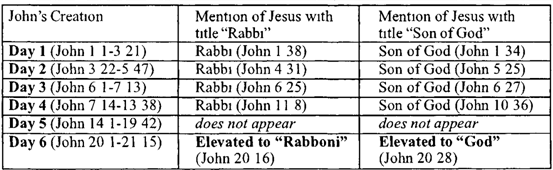
Table 1 Names above Names An indication of how two important titles of Jesus are elevated to supenor format in Day 6 of John’s Creation, (after disappearing in Day 5)
The term “Rabbi” is applied to Jesus throughout Days 1-4 and disappears in Day 5, replaced with insults from those mocking him on the cross. In Day 6, the day of the new man, the title reappears as “Rabboni” – Teacher amongst Teachers, (or “Lord,” as Mark 10:51):
Jesus said to her, “Mary.” She turned toward him and cried out in Aramaic, “Rabboni!” (which means Teacher) (John 20:16).
Likewise the title “Son of God,” Jesus’ title throughout Days 1-4, was stripped from him in Day 5 (as all was stripped from him, including his life); and reappears in Day 6 in augmented form.
Thomas said to him, “My Lord and my God!” (John 20:28).
An extraordinary declaration, which needlessly troubles many. Notice an important thing: Thomas is neither corrected nor rebuked for his statement, and Jesus does correct improper references attributed to him (Matt. 19:16-17; 12:24-28), indicating the reference of “God” as fully appropriate. The scripture is well -balanced because the same chapter indicates there is no case for Jesus being the actual person of God (John 20:17), yet God has been pleased to give His Son Jesus the very name of God for the obedience of his sacrifice (as Phil. 2:6-11). It is in this section of John’s Gospel, the day of man’s premiership, that John reveals the new names of Jesus: firstly Rabboni, and secondly the Name that is above every Name, the very Name of the Almighty himself God. How well this fits the Day 6 theme: a new and even greater authority for Jesus in his role as the spiritual equivalent of Adam, the first man — both chronologically and authoritatively — of the spiritual creation.
The role of Key holder: directive to the apostles
In the natural creation, the man is created to have authority over all the other creatures, and with that authority comes a responsible role, for Adam it is to tend the Garden that the Lord created in Eden (Gen. 2:15). Day 6 of John’s Creation is similar; the New Man is shown in his premier role of Keyholder — the gatekeeper to God’s Kingdom. It should be noted that the “keyholder” role in scripture itself is not new, and it is one that has always been invested in the religious leaders of the day. Notice how Jesus invests this role to his apostles here in Day 6:
And with that he breathed on them and said, “Receive the Holy Spirit. If you forgive anyone his sins, they are forgiven; if you do not forgive them, they are not forgiven” (John 20:22-23 NIV).
These words share the same spirit as those spoken to Simon Peter, following his confession of Jesus as the Christ. Jesus says to Peter:
“I will give you the keys of the kingdom of heaven; whatever you bind on earth will be bound in heaven, and whatever you loose on earth will be loosed in heaven” (Matt. 16:19).
The image of Peter standing “at the Gates of Heaven” as the keyholder has passed into popular Western culture and, from there, has been adopted by large portions of Christianity. However, Peter forever standing at the gates of God’s community, perched on the periphery of heaven is a gross and comical overstretch of this verse. The context demonstrates that the role was bestowed on Peter because of the confession that he made: “You are the Christ, the Son of the living God,” and thus it is reasonable to suppose that the same status is bestowed on all those who make that same confession. This supposition is corroborated by Jesus’ directive to the apostles (John 20:22-23).
History of the Key holder in scripture
Furthermore, scripture makes clear that all those who adopt the highly placed roles within the religious leadership of God’s people have the responsibility of this role of key holder. Jesus observes this to those incumbent in religious leadership at the time: the Pharisees, alongside the observation of how appallingly badly they fulfilled that role.
“Woe to you experts in the law, because you have taken away the key to knowledge. You yourselves have not entered, and you have hindered those who were entering” (Luke 11:52).
The preceding verses clarify that the principal way in which the Pharisees and scribes had hindered God’s children was in the rejection (and in some cases murder) of the prophets God had sent. As a result, their own actions passed judgment on themselves.
“Therefore this generation will be held responsible for the blood of all the prophets that has been shed since the beginning of the world, from the blood of Abel to the blood of Zechariah, who was killed between the altar and the sanctuary. Yes, I tell you, this generation will be held responsible for it all” (Luke 11:50-51).
Jesus is condemning the key holders of the day, for far from exhibiting the enabling spirit of those who unlock doors for their trustees, they have taken the spirit of the murderer that cannot hear the words of the men from God and, being driven to murder that which they cannot tolerate, stand condemned by their own actions. The crime is worsened by their position of responsibility as men of responsibility: key holders — those who have been entrusted to guide the children of Israel to the sanctuary of their Father.
Fortunately, however, God has provided another Key holder.
“I will place on his shoulder the key to the house of David; what he opens no one can shut, and what he shuts no one can open” (Isa. 22:22).
The immediate context shows that these words are primarily written about Eliakim, son of Hilkiah. Although attributing a dual application of a prophecy is a dubious procedure in the main, there is good scriptural justification to apply these words to Christ, because the same prophet notes that Jesus will inhent the very throne of David and therefore all the authority along with it (Isa 9 7) The idea of Chnst as a keyholder is strengthened by the later testimony of John, who sees Jesus directly as the keyholder of death and hell
“I am the Living One, I was dead, and behold I am alive for ever and evert And I hold the keys of death and Hades” (Rev 1 18)
Doors opened by the presence of the Key holder: physical…
We have seemingly wandered from the original text of John 20, and the idea we were following the investment of the authority of key holder from Jesus to his faithful apostles We developed the idea of Christ as the key holder because it helps explain a couple of otherwise bizarre details here in Day 6 of John’s Creation — specifically how John repeatedly demonstrates that locked doors are not an impediment for Jesus
On the evening of that first day of the week, when the disciples were together, with the doors locked for fear of the Jews, Jesus came and stood among them and said, “Peace be with your” (John 20 19)
A week later his disciples were in the house again, and Thomas was with them Though the doors were locked, Jesus came and stood among them and said, “Peace be with you”‘ (John 20 26)
That a locked door is no impediment for the Son of God is, by this stage in the Gospel, no surprise at all We understood as early as Day I that Jesus had an unlimited supply of the Spint of God (John 3 34) and saw an abundance of miracles throughout the Gospel to demonstrate that very point Thus we attribute the inclusion of this detail, and its emphasis through repetition, not so much as a demonstration of Jesus’ physical powers per se, but as a gentle, carefully crafted allusion to the role of Jesus as supreme keyholder — the man by whom all doors are opened
…and spiritual
Early on the first day of the week, while it was still dark, Mary Magdalene went to the tomb and saw that the stone had been removed from the entrance (John 20 1)
John deliberately marries the concept of open doors in the presence of Jesus with the open door of the empty tomb Furthermore, this is not just any open door, but one that we recognize from Day 2 the stone removed from the mouth of Jacob’s well We remember the quote when Jacob talks with the shepherds “Water the sheep and take them back to pasture ” “We can’t,” they replied, “until all the flocks are gathered and the stone has been rolled away from the mouth of the well Then we will water the sheep” (Gen 29 7-8)
We considered the implications of this quote previously the precursors to receiving the living water at Jacob’s well were that the stone be rolled away and that the flocks be gathered together (Article 7) We have reached the point where the key holder, the New Man, has caused the stone to be rolled clear and the door is open Two implications anse
Firstly, this implies that the remaining task is for the flocks to be gathered suggesting that the return of the Shepherd to gather his flocks is the very next item in this agenda1 This is an exciting thought, and helps fuel our enthusiasm toward the return of the one so longed for1 However, as rather a didactic counterpoint to this happy thought, we wonder how much of the task of the gathering (speaking spiritually) might actually rest with the sheep themselves Common experience indicates that gathering the sheep is pnmanly the job of the Shepherd, but it is clear that job is greatly facilitated by whatever gathering the sheep have already achieved Jesus’ teaching imparts both aspects that the Shepherd gathers the sheep but that the sheep are supposed to follow the Master’s voice they hear (John 10 3-4,16) The question is therefore directed from these scriptures Are Christ’s sheep as gathered as they can be in demonstration of willing participation in the work of the Shepherd? Similarly, do they recognize that any fragmentation in their gathenng necessanly impedes the work of the One who comes to gather? We who would name ourselves Christ’s sheep, and claim to be cognizant of our Shepherd’s bidding, are doubtless obliged to respond to such challenges
Secondly, the implication of the work of the key holder in rolling away the stone is the nature of the doorway that has been opened This is not any doorway this is the doorway by which salvation is accessed — the doorway to the House of God, the door of the sheepfold John carefully illustrates this in his Gospel defining both the doorway, and the effects of crossing the threshold
“I am the door If anyone enters by me, he will be saved, and will go in and out and find pasture” (John 10 9 RSV)
“Finally the other disciple, who had reached the tomb first, also went inside He saw and believed” (John 20 8 NIV)
What is particularly stn king here is the personal nature of the testimony in this latter quote John is describing that stunning moment of revelation in his own personal discipleship seeing the empty tomb and realizing what it all meant — the moment of his own absolute conversion of understanding’ These are powerful moments in the Gospel, and we do well to pay them full attention The door stands open, and those who will cross the threshold step into the territory of Day 6 — The New Man and will indeed be utterly, and irreversibly, transformed.
 The Origin of the Organic World – Part One