
We Arrive at Day 4, an important point because we have completed the first cycle of heaven, sea and earth and are returning to the beginning of the cycle for the second pass (see Article 3). Natural creation’s Day 4 revisited the initial component – light – developing it to produce the lights to rule day and night. We anticipate the same in John’s Creation, and hence we have our basic premise for Day 4.
We expect to find a resurgence of the illuminating element “light” and development of Jesus and his ministry as “The Light of the World,” (i.e. the echo of Day 1) into a specific focus of judgement, ruler ship, authority and kingship.
Sun, moon and stars: symbols of ruler ship
Before we approach the text in John directly it is important to introduce the concept that sun, moon and stars are commonly used in scripture as symbols of governments and ruling bodies. This should not be surprising to the scriptural scholar, because that is precisely how they are introduced in the very beginning — in the capacity of ruler ship:
God made two great lights — the greater light to govern the day and the lesser light to govern the night. He also made the stars (Gen. 1:16).
Table 1 documents scriptural examples of kingdoms and governments being represented as celestial bodies. Frequently this allusion comes when God is pronouncing judgement against them; thus the picture is presented as the sun or moon being darkened (i.e. their light/power being put out).
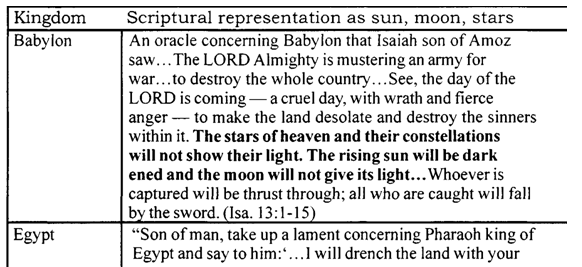
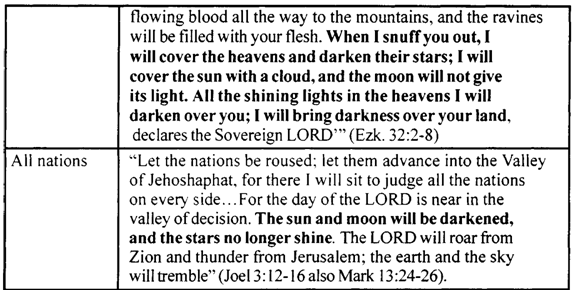
Table 1: Scriptural examples of governing bodies of men being described metaphorically as the astronomical bodies of sun, moon and stars
Clearly the Biblical language of sun, moon and stars is used to describe those in authority, reflecting the profound and graphic metaphor that began in Genesis 1, where the sun, moon and stars were created to rule day and night. The metaphor is deductive, because political authorities are similarly elevated above the majority of the people and govern the days and nights of those beneath them; therefore, prophecies likewise describe them as the heavenly bodies. Similarly, when judgement comes upon them, the Bible employs the metaphor of God dousing the lights of the heavens: acting to extinguish the ruling light they held.
The light to rule
With this necessary prologue in mind, read through John 7:1-34. The explicit focus of the text is the authority of Jesus: the authority by which he teaches and the authority by which he heals.
Jesus answered, “My teaching is not my own. It comes from him who sent me. If anyone chooses to do God’s will, he will find out whether my teaching comes from God or whether I speak on my own” (7:16-17).
“Stop judging by mere appearances, and make a right judgement” (7:24).
We see how John inseparably binds the component of “light” to the component of “judgement.” Again:
When Jesus spoke again to the people, he said, “I am the light of the world. Whoever follows me will never walk in darkness, but will have the light of life…You judge by human standards; I pass judgment on no one. But if I do judge, my decisions are right, because 1 am not alone. I stand with the Father, who sent me” (8:12-16).
Absolute authority
The common and mingled appearances of light and judgement are in good agreement with the model of John’s creation. But there is more. John now steps up a gear in presenting the authority of Jesus Christ. Read through John 10-11 (the story in chapter 9 is also central, but we defer it to the following article.)
“I am the good shepherd. The good shepherd lays down his life for the sheep…The reason my Father loves me is that I lay down my life — only to take it up again. No one takes it from me, but I lay it down of my own accord. I have authority to lay it down and authority to take it up again. This command I received from my Father” (10:11- 1 8).
The gospel writer shows us that Jesus has the power over his own life and death: a level of authority not matched by any other human in history. Further more, John goes on to demonstrate that this unique level of authority is not limited to Jesus’ own life, he also wields this ability (both the dynamic power and the authority) in the lives of others. It is therefore no longer surprising that the very next story is the resurrection of Lazarus, because it demonstrates beyond doubt the unique authority of Jesus Christ.
Jesus said to [Martha] “I am the resurrection and the life. He who believes in me will live, even though he dies; and whoever lives and believes in me will never die” (11:25-26).
Pay close attention to the implications of these statements, because there is a new component that emerges. It is an investment from God of absolute authority in His Son. The absolute nature of authority is a new component both in the history of man and in the gospel. Let us be sure that we understand this unique reality. Sometimes it is said that a ruler of ancient times, for example a Roman Emperor or an Egyptian Pharaoh, had “absolute power”; that they held the power of life and death over other humans in their hands. This statement is factually incorrect. The highest level of human power achievable (which these emperors and pharaohs held) was the power of death only. It is true that they had the authority to put any man to death at any moment their whim dictated, but this is not the power of life and death; it is only the power of death. The power to dispense death is the ceiling limit of human authority; humans cannot dispense life even if they want to. Absolute authority is the power to dispense either death to a living person or life to a dead person. This is why John proceeds to the miracle of the resurrection of Lazarus, firmly making the point that Jesus was the only human to hold this power.
Thus once again we find an excellence of the spiritual creation over the natural creation: the ultimate level of natural authority is the power to distribute death to the living, and the ultimate level of spiritual authority is the power to distribute life to the dead. As with other Days, so with the judgment of Day 4: we find only death at the natural level and life at the spiritual level. John makes this plain by relating this account of the ruling light in his full authority:
Jesus called in a loud voice, “Lazarus, come out!” The dead man came out, his hands and feet wrapped with strips of linen, and a cloth around his face. Jesus said to them, “Take off the grave clothes and let him go” (11:43-44).
And the man who was dead, under the authority of Jesus Christ, the ruling light, walks from the tomb.
The coming of the king
Chapter 12 shows the final, uppermost level of this authority: a throne. The Son of man enters Jerusalem for the first time, (though not the last), as King. This is absolute ruler ship in social terms: here comes the King. Read through John 12:12-50.
The next day the great crowd that had come for the Feast heard that Jesus was on his way to Jerusalem. They took palm branches and went out to meet him, shouting, “Hosanna!” “Blessed is he who comes in the name of the Lord!” “Blessed is the King of Israel!” (12:12-13).
The Bible presents for us — in characteristically juxtaposed fashion! the manner in which life will be realized by Jesus Christ: in his crucifixion. Ultimately the power of life will come through death. It is not just that the king must die, but that the king must die in order to become king.
“The hour has come for the Son of Man to be glorified. I tell you the truth, unless a kernel of wheat falls to the ground and dies, it remains only a single seed. But if it dies, it produces many seeds. The man who loves his life will lose it, while the man who hates his life in this world will keep it for eternal life” (12:23-25).
Here then is the glory of the Son of Man, the perfect fulfillment of God’s purpose and the ultimate evidence of His greatness: Jesus resigning himself to death, and thereby obtaining the absolute in authority. Light has victory over darkness, and darkness is judged: sin and the power of death are destroyed in the victory of the Son of man on the cross.
Judgement from the ruling light
It would be easy for the direction of the gospel to extend the idea of kingship forward into the kingdom of God, the Millennium, the restoration of the temple and suchlike in natural chronological procession. However, John demonstrates again the firm grounding of his gospel in the creation pattern. Therefore it is the elements of Day 4 — light and judgement — that dominate as Jesus rides into Jerusalem for his final, dreadful Passover. John writes of judgement (12:31), then of light (12:35-36), and finally of the two combined:
“I have come into the world as a light, so that no one who believes in me should stay in darkness. As for the person who hears my words but does not keep them, I do not judge him. For I did not come to judge the world, but to save it” (12:46-47).
It is interesting to understand how the judgement falls. The world is judged (12:31), but not by Christ (12:47). It is that the illumination of Christ (the light) causes the actions of the world to be seen, and it is these actions themselves that condemn the world. John takes care to explain this both generally, and in the specific case of the traitor Iscariot:
“What you are about to do, do quickly,” Jesus told him…As soon as Judas had taken the bread, he went out. And it was night (13:27, 30).
Notice the absence of judgement from the light, Jesus Christ. Jesus speaks no word of condemnation, no anger, no hatred. (This is an amazingly powerful exhortation to us in self-control, for Jesus is conversing with a man whom he knows is plotting to murder him!) But judgement does surely fall, and it falls from the actions of Judas himself: departing the house into the night. This understanding of how judgement falls — self-inflicted from the actions of the guilty — is not new: it has been this way from the beginning. The precedent murderer, Cain, is not condemned by God, he is condemned by the blood he himself has spilled:
The LORD said, “What have you done? Listen! Your brother’s blood cries out to me from the ground” (Gen. 4:10).
Council for the prosecution, for Cain and ourselves, comes from our own hand: it is solely ours to direct, to fuel and to conduct. The Lord Jesus does not and will not speak against us: indeed he has already acted, and continues to act, as our best possible defense. The same is true here in John 13. We notice the two details that define Judas’ actions: that he goes “out” of the house, and that “it was night.” The former we should remember in the context that it was Passover (13:1), and salvation is only found by remaining in the house (Exo. 12:22). With malice aforethought, Judas leaves the house where Jesus is (the spiritual house being more relevant than the physical) and walks out into the streets, where the angel of Passover awaits him.
Secondly, “it was night.” Judas departs from the light of the world (John 8:12) into the darkness. Be aware that we do not consider any of this for the purpose of condemning Judas ourselves: that is not our place, nor should it be our desire. Characters like Judas appear in scripture so that we may learn to despise the actions that they perform, and genuinely fear the consequences that such actions inevitably engender. But we must never create a mental divide between ourselves and the character in scripture who has stumbled, heaping condemnation upon one whom Jesus also desired to save. Only the constant reminder of the similarities between our behavior and these evil characters can enable our approach toward the Master in genuine humility, to obtain that new heart of which David spoke (Psalm 51). Nor does this just mean owning up to “socially acceptable” faults, such as a short-temper, hastiness, recklessness and the like. It necessarily includes our cognizant recognition of behavior from which we would be tempted to recoil and deny: Cain’s murderous hatred; Amnon’s twisted sexual lust; Absalom’s vanity and insatiable greed for power; the Pharisees’ unyielding pride and even Judas Iscariot’s cowardly and murderous betrayal of the one who loved him. A heinous catalogue, and yet one with which every human heart who would find salvation must associate. It is in the light of these thoughts that we consider Judas at the last supper. He has sat in presence of the light of the world, and being convinced of (and convicted by) his own mind, has departed into the darkness (13:30).
And for Judas, sadly, how dark that darkness was to prove.
 The Origin of the Organic World – Part One