
Jacob’s well: Time…
Jesus encounters the Samaritan woman at the well near Sychar (John 4:1-43). The time of day when the meeting occurred is specifically recorded – noon (4:6). This timing forms a stark contrast to the approach of Nicodemus, who came to Jesus at night (3:2).
Note the completeness of contrast between the two characters: Nicodemus is Jewish, male, and a member of the Sanhedrin council. The woman is Samaritan, female, and has previously had five husbands. The contrast is clear and exhortation: in all points the social superiority of Nicodemus over this woman is declared. Yet the gospel writer reverses that rank by noting that it was the Samaritan woman who approached Jesus in the light of the noonday sun, while Nicodemus, of much higher worldly rank, deemed it prudent to conduct his meeting with Jesus under clandestine cover of darkness. This seems symbolic of the Biblical theme of one of lowly status, from outside the covenant, eclipsing the “rightful” Jewish heirs with a more sincere and knowledgeable faith. (An exhortation point for ourselves is the fact that as “outsiders” so frequently showed superior faith to the Jews for centuries, we, who would claim to be the children of the living God and spiritual Jews today, should be given considerable pause for thought.)
…and Place
The site of Jacob’s well is also of particular significance. The Bible has introduced us to the context of Jacob being at a well just once before, Genesis 29:1-8. At first thought, the Genesis passage seems an innocuous conversation between shepherds – hardly necessary to record for the edification of later generations! Nevertheless, note the statement in which this conversation culminates. Jacob instructs the shepherds to water the sheep, and they answer:
“We can’t,” they replied, “until all the flocks are gathered and the stone has been rolled away from the mouth of the well. Then we will water the sheep” (Gen. 29:8).
An intriguing statement, not so much in the physical sense, where its explanation is obvious, but within its spiritual counterpart as Jesus sits atop Jacob’s well some centuries later. There are two stipulations to watering the sheep: that the “flocks are gathered,” and that the “stone is rolled away.”
Gathering the flock
Let us consider the first part, gathering the flocks. The Samaritans were hated by the Jews, partly for their Assyrian descent and partly because they had sided with the Seleucid Greeks fighting against the Jews in the recent Maccabean revolution. The rift was so entrenched that a Pharisee would not even use an article of crockery or cutlery that a Samaritan had used. The woman clearly refers to this in her statement: “For Jews do not associate with Samaritans” (4:9) – the word “associate” refers to a common sharing of articles or practices. How appropriate, therefore, that when the Good Shepherd comes to water his sheep, he sits down at Jacob’s well! That Jesus had come to unite the sheepfold, in healing the rift between Jews and Samaritans, and to extend it in bringing hope to the Gentiles, is evident from scripture (Jn. 10:16) and the meeting between the Son of God and the shunned Samaritan.
Rolling away the stone
The second stipulation for the flocks to be watered was that the stone must be rolled away (Gen. 29:8). We consider this in the light of the gentle refusal given by Jesus to the woman when she asks to receive the “living water” of which Jesus has spoken. Read John 4:15-18. The woman approaches Jesus for the living water, yet interestingly she is gently put off, and told to go and bring her husband. This seems a curious refusal by our Lord, and warrants our consideration.
For solution, once again we remind ourselves that we are at Jacob’s well, and thus we are primed to consider the words in Genesis. There was an obstruction impeding the progress of the sheep to the water – a stone – and the Shepherd was required to take that stone away. On the spiritual plane, the physical parallel is simple to translate: the impediment between the living water and ourselves is our sins; it has been that way since Eden. The Shepherd (Jn. 10:14) takes this impediment away by his crucifixion and resurrection (Heb. 2:14).
The spiritual world and the physical world intersect in the sign that they give to proclaim the risen Lord: an empty tomb, with the stone rolled away from its entrance (Matt. 28:2). It is therefore clear that the woman cannot yet receive the living water: the flocks have not yet been gathered (at that point, the Gentiles had not yet been included into the fold) and the stone had not yet been rolled away (Christ had not yet exited the open tomb, risen from the dead). Thus it is clear, at that point, none could yet drink the living water Jesus offers.
Waters above the divide
Read John 4:10-14. Consider the conversation in relation to both the physical choreography of this setting, and in relation to Day 2 of the Creation sequence. Day 2 in Genesis presents the scene where there are two bodies of water and a spatial divide between them: the living waters above the divide, and the earthly water beneath.
This conversation in John 4 also presents both living water and earthly water — and notice the setting: Jesus is sitting at the top of the well. Observe the cunning that the setting evidences: “ordinary” earthly water is at the bottom of the well, there is a spatial divide of air in the well shaft, and Jesus (the living water) is seated at the top of the well! The woman asks: “Where is this living water?” But we shouldn’t need to wait for Jesus to speak in response — John’s Creation has taught us where to see the answer in the geometrical arrangement of the conversation taking place!
Pertinent to this choreography is the question Jesus asks:
Jesus said to her, “Will you give me a drink?” (John 4:7).
This statement emphasises the Creation pattern by attractively contrasting which type of water can be supplied by the one person to the other. The woman (“he that is of the earth is earthly,” Jn. 3:31) can supply Jesus with the earthly water from the bottom of the well, whereas Jesus (“The one who comes from above is above all” ibid), sitting at the top of the well, can supply the living water from himself. Here is a perfect mirror of the separated waters of Creation’s second day. How carefully are these stories crafted within the Gospel of John!
There is one more essential point: the profound implication this pattern has on defining the nature of Jesus Christ himself. Day 2 graphically shows how the living water was originally drawn from the earthly (dead) water, and transformed by God to be in the elevated position. What an accurate description of the nature of Christ! – born of a woman as a mortal human man (Galatians 4:4) yet raised by God into a heavenly state where he could supply life for all men (Ephesians 2:6), and receive a name above every name in heaven and earth (Phil. 2:9-10). How beautifully these things are encapsulated in the choreographed setting at Jacob’s Well — a scene indeed resplendent with meaning!
‘Come’ and ‘Go’ in Scripture
There are yet deeper levels to explore in this exchange. The woman is explicitly sent away from Jesus. Jesus tells her:
“Go, call your husband and come back.” (Jn. 4:16).
We assume that Jesus does not say this in desire to meet the woman’s partner. She is dismissed from the presence of the Lord, at least temporarily, because there is a matter she needs to address before she can return. Jesus is gentle with her, yet the firmness is also unmistakable. If she continues her life in its present course, she is not, in spiritual terms, able to walk with the Lord.
It is educational to observe the broad trend of those who are told “Go” by the divine authority, especially when contrasted with those who are invited, “Come.” Table 1 shows an exhaustive listing of all those who are invited to “Come” (Greek: erchomai), by Jesus, as well as some contrasting examples of those who are told, “Go” (Greek: hupago).
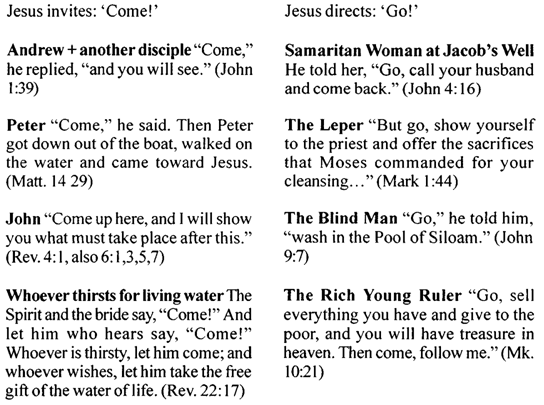
Table 1: A comparison of all those who are invited “Come’ in the New Testament scriptures, with a selective representation of those who are told “Go.”
We can be confident about any common theme we see running through the four cases of the word “come” because the list is exhaustive. In each of these cases, Jesus is addressing a brave, sincere and humble disciple, one who knows enough to come to Jesus, and also knows he has a lot more to learn. It is exhortational to observe that the invitation “Come” is not distributed from the Lord Jesus to anyone with any different attitude.
By contrast, those who are directed “Go” in Table 1 are generally associated with some state of imperfection. In the case of the leper and the blind man, the imperfection is strictly physical: they were the human equivalents to the offerings of the Mosaic Law that were not permitted inside the temple (Deut. 15:21). Under the covenant of Christ, these people escape both their disabilities and their exclusion. In front of Christ, all stand halt, blind and lame, and, subsequent to his touch, all can be healed and approach the presence of the King. This also applies in the other two cases: the rich young ruler and the Samaritan woman’s imperfections are spiritual – love of money and sexual promiscuity. This prevents them from being able to remain in the presence of Messiah, even though their afflictions are invisible to the human eye – very much unlike leprosy and blindness.
Appreciate how Jesus responds to all the above cases in exactly the same way: the dismissal is temporary. It is inherent in the text, either explicitly or implicitly, that Jesus desires the person who is told “Go” to ultimately return. But something is initially inhibiting each of these people from walking in Jesus’ company, so Jesus tells them, clearly but gently, go away, address the problem, and come back and share company with me.
“Come” and “Go” in discipleship
Lest we suspect this command is pointing at everyone except ourselves, we recall the directive of Christ toward us:
“Therefore, if you are offering your gift at the altar and there remember that your brother has something against you, leave your gift there in front of the altar. First go and be reconciled to your brother; then come and offer your gift” (Matt. 5:23-24).
We meet before the spiritual altar each Sunday to offer the sacrifice of our own humble and contrite spirit. The command is clear: if we have anything against any brother or sister we are to rectify that matter before we take bread and wine. This interpretation is clear and unambiguous, although sadly the practice is seldom, if ever, realised. Those who are told “Go” by Jesus (Table 1) are so instructed because there is a very real impediment between themselves and fellowship with their Lord which they absolutely must remove before they can receive the invitation “Come.” It must be equally obvious to us that, even though we may physically consume bread and wine, we will not share communion with Messiah until we have first healed any breach with any brother or sister with whom we are not fully loving siblings. Hopefully this reminder of who is told “Go” when they approach Jesus, and why, will provide the necessary impetus to make this command of reconciliation a living reality among God’s people.
Conclusions from Day 2
We have seen good evidence of Day 2 of Creation in this part of John’s Gospel. The stories use the vehicle of water with which to deliver their message (baptism, woman at the well, ruler’s son healed, impotent man at poolside — see part 1 last month); and the message itself is one of drawing up something life-giving from that which was not life-giving beneath. As with Day 1, we have also seen the superiority of the component of the spiritual creation over the corresponding component of the natural creation. The encounter at Jacob’s well shows that it requires many draughts of natural water to provide temporary life for a man, and yet a single draught of spiritual water from Jesus to provide eternal life. Spiritual water has excelled natural water.
The creation of the divide between things below and things above is also graphically seen. The pictures of healing in John 4 and 5 illustrate that earthly things are dead, and yet all have the chance to be drawn above the divide by God, to the living regime with Christ. This is the role of Day 2. Day 1, the Light (which translates as “understanding” in the spiritual creation — see Articles 4 & 5), enables us to appreciate the existence of this divide, and appreciate that our origin is with those “things beneath.” But for all the understanding (illumination) this brings, it does not transport us across the divide itself. We can only be transported to the realm of “things above” by receipt of the living water from Christ.
This is a particularly attractive picture, because to be “drawn above” we actually have to become part of the spiritual creation itself, (because the living waters are what are drawn up). To be part of a new creation necessarily implies that we must be “recreated” – reborn in the waters of baptism — in the life giving waters from Christ.
Finally, we observe that Day 2 necessarily follows Day 1. Day 2 does not precede Day 1, nor is it contemporary with Day 1. Hence baptism cannot precede understanding, nor does not it come alongside understanding. We are learning that John’s Creation also provides excellent direction for the footsteps of the disciple. Day 1 (Illumination) comes first: a discrete level of understanding must be reached before any useful baptism can be achieved. Day 2 follows: being drawn up to the presence of Jesus with the waters of baptism.
 The Origin of the Organic World – Part One