
We begin our excavations into the mystery of the structure of John’s gospel. We already know that John’s gospel differs greatly from the other three gospel records, who adhere to a more chronological form, like a diary. This difference is highlighted when comparing the parables and healing miracles (i.e. common and easily identifiable features of the Lord’s ministry) between the gospels. Two distinct facts distinguish John from the synoptic records. Firstly: parables and healing miracles are extremely rare features in John compared to Matthew, Mark and Luke. Secondly: there is no overlap whatsoever between such parables and miracles that do exist in John with any of the synoptic records. Since the Bible is the inspired word of God these differences cannot be inaccuracies and discrepancies — rather they have meaning. Thus we move on to explore why John’s gospel differs so much from the other three, and what those differences might teach us.
The Significance of the Difference of John’s Gospel
This task has particular importance because we recognise that John is a highly favoured disciple: we should not take the description of “that disciple whom Jesus loved” lightly by any means. Furthermore, we remember that John was the recipient of the apocalyptic vision (Revelation). John was deemed the apostle fit to receive the library of powerful visual prophecies in which is encoded the future purpose of God: the ultimate destruction of sin and death; the creation of New Jerusalem: and the whole means by which God would unite Himself with His creation. That John should receive this burden, and this privilege, is further evidence of his superlative standing in the spiritual understanding of the work of his, and indeed our, Master.
The spiritual ascendancy ot John is a very important thing to have determined, for it identifies the Gospel of John as an equally superlative spiritual testimony of the character and person of the Lord Jesus Christ. It is reasonable to suppose that such an intensely spiritual document will be imbued with levels beyond the surface text in which evidence of God’s hand can be perceived. It is further reasonable to suppose, since God is a God of order and not of chaos (I Cor. 14:33), that this evidence will be seen as an ordered structure or pattern. From this reasoning we conclude the likelihood that John’s gospel contains some pattern in which the reader, with careful study and prayer, might better see the hand of God in the witness John gives. With these thoughts we approach this gospel with additional caution — and additional excitement!
Finding a Pattern in John: Dos and Donts
One manner in which we shall not be attempting to find a pattern in John is by simply reading through the gospel and jotting down everything we deem to be significant. This would constitute a highly subjective process that would yield a pattern which revealed as much of the reader’s mind as the word of God before it. Worse yet, it is in general a scientifically demonstrable fact that the human mind is a habitual fabricator of patterns where none truly exists. It is a known reflex function of the human brain to create an ordered pattern, or a recognisable geometry, within a system where that pattern does not occur, and sometimes where there is simply no pattern at all. Obvious examples of this tenet are seen in the creatures perceived in inkblot patterns (e.g. the Rorschach test), or cloud formations, or the facility with which the brain detects the presence of a smiling human face from just two dots and a curve. Whilst this is bad news for our attempt to use our brains to deduce a pattern in John, all is not lost: we must just take care not to base any perceived pattern solely on the interpretation of the human mind. Rather we must ensure that we are always working from the literal text of the gospel.
Nevertheless, despite the potential pitfalls associated with the delicate science of pattern perception, there are also positive points to note. We know that our brains have been created by God, and therefore we should be able to recognise patterns within His word because we are patterned after Him (Gen. 1:26). More encouragingly than that, it is also true that God desires us to understand His word, and we have been promised that those who seek (in truth) shall find (Matt. 7:7).
We can now identify the next step of our excavations. If an overall pattern is indeed present in John what we will need to do is compile some form of summary of the gospel, in an objective a manner as we can, so that the big picture can be appraised. This then becomes our next task.
Summarising John’s Gospel: The Method
In the light of the above, we will create a summary of John’s gospel by reading it through and noting down the words that John decides to use most frequently. The results we will get from doing this have a good level of objectivity, because it is the gospel writer, gently compelled (there is no contradiction) by the divine hand, who has determined the frequency of the words which appear in the text. Then we will reconstruct the entire gospel by writing it out using only these ‘keywords’ that appear most frequently.
As a prerequisite task, we must first excise those words that are “un important” — necessarily a delicate task. We can be confident in dismissing all conjunctions, articles and pronouns from our study, for these will not bear the gospel message, even though they are the words most commonly appearing. Additionally we shall disregard the characters themselves: the Lord God, the Lord Jesus Christ, the apostles, the Pharisees, and non-specific references to characters such as “man” and “woman.” It is evident who the gospels are focusing on and why. We know that the focus of the gospel is on the Lord Jesus Christ, and that such a focus exists to glorify God, for the salvation of those men who will receive him, and the destruction of those men who will reject him. Having removed these words, we are left with simple nouns and verbs: these form the vehicle by which the message of the gospel is carried. This study will focus on the concrete nouns found in John in order to generate an objective summary of the gospel, (though that is not to say that the verbs and repeating phrases in John’s Gospel could not themselves form fascinating studies also).
Summarising John’s Gospel: The Result
The result of our study reveals the top four concrete nouns that are used in John’s gospel: light (25 occurrences), judge (24), water (24), bread (23). (These results were yielded from the KJV: their supremacy is corroborated in the original Greek.) We shall hereafter refer to these words as “keywords” of the Gospel of John. In addition we make a partially artificial inclusion of a fifth keyword: we include the Greek word stauros, which is translated as the English words “cross” and “crucify.” Admittedly this is not the fifth most commonly employed word in the gospel, it places in seventh position; nevertheless we include it because the crucifixion event is of central importance to the gospel message. It would seem to engender an error to compile any summary of a gospel in which the sacrifice of Christ’s crucifixion is not included, and therefore we shall include it. So we have five keywords: Water, Bread, Light, Judge and Cross, with which to construct our summary.
Constructing the summary itself is now extremely easy. We write out the entire gospel from start to finish in order, and omit every word except the five keywords. The result is shown in Table 1, including the references from which each word is taken to provide a way to assess how comprehensively the gospel has been covered.
The summary we have compiled may seem featureless and illegible, but we take encouragement in its relatively high level of objectivity. It is this most raw of forms that we shall work with, hoping the message of the gospel to crystalline most accurately before our eyes now that we have minimized the distorting influence of the attendant mind.
Summarising John’s Gospel: Graphical Representation
To address the problem of the illegibility of the summary, we will use a graph in place of words, and thus supply ourselves with an accessible “picture” (literally) of our summarised content of John. We shall replace each word in Table 1 with a block of a chosen tone, using a single tone for each keyword to give us a bar of tones reflecting the keyword sequence. The result is shown in Figure I. Alongside the summary bar is an approximate positioning of chapter numbers, purely for clarity and perspective.
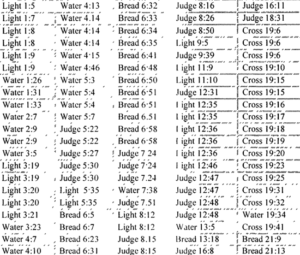
Table 1: The Gospel of John (KJV) in order using just 5 keywords: Light, Water, Bread, Judge and Cross.
As a final point, we note that the period after the crucifixion when Jesus was resurrected (chs. 20-21) is poorly represented: with just two mentions of the word “bread;” themselves somewhat non-central to the contextual argument (Table 1). Thus we add the comment that Jesus is raised. Without this we would have represented the Gospel of John as finishing with the thought that Jesus is dead. This would be a terrible misrepresentation of any gospel for it would hardly constitute good news to communicate an account in which Jesus our Saviour finished dead! It is arguably the central point of the gospel that Jesus finishes alive, and remains alive at the right hand of his Father to this day: indeed it is a belief around which all our hopes congregate.
So we have concluded our opening task, and created a summary of John. Of principal importance to note is the fact that there is an objective backbone to this summary: the keywords reflect to a large extent the frequency with which John himself chose to use them. Thus we have not relied upon a subjective “impression” of the Gospel of John, or what it “felt like to us” when we read through it. This is of chief importance, since it gives us the best chance of seeing what pattern has been put there by the Hand of God.
Our next task, therefore, is to deduce exactly what that might be.
 The Origin of the Organic World – Part One