
Day 3 is the day of food and nourishment, the provision of all things by which living animals, including man, will feed. It is the day of bread, and from this we form our basic premise.
Basic premise for Day 3
We anticipate seeing Christ in the manner of one who feeds and sustains God’s children, and the gospel message being carried through the metaphor of bread. How fitting it is that we immediately encounter the miracle of the feeding of the 5,000! We see Jesus as the provider to the hungry mouths who follow him, both in the physical and the spiritual sense.
Day 3: beyond the water
After these things Jesus went over the sea of Galilee, which is the sea of Tiberias (John 6:1).
What a perfect bridge from Day 2 to Day 3! Leaving the water behind, we move on to consider the bread from heaven. This statement also has profound effect on the narrative to follow (even though it seems an innocuous introductory verse), because it states clearly that all those who were to share the bread from heaven with Jesus that day had first to cross a body of water. In the spiritual creation, that principle is equally true: sharing the communion bread together, both for the disciples then and ourselves now, takes place on the other bank from where we began our lives: beyond the waters of baptism.
Passover — whose Passover?
The Jewish Passover feast was near (John 6:4).
This is another detail hidden in the text: one so small as to be easily missed, and seemingly quite incidental to the narrative. Automatically therefore, our curiosity should be aroused: we are familiar enough with the Gospel of John to know that each detail is carefully measured and inserted as part of the pattern that John is constructing.
The central focus of Passover is the Lamb. The Gospel of John has taken particular care to introduce Jesus as the Lamb of God; stating the fact twice in the opening chapter (John 1:29, 36). Passover is the time when the children of God should be seeking a lamb (without blemish) to shrive them from their sins (to provide a basis for God sparing them from death). Doubtless John has therefore included this detail to show that this is the exact time of year that Israel should be seeking the Lamb. We can deduce from this, therefore, that the multitudes who follow Jesus have done the right thing, because they have assembled around the Lamb at Passover. We can anticipate that this (perhaps unwitting) decision will lead to a blessing for them — and indeed it does.
We notice also the particular form of reference given by John to Passover, and the subtle difference this has from the Old Testament description. Observe that John refers to Passover as “the Jewish Passover,” and not “the Lord’s Passover” that one finds in the Old Testament. This is not a singular difference; we need to be clear on how sharp the divide is between Old and New Testament descriptions. Where reference to “ownership” of the Passover is made, it always is said to belong to God in the Old Testament and it always is said to belong to the Jews in the Gospel of John: there are no exceptions (Table 1).
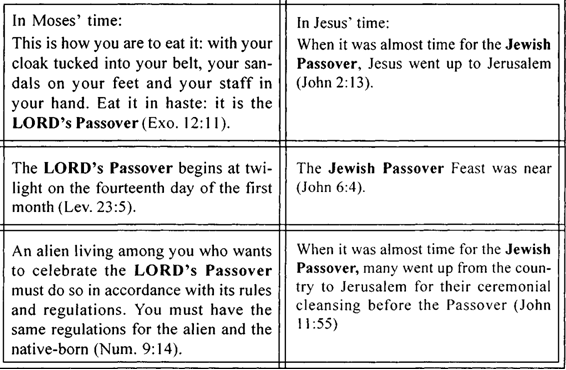
Table 1: Whose Passover? Representative texts from Moses’ day
and Jesus’ day declaring to whom the Passover meal “belonged”.
The transition is absolute, and thus this seems a genuine message of how the Jews had turned away from God within the celebration of Passover. By the time of Jesus Christ, the celebration of Passover is devoid of any recognition of salvation from the omnipotent Creator. It is still an important feast day, but only because it is exclusive to the Jewish culture. In terms of a memorial to God, Passover is bereft of spiritual power: as empty as the water jars at Cana.
Philip: overwhelmed at the task
When Jesus looked up and saw a great crowd coming toward him, he said to Philip, “Where shall we buy bread for these people to eat?”
He asked this only to test him, for he already had in mind what he was going to do. Philip answered him, “Eight months’ wages would not buy enough bread for each one to have a bite!” (John 6:5-7).
The impression from the text implies that the answer Philip gives, though doubtless true in itself, was not what Jesus was hoping for. But what was Philip supposed to say? Just how explicitly was Philip expected to have the solution to providing food for this multitude?
We can never be sure of what would have, could have, or should have, been and on many occasions it is fruitless to speculate. Nevertheless here we gain insight from considering what the Lord required. We do not suppose that Jesus is expecting Philip to have the logistical solution to how these 5000 men and their families will be fed, but that this “test” pertains more to the bigger picture of his discipleship. In this situation, here on the mountainside (physically) and throughout the rest of Philip’s life (spiritually) there will be two types of people: those who provide food, (although always from the hand of God) and those who need to be fed. We suppose that what Jesus is trying to provoke from Philip is recognition both of that divide; and of the side to which he belongs.
Does Philip yet recognize that, as one of the twelve, he is going to be required to supply the needs of others, rather than to be just another hungry mouth himself’? That he is not to be someone who leans on others, but someone others will lean upon? We suspect it is this recognition for which Jesus gently probes: that the twelve should be looking to themselves to play a leadership role in feeding those who are hungry; while leaning upon their Heavenly Father as the ultimate provider. (We know that ultimately this is to be their role; Jesus commissions them in exactly this way when speaking to Peter: “Feed my sheep” John 21:15,16,17.) But at this stage it seems Philip has not yet grasped the fact that being a provider is an important function of his discipleship and emulation of his Lord.
Andrew: A humble submission of effort
The Gospel record sets Andrew in sharp counterpoint to Philip. Andrew says:
Here is a boy with five small barley loaves and two small fish, but how far will they go among so many? (John 6:9).
Andrew is aware of the realism of the situation: his offering is pathetically small — but he makes the offering anyway. How exhortation is Jesus’ response to Andrew: he takes the tiny provision that Andrew has found and uses it as the very basis of the miraculous provision! What an excellent metaphor this forms for the gifts that we have to bring before our Father! At all times all that we have to offer is as five loaves and two small fish to feed a multitude. But notice how Andrew’s offering is neither mocked nor even dismissed by the Lord for its inadequacy. Rather it is taken by Jesus and used as the basis for the miracle of provision from the hand of God. It is not that God required such an offering from which to work, but it is manifestly apparent that God desires us to make such offerings in His service, and the miracles He provides (as on this occasion) often utilise those things that we bring to Him, to encourage us in being fruitful toward Him (John 15:2). There is much exhortation in the contrast of Philip and Andrew’s response.
Bread from heaven
Jesus said, “Have the people sit down.” There was plenty of grass in that place, and the men sat down, about five thousand of them. Jesus then took the loaves, gave thanks, and distributed to those who were seated as much as they wanted. He did the same with the fish (John 6:10-11).
Five thousand men, plus women and children, are fed from the five loaves and two small fishes by the miraculous provision of the hand of God. There is nothing we can add to such an incredible act; we can only be still and marvel, and perhaps that is the best response. This miracle is also an able reminder of the fragility of the human condition: a simple journey into a wilderness place realises an environment in which we are helpless. Yet this is precisely the environment in which the natural pride we bear, when we wallow in the illusion of self-sufficiency, can be swept aside. Here their (our) total dependency on the Father was convincingly demonstrated. It is a clear repeat of the Egyptian Exodus where Israel was provided with bread from heaven — again in the wilderness, and again for precisely that reason.
He humbled you, causing you to hunger and then feeding you with manna, which neither you nor your fathers had known, to teach you that man does not live on bread alone but on every word that comes from the mouth of the LORD (Deut. 8:3).
What was performed in the wilderness of Paran in Moses’ day has been repeated, and superseded, by the events performed on the mountain side by the Lord Jesus Christ. Manna was provided in the wilderness, a small, sweet, bread-like flake formed in the dew on the ground, and a meal of bread and fish have been provided for these Israelites blessed to be contemporaries of God’s Son.
Bread of heaven
Yet this parallel between the events of the Old Testament and the New is not the most important: the parallel between the physical and the spiritual exceeds it. Jesus has performed a physical miracle on the mountainside, yet he supersedes even that by repeating the miracle — on the spiritual plane. For those who marvelled at the physical bread from heaven, they must prepare themselves for all-out astonishment at the declarations that follow, as Jesus elevates the level of teaching and reveals to them the true bread from heaven.
The revelation of bread from heaven is born from the physical chrysalis of the feeding of the 5,000 into the spiritual beauty of the Lord Jesus Christ himself.
Jesus said to them, “I tell you the truth, it is not Moses who has given you the bread from heaven, but it is my Father who gives you the true bread from heaven… I am the living bread that came down from heaven. If anyone eats of this bread, he will live forever. This bread is my flesh, which I will give for the life of the world” (John 6:32,51).
This is the second miracle, and yet also the first miracle, only elevated to the spiritual plane. As we have seen many times before, (in Day 1 for example), the second excels the first, because the Bible shows us that the second (be it a son, or a covenant, or the birth of an individual, or even this bread from heaven,) contains life, whereas the former contains only mortality. Note how that contrast of death in the former and life in the latter is explicitly detailed here, too.
“Your forefathers ate the manna in the desert, yet they died. But here is the bread that comes down from heaven, which a man may eat and not die” (John 6:49-50).
Times and seasons
There is one more way in which the spiritual bread in John’s creation excels the bread from natural creation’s third day: in the manner of its availability. The Bible emphasises the well-known fact of nature that physical fruits are only available at certain times and seasons. We recall the time when Jesus approached the fig tree, apparently looking for figs: “Seeing in the distance a fig tree in leaf, he went to find out if it had any fruit. When he reached it, he found nothing but leaves, because it was not the season for figs” (Mark 11:13)
Even the provision of manna, the former bread from heaven, was only available to the children of Israel for a finite period of time: the morning hours before the sun grew hot. This fact is announced explicitly to Israel and preserved in the Bible for us to learn from. “Each morning everyone gathered as much [manna] as he needed, and when the sun grew hot, it melted away” (Exo. 16:21).
Always the lesson is the same: there is goodness provided in the natural bread, but it is only available at a certain time, in a certain place, during a certain season. Contrast this with the provision of the spiritual bread from heaven:
Then Jesus declared, “I am the bread of life. He who comes to me will never go hungry, and he who believes in me will never be thirsty… and whoever comes to me I will never drive away” (John 6:35,37).
Notice the permanence of the availability: the spiritual bread of John’s Day 3 constantly flourishes in life-giving food! This is metaphor, of course, but these abstract philosophical principles translate to the physical world in a tangible way. Sustenance from Christ comes in many forms: in prayer initiated by us, and in direct blessing from the hand of God in our lives. Both of these very real facets of spiritual bread are unconstrained in time and season. We can always approach our Heavenly Father and the Lord Jesus in prayer, to obtain either the education of meditation, the catharsis of confession and/or the compelling strength of the realisation of One who truly hears, and answers. Similarly the myriad blessings that rain down from heaven upon us, most of which doubtless escape our inattentive senses, are equally distributed at all times and seasons.
We are indeed blessed with every sufficiency.
 The Origin of the Organic World – Part One