
Careers through the ages
Managing jobs and careers is a major challenge for any marriage in the modern world. From the time the New Testament was written till the period when the Christadelphian pioneer brethren wrote, the workplace environment had hardly changed. While it is difficult to get precise figures for the types of jobs and careers people pursued in Biblical lands in the first century A.D. most guesstimates presume that somewhere around 90% of the population were involved in agriculture and the remainder were in trade professions, or worked as government servants for their Roman masters, or served in the Legions. The Apostle Paul was a tentmaker as were his compatriots Priscilla and Aquila. Our Lord Jesus was a carpenter; Peter, Andrew, James and John were fishermen (and possibly also Philip); Matthew was in effect a Roman civil servant and Lydia in the luxury clothing business.1In a preindustrial agricultural and craft society husbands and wives, as well as their children, usually formed a self-contained economic unit. Women worked alongside their fathers, or later their husbands, and had work skills commensurate with careers that were fashioned by that milieu. Priscilla and Aquila worked side by side in their tent making profession. Jesus’ craft he no doubt learned from working as an apprentice to Joseph, also a carpenter. The lessons learned as a carpenter were well remembered in some of Jesus’ parables e.g. the mote and the beam, and the necessity for building a house on a firm foundation. Dorcas was a seamstress and I suggest, consistent with 1st century culture, that it was a profession she probably practiced with her husband and continued doing so after becoming a widow.2The nature of the workplace didn’t change very much over the next 1800 years and I am familiar with this personally. My maternal grandfather and grandmother worked together in their own tailor shop throughout the 1930’s during the Great Depression and my grandfather subsequently taught my mother how to be a seamstress. The change from primarily an ancient long-standing agricultural to an industrial society has tracked almost parallel to the lifetime so far of our own Christadelphian movement. The Table below illustrates the enormous change in the work environment from 1790 to the beginning of the 21st century.3This vast change has important implications on the marriage relationship and has created challenging issues for husbands and wives that never could have been envisaged by earlier generations of Christadelphians. Perhaps only in the Amish community has the strain of the modern workplace changes, and their challenges upon the marriage relationship, been avoided.
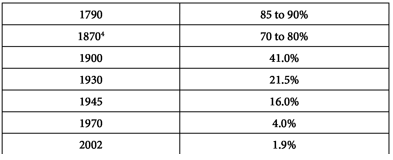
The modern workplace
What specific challenges does the modern workplace put upon us? Many social commentators have indicated that the United States, and most other nations comprising what was formerly known as industrial societies, have actually entered a new economic phase dubbed the “post-industrial” age. In this new economic world jobs in manufacturing, agriculture, or crafts will provide severely limited chances for employment and what will matter instead will be information, creativity and technical skills. To prepare oneself for this new paradigm it is important for one to acquire as much education as one is capable of handling. I know that in my parents’ generation (pre-1940s) if you didn’t have a high school diploma your chances of gainful employment were greatly diminished, but if one was willing to work hard there were still a number of reasonable decently paying unskilled and semi-skilled factory jobs available. Post 1950s the need for at least a college bachelor’s degree became more and more the bottom line for having a chance at a lifelong gainful career. The number of college graduates in the United States in the year 2003 was 40,621,000, a 40% increase over the previous decade and this number continues to rise.4This is a number that amounts to greater than 25.6% of the adult population compared with 2.7% of that population segment in 1910.5These figures do not include those graduating from Community Colleges or other post-high school training programs.
Now it is entirely possible that some in our community still may be able to pursue work on the family farm, or in a family business, or be so clever they don’t need a college education to survive in the post-industrial society. After all some of our most successful business men in America, including the founders of Microsoft and Facebook, never graduated from college, but they are the exception not the rule. Too many marriages have floundered on the rocks of financial instability. Furthermore, if something unfortunate happens in a marriage, which causes one partner to exit the relationship, be it by divorce or sadly by death; if the remaining partner has no employable job skills the result can only be disastrous.
In entering a marriage it is important that both partners recognize the need for financial stability and this can only be achieved if both have a mature approach to what it takes to accomplish this goal. The words of Solomon provide us practical advice: “The sluggard does not plow in the autumn; he will seek at harvest and have nothing” (Prov 20:4 ESV). And also: “The plans of the diligent lead surely to abundance, but everyone who is hasty comes only to poverty” (Prov 21:5 ESV). The exhortation here is that planning for the future is something that the Word of God wants us to do. If one is to enter into the responsibilities of a marriage, and be further blessed perhaps with children, then one owes it to those in our care to be able to support them. There have been times in our community that some have felt that prophetic fulfillment was so clear that the second coming Lord Jesus eminent, and therefore there was no need to pursue an education or a career because soon enough we would be in the kingdom. I well remember that when I was preparing to go to college in the mid-1950s that the long yearned for establishment of the State of Israel, as an independent nation, had occurred only a few years earlier and this had created much eager anticipation that the Kingdom was near at hand. Several brethren advised me that I was perhaps wasting my time going to college: that it would only detract from my potential time to serve the Lord in those last days. Fortunately, my parents did not share this view; instead they encouraged me to get as much training as possible, being aware that we know neither the day nor the hour that the Lord will come.6Therefore, “Engage in business until I come”.7Furthermore, if I hadn’t obtained at least some further education beyond High School, I am certain no one would want to read anything written in the manner that I wrote when I was 17 years old!
In planning a job career it is essential that one have a passion in life to do something specific, and do it well, whether it is to be an artist, a salesmen, a professional, automobile mechanic, or whatever.8 Generally, if one is dedicated to doing something, one will be willing to do the hard work to do it admirably and undoubtedly success will follow. Solomon tells us: “Hard work always pays off; mere talk puts no bread on the table” (Prov 14:23 The MSG). If one finds that a prospective spouse is lazy, unfocused and unwilling to dedicate themselves to accomplishing sometimes even unpleasant tasks — that type of person is a risk to marry, period. These days one cannot guarantee lifetime employment in almost any company. Who would have thought that some of the largest most successful corporations in the world would go bankrupt in the 21st century. The first job I had out of college was with a long established utility company, which no longer even exists, and the research laboratory buildings and grounds where I worked were sold for real estate development a long time ago. This is one compelling reason, among others, that it is wise if both partners in a marriage have trained for some marketable job skills. My Dad was frequently out of work and if it hadn’t been for my mother’s skills as a seamstress, that put food on the table, we would have been street people, or even worse had to move in with relatives!
There is a caveat here that needs to be mentioned. Precisely because we do not know the day or hour of our Lord’s return, nor the hour of our own demise (which in effect is the instant of the Lord’s return for the departed individual) it is incumbent upon us not to neglect the work of the Lord at any stage of our lives. We should not sacrifice Christ on the altar of striving for material success. It is entirely possible to take the attitude “ I am too busy trying to obtain an education to have time right now to do any service for the Lord”. This can unfortunately include neglecting to attend Bible classes and Memorial services. As life goes on this attitude can carry over to behavior, which says, “sorry, I have to develop my career first”. This leads to the excuse that “my boss demands my time and I need to dedicate myself to moving up the career ladder”, only to find as one moves up the ladder employment demands swallow more and more of one’s time squeezing out the Truth. Finally in the twilight of one’s lifetime one can take the view that you are too old to contribute much to the Ecclesia, and must leave it all to the younger generation. Thus, one can fritter away a whole lifetime being on the fringes of Ecclesial service, or doing it in such a shabby fashion that we are not giving it the time and energy it deserves or sadly, even neglecting it entirely. Balance is an important attribute in life and if one follows the destructive path I just outlined it would be terrible example indeed to set for our children, and often puts an extreme emotional burden on the other spouse. In a marriage one needs not only to provide for the material wellbeing of our spouse and children (if so blessed), but also for their spiritual welfare as well.
Paul’s letter to the Thessalonians (2 Thess 3:6-12) provides us some insight into how the apostle viewed the role of work in the life of Christian. In fact he puts his exhortation in the form of a command and not a mere suggestion: “..Keep away from any brother who is walking in idleness and not in accord with the tradition that you received from” (v. 6 ESV). By tradition he meant his own example that he set for them while in their company: “..you ought to imitate us, because we were not idle when we were with you, nor did we eat anyone’s bread without paying for it, but with toil and labor we worked night and day, that we might not be a burden to any of you” (v. 7, 8 ESV). Finally, the apostle puts the command quite bluntly: “..If anyone is not willing to work, let him not eat” (v. 10 ESV).
This points out another obligation of a married couple, and that is the obligation to support the ecclesial family,and not be supported by it. There may be indeed times when interim welfare is needed to get a family by a difficult personal situation, but none should enter into a marriage (or be in a marriage) thinking they automatically can call upon the ecclesia to satisfy their material desires. The ecclesia is a community linked together by a common faith and hope, but not necessarily by uniform financial and social resources.
This has ever been the case, in the first century ecclesias had “Masters” and “slaves” as members of the same congregation (Cp. Philemon).9Members of Caesar’s household shared communion with brothers and sisters who were mere plebeians. Correspondently, in the household of faith we have members of every social and economic segment being part of the same shared communion. The ecclesia is not a social country club that restricts membership based on worldly social standards. But this diversity of social, economic and education demography makes it all too easy for a young married couple to look at what others have in terms of material comforts, that perhaps may have taken them a lifetime of hard work to achieve, and expect the same as it were, instantly. Thus placing economic demands upon the martial partnership that can lead to economic ruin and put the marriage in jeopardy of dissolution.
The antidote to the dilemma of needing to provide for our families, while at the same time being content to live within the limits of what a couple is individually capable of achieving, are spelled out by the wisdom of Jesus Christ. “Therefore I tell you, do not be anxious about your life, what you will eat or what you will drink, nor about your body, what you will put on. Is not life more than food, and the body more than clothing? …Therefore do not be anxious, saying, ‘What shall we eat?’ or ‘What shall we drink?’ or ‘What shall we wear?’ For the Gentiles seek after all these things, and your heavenly Father knows that you need them all. But seek first the kingdom of God and his righteousness, and all these things will be added to you” (Matt 6:25-33 ESV).
- Lydia (see Acts 16:14) “a seller of purple”. Rome, Egypt, and Persia all used purple as the imperial standard. Purple dyes were rare and expensive; only the rich had access to them. The purple colorants used came from different sources, most from the dye extraction from fish or insects…. It took some 12,000 shellfish to extract 1.5 grams of the pure dye. Cited from: http://pffc-online.com/mag/1348-paper-history-shellfish-royalty
- A fairly complete list of the various occupations mentioned in the Bible can be found at the website: http://www.sundayschoolresources.com/jobsinthebible.htm
- Data taken from the “Economic Research Service”, United States Department of Agriculture. Interestingly data for 2007 from the United Nations shows approximately 1.9% of the population of the United Kingdom workforce was involved in agriculture and only slightly higher figures applied for France, Germany and Italy.
- Data from the National Science Foundation.
- Data taken from: Digest of Education Statistics, 2001 published by the National Center for Education Statistics.
- Op.Matt 24:42-50
- Luke 19:13 ESV — the AV says “occupy till I come” — the whole parable here is instructive.
- The Bureau of Labor Statistics (see www.bls.gov) website has all sorts of relevant information on Job prospects and occupational outlooks for the coming years in the United States economy. A valuable information source for someone seeking to plan a career or change career direction.
- And such was the case in the Christadelphian movement before the American Civil War.
 The Origin of the Organic World – Part One