
Faith works. Faith moves people to do Godly things that they would not otherwise do; often things they could not do without it.
“By faith Abel offered to God a more acceptable sacrifice than Cain. … By faith Noah, being warned by God concerning events as yet unseen, in reverent fear constructed an ark for the saving of his household. … By faith Abraham obeyed when he was called to go out to a place that he was to receive as an inheritance” (Heb 11:4, 7, 8). (All references are from the ESV)
Faith also keeps people from doing things that ought not to be done.
“By faith Moses, when he was grown up, refused to be called the son of Pharaoh’s daughter, choosing rather to be mistreated with the people of God than to enjoy the fleeting pleasures of sin” (Heb 11:24-25)
Hebrews 11 is a testimony to the fact that faith works.
Of course, there is another side to this story. Unbelief has its works, too. It leaves people vulnerable to doing things that they ought not to do, and it keeps them from doing things that ought to be done. Unbelief keeps men and women from living up to their potential as beings created in the image of God.
Our children need to begin finding their way through this world of faith and unbelief, and Sunday school provides some wonderful opportunities for us to help them do it. The Bible stories that we tell the children often revolve around the lives of people; good, bad, faithful and unfaithful. The details are presented as God knows them, so there is plenty in these stories for us to learn from — and teach — about life.
Lessons of life
People have not changed since Bible times, and the needs of people have not changed. People still need to grow spiritually and they still need salvation. The Bible shows how God meets these needs in the lives of responsive individuals. The process is a dynamic one and it involves the participation of those who are being saved.
When we read about men, women, and children in the Bible, it is not difficult to see how God wanted them to live. We can take the details of their lives, learn from them, and create lessons of life for our Sunday school children. Just as we all participate in the process of living, the lessons of life that we create for our children need to involve their participation. Lessons of life are active lessons, not passive ones.
Consider, for example, a few details in the life of the apostle Paul. Then begin thinking about the life lessons you might build around these for your children.
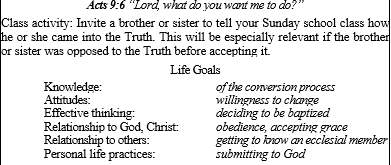
- “Lord, what do you want me to do?” (Acts 9:6). This is a timeless question! What did the Lord want Saul to do? How did Saul respond? What compelled Saul to change his entire outlook on life? How does Saul apply to us today?
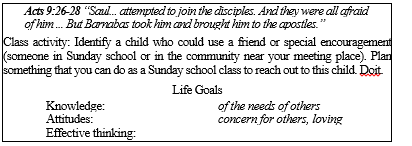
- “Saul … attempted to join the disciples. And they were all afraid of him. … But Barnabas took him and brought him to the apostles” (Acts 9:26-28). Thank God for Barnabas! He was willing to stick his neck out and give a questionable man a chance. What lessons are here for us and our children? Do the children know anyone who needs a friend to come along side and help him or her become accepted?
- “So the disciples determined, everyone according to his ability, to send relief to the brethren” (Acts 11:29). This hardly needs comment. What do our children know about the needs of brothers and sisters and young people in other parts of the world? And once they know some of these needs, what do they think they can do to help?
- “Then after fasting and praying they laid their hands on them and sent them off” (Acts 13:3). Thus Paul’s missionary journeys began. What do our children know about the journeys of Christadelphian Bible missionaries? What kinds of life practices are implied in “fasting and praying” for our missionaries?
- “Sergius Paulus, a prudent man … called for Barnabas and Saul, and desired to hear the word of God” (Acts 13:7). What is God’s definition of a prudent man? It is not difficult to figure out, so let’s get prudent! How do we start?
- “But Elymas the sorcerer withstood them, seeking to turn away the deputy from the faith. …”And now, behold, the hand of the Lord is upon you, and you will be blind and unable to see the sun for a time” (Acts 13:8-11). Who or what are the modern-day sorcerers that our children face in the world of unbelief? Let them provide the answers to this question. How can they render blind these enemies of the truth?
- “But they … went to Iconium. And the disciples were filled with joy and with the Holy Spirit” (Acts 13:51-52). What joy can our Sunday school children bring to other believers or to other Christadelphian Sunday school children? Let them come up with the answers … and then do something.
- “The gods are come down to us in the likeness of men … and (they) would have done sacrifice” (Acts 14:11-13). What honors does the modern world render to superstition? Is there a reason why newspapers publish daily horoscopes but not daily Bible passages? What signs can our children see that the world still worships other gods? Where do believers stand in regard to these things?
- “They rehearsed all that God had done with them” (Acts 14:27). Brothers and sisters, the world over, still do this kind of thing when they come back from the mission field. The Bible Missionary magazine is full of their reports. What do our Sunday school children know about the Christadelphian Bible Mission? Are they aware that God is still at work with those who venture to serve Him?
- “… no small dissension and disputation … much disputing … the contention was so sharp between them” (Acts 15:2, 7, 39). And this amongst brethren! Do our children know any Biblical principles of conflict resolution? How can they apply these principles to their own quarrels? This would be a great place to introduce a case study on conflict resolution, one that speaks directly to the age level of the children.
We could keep going. The Bible is packed with details like these that pertain to life and human conduct. The scope that it gives us for creating lessons of life for our children has almost no bounds.
Life Application activities on the web
The Tidings Committee is in the process of creating a Sunday school link on its website (http://www.tidings.org/). Life application activities will be posted there for anyone to read, download, use or adapt. As with all the Sunday school resources we plan to post, God willing, life application activities will be organized and accessible by Scripture, Subject, and Learning Level.
Life application activities will also be referenced to the life goals – the Transformation Goals – that have been proposed in this series on “What’s the Goal?” We hope that this will be helpful for Sunday school teachers.
Let’s conclude by looking at two of the many life application activities being prepared for posting on the Tidings website. The first example will be accessed from a menu entry that reads: Scripture — Acts 9:6; Subject — Conversion; Learning Level — Preteens, Teens.
The second example will be accessed from a menu entry that reads: Scripture — Acts 9:26-28; Subject — Fellowship, Friendship; Learning Level — All levels.

 The Origin of the Organic World – Part One