
God’s truth is revealed truth. To learn it is to be informed by God. It is also to be transformed by Him. This is what life is about, and it is what God has sent His word to accomplish in us. Learning God’s truth is cultivating godliness in mind and manners.
In keeping with this, a set of information goals for Sunday school teaching was defined in last month’s article.1 Our children need to learn about Bible contents, God, Christ, man, the ecclesia, doctrine, and God’s commandments.2
The acquisition of Bible knowledge changes our children. As they learn the revealed things of God, they are never exactly the same again. But knowledge by itself is not everything. What our Sunday school children do with the knowledge they acquire determines how they develop in the likeness of God.
“The fear of the LORD is the beginning of wisdom; all those who practice it have a good understanding. His praise endures forever!” (Psa 111:10)3.
Letting God’s truth live in us is vital. In keeping with this, we also identified a set of transformation goals for Sunday schooling.1Starting with the acquisition of Bible knowledge, we look for our children to make positive changes along all of these lines: Knowledge, attitudes, effective thinking, relationship with God and Christ, relationship with others, and personal life practices.2
Focusing on Sunday school goals
By themselves the two lists of goals are pretty academic. As Sunday school teachers we can easily give assent to them and move on, all but ignoring them under the constant pressure of getting lessons ready every week. It is helpful, I believe, to place the two sets of goals against each other and get into the habit of thinking how they relate to each other. A two-dimensional array — the educational goal grid — encourages this kind of thinking. It also helps us identify essential things to build into our lessons.
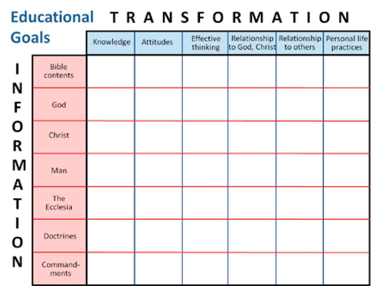
Every blank space on the goal grid invites us to ask how an information goal impacts on a transformation goal. How, for example, does our knowledge of Christ affect our attitude toward him and toward others? How should it change the way we think and make decisions? How should our knowledge of Christ also affect our relationship with God and our relationship with others around us? How should it change our private and public lives?
In other words, how should our knowledge of Christ change us as persons? And are we willing to change? Transfiguration is an essential aspect of salvation.
It is not just Sunday school teachers that need to think about questions like these. The children also need to think about them. They need to learn what to do with the information they are taught in Sunday school. And they need to begin identifying the opportunities they have in life to put the lessons into practice.
Framing goal-based questions
Take a good look at the questions that we ask our children in any Sunday school lesson. How many of them are information questions; simple matters of recall, perhaps requiring the child to restate what he or she has been told? These are important questions. Properly framed, the answers can tell us whether or not a foundation of knowledge has been laid. But we must not assume because a foundation is in place that the house will build itself. We need to ask transformation questions as well.
Transformation questions are different from information questions, so this point needs to be developed more fully. To do this, it will be helpful to work within the framework of a Sunday school lesson.
Feeding the 5,000.
We will take Christ’s feeding of the 5,000 as the Sunday school lesson, and choose knowledge of Christ as the primary information goal for our children. Beyond this, we will build on the children’s knowledge of Christ and take them into areas of personal transformation. Let’s start with the story.
“The apostles returned to Jesus and told him all that they had done and taught. And he said to them, ‘Come away by yourselves to a desolate place and rest a while.’ For many were coming and going, and they had no leisure even to eat. And they went away in the boat to a desolate place by themselves. Now many saw them going and recognized them, and they ran there on foot from all the towns and got there ahead of them. When he went ashore he saw a great crowd, and he had compassion on them, because they were like sheep without a shepherd. And he began to teach them many things.And when it grew late, his disciples came to him and said, ‘This is a desolate place, and the hour is now late. Send them away to go into the surrounding countryside and villages and buy themselves something to eat.’ But he answered them, ‘You give them something to eat.’ And they said to him, ‘Shall we go and buy two hundred denarii worth of bread and give it to them to eat?’ And he said to them, ‘How many loaves do you have? Go and see.’ And when they had found out, they said, ‘Five, and two fish.’ Then he commanded them all to sit down in groups on the green grass. So they sat down in groups, by hundreds and by fifties. And taking the five loaves and the two fish he looked up to heaven and said a blessing and broke the loaves and gave them to the disciples to set before the people. And he divided the two fish among them all. And they all ate and were satisfied. And they took up twelve baskets full of broken pieces and of the fish. And those who ate the loaves were five thousand men” (Mark 6:30-44).
Now that we have the story, we need to be sure to address the information goal we have set for the children. In this case, it is knowledge of Christ.
To simply tell the story to our children is to enhance their knowledge of Bible contents. It is to help them acquire valuable Bible literacy. This is a legitimate information goal, but it is not the goal that we set for this Sunday school lesson.
Telling the story of the 5,000 fits in the upper left-hand corner of the goal grid; it does not specifically focus on knowing Christ.
If we go a step farther and interpret the story for our children – that is, tell them what the feeding of the 5,000 means – we will probably add knowledge of Bible doctrine to their knowledge of Bible contents. This, too, is a legitimate information goal, but it still does not have the focus that we want.
Let’s go back to the story of the 5,000, therefore, and focus on Christ. What can the children learn about Jesus as a person from this story? What is revealed about him? Here are some questions that focus on the knowledge of Christ:
- What did Jesus do in this story that no other person could have done? What does this tell us about him?
- What did Jesus do that we can also do? What does this tell us about him?
- Identify details in the story that reveal the kinds of attitudes that Jesus had toward life and people?
- What decisions did Jesus make in this story? Could he have made different decisions than these? What does this tell us about him?
- What does the story tell us about the relationship that Jesus had with God?
- What does the story tell us about the relationship Jesus had with his disciples?
- What does the story tell us about the relationship Jesus had with the ordinary people of this world?
- What characteristics of Jesus are familiar to you in this story because he shows the same characteristics elsewhere in the Gospels?
Once the children know something about Christ from the 5,000 story, we need to turn the spotlight on them. What are the implications of Christ for our children? This is where we can begin to frame useful transformation questions. Here are a few to consider. You might well want to frame a different set of questions for your children.
- Would you like to have Jesus as a friend? Why? How does Jesus become your friend?
- Would you make the same decisions that Jesus did under similar circumstances? For example, would you give up your desire for “rest and leisure” to meet the demands of someone else? What would it require of you to do this?
- Would you like to have the kind of relationship with God that Jesus had? How do people like us begin to develop a good relationship with God? How can we help each other in the process?
- What is one specific thing that you can do in the week to come to show “compassion” on others like Jesus did when he fed the 5,000? Let’s pray together that God will help you do it.
These questions address transformation goals. With older Sunday school children you could occupy a full class period or more discussing a set of questions like these. They are pretty intense! Given the length of time we usually have for Sunday school, we have to be realistic. One or two well-chosen transformation questions are probably all that can be handled on a given day.
And, of course, the questions that we ask need to be designed with the children in mind. I tend to think in terms of older children because I worked with teenagers all my teaching life. Ultimately, as the teacher, you have to decide what goal-based questions are appropriate for your class of Sunday school children.
 The Origin of the Organic World – Part One