
Over the years I have heard some pretty good rules that brethren follow for making decisions. One of them goes like this: When you have a decision to make, decide what it is that you want to do; then do the exact opposite!
It is not hard to understand why this is a good rule. If there is anything about ourselves that we can rely on, it is that human nature will impel us in the wrong direction. When we follow the dictates of our hearts — that is, when we give free reign to self-will — we will find ourselves at cross-purposes with God. To do the opposite thing is to crucify the flesh with its passions and desires.
Simple, isn’t it? Yet it is incredibly challenging.
There is another rule that is just as simple and just as challenging: When faced with two or more choices, always make the choice that requires the greatest faith. Because faith comes so unnaturally to us, the choice that requires the greatest faith is the one that promises the greatest spiritual benefit. It is the one that will bring us closest to God.
If only we would follow these rules. But it takes real discipline, to say nothing of ardent prayer.
Practice it in Sunday school
If, as adults, we need discipline to make good decisions, what about our children? Do they even know how to begin? Are we taking full advantage of Sunday school to train them in the basics of good — Godly! — decision making? If this is not a clearly articulated goal for our Sunday school instruction, we can be almost certain that it is not getting the attention it requires.
Several teaching strategies can be used to help our children learn how to make good decisions. Here are a few of them:
- Take a fresh look at familiar Bible stories from the standpoint of the decisions that were made. The Bible is full of good and bad decision-making models.
- Use case studies. Real life situations not only capture the children’s imaginations, they can be used to give them practice in identifying and evaluating the kinds of decisions that people make.
- Use decision making activities. These often start with a basic problem and then explore different approaches, faithful and unfaithful, for solving the problem. Activities of this kind can also be used to show that decisions come with consequences.
- Give the children straight forward “What would you do if …?” problems to solve.
All of these kinds of activities require the children to do some thinking, and they change the children from passive listeners into mentally active learners. The rest of this article takes a closer look at these strategies.
Decision making in the Bible
The possibilities here are endless. Every story of human enterprise in the Bible involves some kind of decision making process. For example, think of the options open to the woman when she first encountered the serpent in the Garden. She could have refused to listen to the serpent. She could have decided to talk matters over with her husband. Perhaps they could have appealed to the angels for guidance if they were still uncertain about the serpent’s message. Instead we have the first bad decisions in history, leaving us with a lot of consequences to talk about with our Sunday school children.
What were Noah’s options when God commanded him to build the ark? What did Noah do, and what was the outcome for him and his family? We read: “By faith Noah, being warned of God of things not seen as yet, moved with fear, prepared an ark to the saving of his house; by the which he condemned the world, and became heir of the righteousness which is by faith” (Heb 11:7). This makes it clear. It is easy to take for granted the fact that Noah did the right thing. It is all too easy to forget that he was a real human being who had to make a very important choice and then act on it. What options did the rest of mankind have while the ark was being built? What decisions did they make and what were the consequences for them? We read of the days of Noah in Matthew 24:37-39 and Luke 17:26-27, which is very helpful.
Another example: the Parable of The Prodigal Son is packed with good and bad decisions. It also offers hope. As human beings we can change from making bad decisions to making good ones. This parable has a lot to teach us about conversion.
Many Sunday school students will be able to identify the decisions that are involved in Bible stories like these. They will also be able to recognize the outcomes that resulted. Consequently, there is plenty of room in almost any Bible story to talk about the relationship that exists between the decisions people made and the consequences that followed. Decisions have consequences.
Beyond this, there is room in many Bible stories to talk about the reasons why people made the decisions that they did. There is also room to identify the characteristics of good decisions and contrast these with the characteristics of bad ones. These are all things that the children need to think through with our guidance.
It is useful at this point to remind ourselves what this kind of instruction accomplishes in terms of addressing Sunday school goals.1
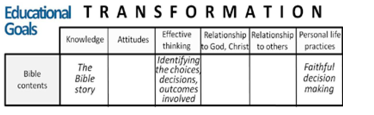
By looking at the decisions involved in Bible stories, our Sunday school lessons have a new dimension. No longer is factual knowledge the only goal of the lesson. At the very least we have added training in effective thinking to the scope of our instruction.
Case studies
Case studies present real-life situations for our children to think about in terms of the biblical principles that are involved. The range of possibilities is endless here, too. The titles of some of the case studies I have used over the years give a hint of this:
- “A Matter of Life or Debt” (Society’s value system vs. God’s value system);
- “Getting Ahead!” (On-the-job challenges);
- “Gimme, Gimme, Gimme” (Selfishness);
- “International Barriers” (Christ transcends every human boundary);
- “Prison Break” (Facing life-threatening danger);
- “Rough Characters at Philippi” (The human realities of Acts 16:16-24);
- “Scrambled Eggs and Ecclesial Life” (A “my way or the highway” story);
- “Voyage of the Marquis of Wellesley” (Attitudes evident in the story of Dr. Thomas’ emigration to America).
I find it helpful to prepare a few pointed questions to use with case studies. These give focus to class discussion. Discussion of real-life issues tells us a lot about our children and the grasp that they have of biblical principles. It can easily show us where there is need for further biblical instruction.
More decision making activities
I also like “Options & Outcomes” activities. These pose a basic problem for the children to consider. Then several options are explored for dealing with the problem. As each option is explored, attention is given to the outcomes that result. Decisions have consequences.
When I design an activity of this kind, I often try to focus on a basic set of options and outcomes that are true to life:
- Option 1 = make a faithful decision; get a “good” outcome.
- Option 2 = make a faithful decision; get a “bad” outcome.
- Option 3 = make an unfaithful decision; get a “good” outcome.
- Option 4 = make an unfaithful decision; get a “bad” outcome.
The terms “good” and “bad” are used here from man’s perspective, not necessarily from God’s perspective. This allows us to recognize, for example, that a faithful decision with an apparently “bad” outcome (e.g., Christ’s death) may, in fact, be very good!
A fifth option also presents itself. This is to make no decision at all; to ignore the problem and just keep going. Our children need to explore this possibility as well. This can be a faithful decision when we know in our heart of hearts that there is absolutely nothing we can do about the problem. We have to leave the matter entirely in God’s hands. However, this can also be an unfaithful decision if we know that there is something we can and should do about the problem, but we do not want to be bothered. Conscience!
May God help us, dear Sunday schoolers! This is true to life.
Something else is evident in this kind of activity. We choose our options; and we are responsible for the decisions we make in life. But we cannot necessarily control the outcomes that occur. This underscores the importance of making faithful decisions and trusting that God will bring good out of our efforts to please Him.
What would you do if …?
Finally, “What would you do if …?” problems provide a simple strategy for teaching biblical principles of decision making. These can be thought up practically on the spot and can be tailored to almost any class and any Sunday school lesson. Just remember to give your students a little time to think about a problem before asking them to tell you “what they would do.”
So go ahead and make good use of decision making activities. Make it a Sunday school goal to nurture your children in the principles of faithful, godly thinking.
Perhaps you already do this or have done it in the past. If so, I would like to hear from you. If you have decision-making / problem-solving activities that you have used and are willing to share, I would be delighted to receive copies of them. The Tidings Committee is in the process of creating a Sunday school link on its website (http://www.tidings.org/) as a place where teachers and CYC leaders can access all kinds of ready-to-use materials. Case Studies and Decision Making Activities are two of the kinds of teaching resources that will be available on the new Sunday School link.
 The Origin of the Organic World – Part One