
17.1 Foreshadowing of Messiah
17.1.1 The promise of Messiah from God’s speeches
Mankind was promised redemption in Eden. God mandated — to one later described as Satan, no less! — that the Seed of a Woman would destroy him, yet the Seed would pay a price to secure that victory (Gen 3:14-15). The New Testament unequivocally teaches Jesus of Nazareth was that victor (Heb 2:14-15).
To this well-known teaching, the book of Job adds two revelations:
- Even a righteous man cannot defeat the Satan
- The Satan can be defeated only by the Word of God
Thus the book of Job thus plays a vital part in teaching us who Jesus is. When we see Jesus defeat the Satan in the Wilderness (Matt 4; Luke 4) his victory doesn’t stem from the fact he is a righteous man. The book of Job teaches us, via the consistency of Scripture, that Jesus’ victory occurs because he is the Word of God.1
Thus even before we reach John’s gospel’s beautiful presentation of Jesus as the embodied Word of God, God’s speeches in Job enable us to anticipate this. Indeed the Joban speeches insist upon it! How satisfying it is to be able to see the Scriptures weaving together these strands of revelation into one powerful message. And this in no way detracts from the impact of the revelation via John when it arrives, that those blessed to live in the first century were privileged to have the Living Word of God among them:
The true light that gives light to every man was coming into the world. He was in the world, and though the world was made through him, the world did not recognize him. He came to that which was his own, but his own did not receive him. Yet to all who received him, to those who believed in his name, he gave the right to become children of God — children born not of natural descent, nor of human decision or a husband’s will, but born of God. The Word became flesh and made his dwelling among us. We have seen his glory, the glory of the One and Only, who came from the Father, full of grace and truth (John 1:9-14).2
The differences between Jesus and Job are as sobering as the similarities. Jesus successfully fought off the wiles of the Satan where Job did not. We must not miss the dramatic differences in their ultimate mortal fortunes, either. Jesus was the “Job” who never received the temporal blessing of restoration in his mortal life. Jesus was burdened with the uncertainty and doubt that plague every human mind, yet was never blessed with the restoration in which his human nature could take courage. This underscores what a truly remarkable man Jesus was! And it also has an intriguing implication for all those who would follow him. Since Jesus had everything taken from him — including the support of friends and family — we cannot follow a ‘winner’ or a ‘successful man’ in any human sense of the word; a beautiful, if subtle, rejection of the clamorously acquisitive world of man.
17.1.2 Temptation in the wilderness
Job, the righteous man, has been tempted in the wilderness by Satan. The parallel is striking.
“Then Jesus was led by the Spirit into the desert to be tempted by the devil” (Matt 4:1).
Table 17_1 details the comparison of the two trials.
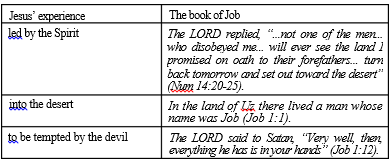
Table 17_1: Comparison of the settings of Jesus’ and Job’s Wilderness Temptations
In each case God directs a journey into the wilderness, resulting in a time of testing and revelation. We can extrapolate backwards to see what Jesus may have learned from the example of Job and, perhaps more importantly, can extrapolate forwards from the examples of both men to learn how we should be responding to the same combative assaults in our lives.
This foreshadowing supplies a further, fascinating reason why these events should have befallen Job. The book of Job now acts as a textbook for Jesus!3A textbook instructing Jesus in resisting Satan; both the Satan without and the Satan within. Jesus learned obedience (Heb 5:8) and doubtless the Scriptural scrolls in which he immersed himself were a principal source of that education, along with prayer and the Spirit’s revelation. I think the wilderness temptation of Christ gives clear pointers of what Jesus learned from Job — both Job’s successes and his failures.
Jesus endured three temptations, reminiscent of Job’s triune Satan. We might be prompted to try and validate a one-to-one mapping between each of Job’s friends and each of Jesus’ temptations, but I do not believe there is profit or accuracy along that path. But there is value comparing the responses to temptation given by Jesus and by Job (Table 17_2).
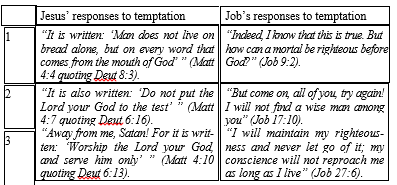
Table 17_2: Comparison of the responses of Jesus and Job in their
Wilderness trials Principal points to notice:
- Jesus prevails! (Matt 4:11) Even though the fullness of his victory comes later (strictly much later, in the Kingdom of God) we can see Jesus resist self-indulgence — the Satan — even here. God’s speeches to Job: that only the Word of God can tame this Beast, teach us that Jesus’ success proves he is the Word of God.
- Jesus restricts his comments exclusively to quotes from the Word. Jesus was a highly intelligent and articulate man, able to outmaneuver even the cunningly planned sophistry of the contemporary intellects of the day: the scribes, Pharisees and Sadducees (e.g. Mark 12:13-17; 18-27). Yet here he only quotes Scripture. I believe he is demonstrating the same truth the Father taught: that the Satan, proud human willfulness, can only be tamed by the Word. I further believe he has learned this from his reflections on the Joban tale; showing his obedience to the divine injunction: “Have you considered my servant Job?” Clearly Jesus had.
- All three of Jesus’ quotes come from Deuteronomy, which we established earlier is coincident with the time of Job (Article 5, Sep 2009). This strengthens the idea that the book of Job was on the Master’s mind during the wilderness temptation! In fairness, Deuteronomy is also simply the time of Israel’s wilderness wanderings; so the simple comparison between Israel and Christ in the wilderness could be the dominant influence on Christ’s replies.
- Jesus’ and Job’s first responses to Satan are similar, but thereafter they diverge. This is indicative of where Job began to fail. (These comments are in no way designed to criticize Job, however. Naturally we all fall short when compared with the Lord!) The critical distinction is that Job deliberately draws Satan towards him; Jesus pushes him away. Job is riled and, buoyed with the knowledge that Satan’s arguments are vain, he’s keen for combat. “Come on, all of you, try again!” he cries, knowing he has the beating of their reasoning, but dangerously blind to the infection of their prideful attitude. Jesus, knowing the nature of the Beast far better and, I suggest, educated by his careful reflection on Job’s previous stumble, refuses to engage the Satan. “Away from me!” his only comment. James later concludes: Submit yourselves, then, to God. Resist the devil, and he will flee from you (James 4:7).
- As a result of engaging the Devil of Pride, Job was compelled to speak of his own integrity: “my conscience will not reproach me as long as I live” (Job 27:6). By contrast Jesus, who shunned Satan, concluded: “Worship the Lord your God, and serve him only” (Matt 4:10). Having remained untangled from Leviathan, Jesus was free to speak well of God.
17.2 Did Job succeed or fail?
This is not a simple question and anyone could be forgiven for being unclear on this point.
On the one hand, the drama began with a barter between the Satan and God. God had backed Job to succeed in a certain matter, the Satan had proudly assumed he knew better than God. This would seem to be all we need to know to solve the question, for if Job failed, God was wrong. So Job evidently succeeded where God said he would.
But on the other hand: if Job succeeded, where do we see the supremacy of Jesus? Haven’t we just said that Jesus succeeded where Job failed? Fourth century Christian expositor Chrysostom is convinced Job succeeded in resisting Satan where Adam did not.4Martin Luther explicitly disagrees, saying Job: “talks, in his human weakness, too much against God, and thus sins amidst his sufferings.”5I concur with Luther: where would be the need for Jesus, if Job has gone before? Furthermore: if Job succeeded against the Satan, why does God upbraid him as one who darkened counsel with words without knowledge? Why have we suggested God saves Job from the jaws of proud Leviathan if Job resisted the Beast on his own? Job evidently failed to overcome the Satan.
So did Job succeed or fail? The resolution is simple: there are two distinct battles going on.
Battle 1: The Satan versus God. The Satan asserted that Job will curse God if his personal circumstances are adversely affected. God knows otherwise. (In analyses of the book, this is commonly referred to as ‘the barter.’) Job’s persevering faith proves God the winner of the barter; and Job too can be said to have succeeded in this regard.
Battle 2: The Satan versus Job. The Pride of Man confronts Job with specious accusations. Job confidently dismisses the false accusations, but his accurate perception of his innocence and insistence on maintaining the debate derails him into the ditch of pride himself. Job was losing (had lost?) the battle against pride when the Word of God came to save him. Later the Word of God made flesh — Jesus — prevailed in the same battle, where even righteous Job had failed.
Interestingly in both cases God’s Word is the only winner.
It makes sense that there are two battles. Since the Satan is the opponent of God, then, by its very nature, it had to attack God’s faithful servant, too. Yet, such is the nature of God that His victory is experienced as a blessing by all involved. Even those who hosted the Satan, the three friends, are brought to salvation through the priest Job; and Job himself is elevated to a position where he can serve God through motives other than fear.
17.3 Reflection
Seeing a scene like this, of Jesus’ response to temptation, is strangely comforting. It assures me that Jesus really was a man like me, afflicted by temptations that he needed to resist — even run away from! These pictures render Jesus of Nazareth all the more accessible to struggling disciples like myself. For if the Son of God needed to flee temptations, how much more important is it for a lesser disciple like myself to give no mental headroom to the things that perennially threaten to draw me away from my Father? The world teaches “look but don’t touch” is a ‘morally legal’ strategy. But the book of Job, from which I believe the Lord also drew strength and education, strongly refutes this. Job’s drama teaches that to give mental space to temptations, just to engage with Satan, actually guarantees disaster. The bottom line: don’t toy with sin. Don’t live life on the cusp of right and wrong. We know we will continue to sin, alas, and can survive only through God’s grace. But let’s not abuse and blaspheme the grace of God by positioning our discipleship’s walk right on the precipitous edge of what we believe to be acceptable, pushing every boundary to the maximum, living in the most morally dangerous way, so that collapsing into the crevasse of sin occurs a hundred times more frequently than if we had followed the Spirit’s lead and pushed temptation as far away as possible.
Jesus never sinned, yet this is not sufficient to define obedience; obedience is much more. It gives me pause to stop and think: if I were asked: “In what ways am I obedient to God’s will?” I might reply: “I don’t murder, I don’t commit adultery, I don’t steal; therefore I’m obedient to God.” Clearly a much different answer is needed, because that’s not what’s at the heart of obedience at all. The concept of obedience is centered around actively facilitating the will of God, not just avoiding violations of His commands.
I find it very encouraging to think about the subject of obedience in this way. All too often ‘obedience’ is projected as a self-righteous maintenance of a sin-free lifestyle. I recall the Headmaster in school assemblies, when I was eleven, intoning the need for obedience — an obedience I was unfortunately poor in maintaining, but perhaps simply because the ‘prize,’ of obedience, as it was then described, wasn’t that appealing. It was always expressed in a negative way: obedience is not breaking the rules, not doing bad things. But this Biblical understanding of obedience is completely different! This is the ‘obedience’ based on positive action; utilizing intelligence and ingenuity in the service of the God I already love. Obedience is designing new preaching courses that can still spark interest in God from a self-fascinated, ADD society. It can be expressed as pitching in at ground level to help the poor; even just playing with toys with an orphaned child. Obedience is combining resources thinly spread across the globe into a coordinated preaching, pastoral or praise effort. What a refreshing notion! For the first time, I’m eager for the label of ‘obedient,’ because it challenges me in ways in which I am excited to respond. Obedience is a playground for the creative; and I want to play.
- Jesus continues to defeat the Satan after the Wilderness struggle also: shunning his powerful resurgence in Gethsemane (Luke 22), killing him in his own death on the cross (Luke 23) and completing the victory (for the battle is merely tied if both finish destroyed) in exiting the tomb in glorious immortality (Luke 24).
- All References are from the NIV.
- I am grateful to Norm Fadelle for provoking my thoughts in this direction.
- Chrysostom in “A Select Library of Nicene and Post-Nicene Fathers of the Christian Church,” in N. N. Glatzer, Ibid, 25
- Luther, “Works of Martin Luther,” 1932, VI, Muhlenberg Press, Philadelphia, PA, USA, 382
 The Origin of the Organic World – Part One