
14.1Job Understands God’s Answer
Job’s pain had caused him to call for the rousing of Leviathan (Job 3:3-8). I’m not suggesting Job perceived God understood the most destructive force as human pride, but in a tragic realization of the age-old adage: “Be careful what you wish for,” Leviathan came! Job did not recognize him, but he surely came: first in his friends’ self-righteousness and latterly, sadly, in Job’s mindset also, which culminated in Job portraying himself as a prince whom God needed to respect (Job 31:36-37). God counters by revealing in whose court Job served:
“[Leviathan] looks down on all that are haughty; he is king over all [princes?] that are proud” (Job 41:34 NIV).
Job is so brilliantly insightful he immediately understands the thrust of God’s answer; that God has revealed the enemy that had slipped under Job’s defenses and which, like any undetected enemy, is the most potent. Most importantly, Job realizes the intervention of God has not acted primarily to correct his errors (although God has done that) nor to reveal the Satanic nature of his friends (although He has done that too), but to snatch him, as a valued possession from the fire; from the very jaws of Leviathan and his own potential destruction!
So Job understands God has saved him. The relatively minor event of Job’s correction illuminates the relatively minor theme of God’s Supremacy, and the major event of Job’s salvation illuminates the major theme of the loving character of that Supreme Father.
This has to be tremendously comforting and liberating for Job. He saw his friends’ pride exposed as folly yet, godly man that he was, that was neither his primary concern nor celebration. He saw that he had never been distanced from his God, except when he nearly slipped into the jaws of Leviathan, and this understanding salved his most pressing fear: that God had left him. Moreover, he saw he had been employed, through the heavy burden of his suffering, to be the foil by which the deadly pride of his friends could be drawn out for God to confront and destroy. He had been employed as a Savior! Job can now feel both connected to God and greatly valued by Him. Little wonder he replies:
“Surely I spoke of things I did not understand,
things too wonderful for me to know.
You said, ‘Listen now, and I will speak;
I will question you,
and you shall answer me.’
My ears had heard of you
but now my eyes have seen you” (Job 42:3-5 NIV).
But then he adds:
“Therefore I despise myself
and repent in dust and ashes” (Job 42:6 NIV).
This closing line doesn’t match the relieved, celebratory tone I’ve suggested Job is feeling – in fact it’s in sharp discord. It sounds like a man whom God has ‘put in his place,’ as almost all expositors suggest,1,2,3,4,5,6,7erroneously, in my opinion. We will explore a happy solution for this apparent contradiction in a later article.
- If Behemoth is Leviathan, Why the Repeat?
An obvious question remains. If Behemoth and Leviathan are personifications of the same human trait, why are two different beasts presented? Wouldn’t either one be enough?
There is direct Scriptural precedent, stemming from the time of Joseph, which solves this question, giving good reason for there to be two dreams with a single meaning. Pharaoh received two visions: one of seven starved cows consuming seven fat cows; then seven malnourished ears of wheat consuming seven healthy ears. Pharaoh was tormented by his inability to understand. Joseph appealed to the LORD, and through the granted prayer explained the two dreams: seven years of healthy crops would be followed by a seven year drought so severe it would consume all the previous seven years’ bounty. Joseph explicitly clarifies that God had only one message to communicate through the two dreams (Gen 41:25) and why two dreams were sent: “The reason the dream was given to Pharaoh in two forms is that the matter has been firmly decided by God, and God will do it soon.” (Gen 41:32).
We can now understand the double nature of the Behemoth and Leviathan vision. The two visions carry the same message: only the Word of God can tame human pride. Using the Scripture to interpret itself, there are two visions because God has firmly decided that He will bring judgment on the Beast and He will do it soon.
And what follows in the very next verses? Judgment on the Beast! (Job 42:7-8) [This is additional evidence that Satan is pride: the office primarily inhabited by the three friends. The double vision demonstrating that the Word of God would tame the Satan very soon is immediately followed by God speaking in judgment against the three friends’ pride!]
Additional support for Behemoth and Leviathan being aspects of the same beast is seen in God’s references to ‘their’ supremacy. God presents both of them as the ‘Number 1’ beast, yet it’s obviously impossible to have more than one premier. Consider:
God says of Behemoth: “He ranks first among the works of God” (Job 40:19). So Behemoth is King! But then Leviathan is presented as: “King over all that are proud” (Job 41:34). So he too is King?
In fact, Leviathan is implicitly described as stronger than Behemoth. Behemoth’s bones are made of iron and bronze (Job 40:18), yet Leviathan crushes iron and bronze like straw and rotten wood (Job 41:27).
There can’t be two ‘Number 1’ beasts; and obviously God does not contradict Himself. The only solution: Behemoth is Leviathan (is Human Pride). And in terms of destructive forces on the beautiful spiritual world, he is Spiritual Enemy #1: THE Satan.
- Behemoth and Leviathan: a Progressive Beast
Without wavering from the interpretation that Behemoth and Leviathan both represent human pride, it is possible to see a progression between the two representations.8At first glance, we see God focuses more on Leviathan; in fact there is a neat arithmetic ratio in evidence. Behemoth is described in 10 verses: about three times more detail than the average of the nine physical beasts in the first speech. Leviathan is then described in 34 verses, about three times more detail again. There’s a progression of detail: from the physical beasts, to Behemoth, to Leviathan.
The growing focus onto Leviathan is highlighted by other subtle mechanisms. God’s first speech presents plural beasts of nine different species. In the second speech, on the spiritual plane, He refines the analysis to plural beasts of one species: Behemoth (a plural noun). Finally God draws the focus to One Beast: Leviathan; the centerpiece of His revelation to Job.
There may be a third progression drawing the focus to Leviathan, concerning the relation the beasts have with the sea (remember the sea is the source of pride: Job 38:8-11). None of the beasts in the first speech are connected to the sea: five are mammals, four are birds. Behemoth is described as an amphibious species, spending some time on land and some in the water; at least a river. Finally, Leviathan is presented as a beast deriving solely from the sea (Table 14_1).
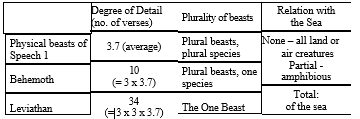
Table 14_1: Three literary mechanisms drawing the focus of God’s answer towards the One Sea Beast: Leviathan.
Finally and most importantly, Leviathan is presented as significantly more dangerous than Behemoth. The Behemoth are big hulking brutes: the ultimate ‘immovable objects,’ who plump down under the lotus plants and are alarmed at nothing, not even a raging river. They can be cowed by their Maker alone. They are huge powerful lumps, but they are not hunters or fighters; indeed they are vegetarian.
Not so Leviathan. He is proactively hostile. His weapon is flames which shoot from his mouth. He doesn’t lie inert under the lotus plants: he thrashes around! He terrifies mighty men. The many verses indicating man’s inability to damage Leviathan indicates man is in constant conflict with Leviathan, yet never successfully so.
I see these as different aspects of human pride: pride in both its passive ‘vegetarian’ form and its active, predatory one. I see Behemoth as stubbornness: the hulking, inertia-laden lump that no man can move: hence the bones of bronze. I see Leviathan as active pride: the self-righteous, rampaging beast that damages not only the one it attacks but also, more subtly, yet more severely, the one who hosts it in his heart. Leviathan is the only superior to Behemoth, being the more aggressive form of the same thing. Hence Leviathan treats even iron and bronze, the very bones of mighty Behemoth, like straw and rotten wood; as stubbornness explodes in voracious activity of self-glory.
14.2 Reflection
I’m struck by the implication of the length of God’s speeches: they’re the longest anywhere in the Bible. So while Job’s situation is indeed horrific, what an incredible privilege to receive such lengthy, personalized communication from God Himself! It is a direct and public affirmation of Job’s favor. It contrasts strikingly with God’s ‘speeches’ to the Satan, which are no more than a handful of words. I’m convinced this highlights God’s approval of Job, and His corresponding disapproval of the Satan.
The subject matter is also enthralling. God reminds Job of the immense beauty of the natural world, quite possibly because the appreciation of the physical world, just in itself, can be an effective anodyne to suffering. It is always appropriate to maintain infant wonderment in the Creation, as part of those child-like aspects essential for anyone who would enter the Kingdom of Heaven (Matt 18:1-4). To find a time of stillness and sit at the crest of a hill, by the side of a lake, in a softly carpeted forest or on a remote sandy beach by the gently booming ocean can bring a sense of well being and inner peace to even the most troubled soul. We can connect more closely to the expressions of the Almighty; and thereby vicariously connect with Him. Atkinson aptly stated: “It is by enjoying the Creator’s handiwork that we often begin to feel again the touch of the Creator’s hand.”9All too often the mind in pain focuses inwards. Peake commented: “[Job] needed to have the detail bitten into his imagination, that the vague generality might become vivid and concrete. For much of the mischief with Job lay in his self-absorption.10God essentially says to Job: “I see your pain. Let’s take a walk in My garden; it’ll help.”
We also see that God’s teaching style centers around questions; (which is true throughout Scripture) and He operates this way with both the Satan and the Righteous Man. But where questions posed to the Satan are repeated verbatim (Job 1:7-8 & 2:2-3), those to the Righteous Man develop (Job 38:2 & 40:8). I suggest this is because the Satan makes no useful response to God’s questions; no progress in his theology. But questioning the righteous man draws him closer to speaking well of his God.
I identified the Satan as human pride; initially hosted solely by the three friends. By concluding Leviathan is God’s picture of the same trait, we can see a simple and beautiful symmetry in the drama.
- In the prologue, God speaks to the Satan.
- He asks him to consider the nature of the Righteous Man.
- In the main movement, God speaks to the Righteous Man.
- He asks him to consider the nature of the Satan.
Even before we explore why God does this, it’s an attractive symmetry, underscoring the inherent simplicity of the Joban tale (an irony given that the book has proven the source of more debate and confusion than almost any other in the Biblical library!).
This symmetry has one final incarnation:
- In the epilogue, God speaks to the Righteous Man and the Satan.
- He asks them to consider each other.
Then the symmetry breaks. God asks the Righteous Man to convey His salvation to the Satan. For ultimately only one of the parties has strength in the universe.
There is an additional contrasting symmetry for our appreciation. In both God’s conversation in the prologue and God’s speeches to Job something is made clear to the reader and something else is hidden. In the prologue, the subject matter, the Righteous Man, is clearly identified; but the character of the second party, the Satan, is obscure and needs to be carefully interpreted. By interesting contrast, here in God’s speeches the reverse is true. The party to whom God speaks is obvious: it’s Job, but the subject matter, the nature of the Satan, is obscured in graphic vision. In both cases it is only with careful work that the obscure portion of each conversation can be solved and then the fullness of the symmetric beauty opens like a flower.
In each case the Righteous Man is plainly revealed to the audience, whether he is the subject of God’s speech (ch 1) or the recipient (ch 38-41). By contrast the Satan is the one obscured both times. This presents an attractive graphical argument. The Righteous Man is plainly visible, in the light, while the Satan lurks in shadow and is hard to detect. This melds effortlessly with the common Scriptural theme of associating light with godliness and darkness with oblivion (e.g. John 1), which theme is also explicitly proselytized in God’s first speech (Job 38:12-13).
This allows a simple but profound definition of a righteous man and a Satan. In the opening exchange, we reasoned Satan never heard the Word of God. He was never aware the conversation was in progress. I understand this as a useful definition of the Satan, the opponent of God: he can’t hear God’s words. By contrast, the Righteous Man is defined by the Joban drama as the one who is able to hear the Words of God and the message they impart. Not only that, but the book of Job shows us that while Satan cannot hear God because of his own pride, the righteous man can hear God even if the subject is his pride!
The more I see these symmetries, the more I’m struck how wonderfully ‘small’ the book of Job truly is. The entire drama is played out with a very small cast of characters and, though the material and message of the book is stunningly deep and profound, that message is borne through surprisingly simplistic and symmetric interactions of the characters involved. It is truly a beautiful book.
Let’s return to the drama. Yahweh has spoken, and his excellent servant has heard Him. We advance to the conclusion. The Word of God has interceded and has brought (arguably) the only thing that the Word of God can bring, and (unarguably) the thing that only the Word of God can bring.
- N.N. Glatzer, Ibid, 8
- D.A Atkinson, Ibid, 157
- J.V. Mc Gee, “Thru the Bible Commentary Series: Job,” 1991, Thomas Nelson, Nashville, TN, USA, 188
- D.Baird, Ibid, 304
- J. Balchin, Ibid, 112
- L.G. Sargent, Ibid, 134
- E.M. Spongberg, Ibid, 143
- I am grateful to Geoff Higgs for assisting my thinking along these lines.
- Atkinson, Ibid, 147
- A.S. Peake, “The Problem of Suffering in the Old Testament,” 1904, in N. N. Glazier, Ibid, 203
 The Origin of the Organic World – Part One