
13.1 God’s Second Speech: Controlling the Beast
Read Job 40:15 through 41:34
At first read, I have far more questions than answers. What are Behemoth and Leviathan? How can any of this be relevant to Job? And why are there two speeches, anyway?
-
Why Two Speeches?
Logic insists God always intended to speak twice: it wasn’t that He forgot to say something the first time around. I suggest the first speech focuses on the natural creation, but the second concerns the spiritual creation.
If this is true, it follows that Behemoth and Leviathan are not physical creatures, but spiritual ones, a hypothesis which fits with the general Scriptural theme of God working first on the physical plane and then the spiritual. We see several examples of this: In the Testaments, where ultimately God’s Word is constructed of the physical covenant and then the spiritual covenant; in the two kings of Israel, Saul and then David; and the births of the disciple: first natural, then spiritual (see John 3:3-8; 1Cor 15:44-46). This is the way God works: first the natural, then the spiritual.
-
Weaknesses of Interpreting Behemoth and Leviathan as Physical Beasts
The vast majority of expositors either assume, or inherit from each other, that Behemoth is a hippopotamus and Leviathan a crocodile.1,2,3,4,5(Or rather they assume Behemoth to be hippopotami, presumably, since strictly the noun is plural.6) I believe limiting the interpretation of Behemoth and Leviathan to the physical beasts is woefully inadequate; because it allows no valuable meaning to be derived from God’s speeches! Let’s consider why this is.
- The interpretation of Behemoth and Leviathan as hippo and crocodile makes no credible sense to the development of the drama. God has already presented nine physical beasts in the first speech. Why would adding two more make any difference?
- It’s clear Job understands something after the second speech which he didn’t understand before, because Job’s response to God’s first speech is not acceptable, but his second response is. Is it credible that some fundamentally new understanding came from the consideration of the hippopotamus and the crocodile? Is it even faintly believable that when God said: “Consider the lion, the king of the beasts; consider the war horse, charging into the fray; consider the eagle, soaring above the slain carcass”; Job was still lost to God’s intended message; yet after He said: “Not only that, but I made the hippo and croc too” Job suddenly cries: “But of course! I see it all now!”? It simply makes no sense that the second speech is nothing more than a continuation of the first.
- The descriptions don’t fit. God’s descriptions of the nine physical beasts in the first speech match the respective animals well. But this is not true for Behemoth and Leviathan being a hippopotamus and crocodile. Behemoth’s tail sways like a cedar tree (40:17). Rays of light glow from Leviathan’s eyes, smoke coils from his nostrils and flames burst from his mouth (41:18-20). The hippopotamus’ tail is scarcely larger than a man’s forearm and, while it apparently has some strength, it clearly doesn’t “sway like a cedar tree.” And the light rays that shine from Leviathan’s eyes or the fire that streams from his mouth simply have no physical manifestation in known species. This argument fails.
- Remember, at the depth of despair in his first lament, Job called for the rousing of Leviathan (Job 3:3-8). The intensity and power of his piercing cry is totally denigrated if we now suggest that Job is merely calling for a crocodile to wake up. Job is speaking with appropriate hyperbole to invoke a supernatural, if mythical, beast who is able to wreak untold havoc upon the Earth.
- Evidence in Support of Behemoth and Leviathan as Human Pride
There is some meager support in the literature for the interpretation of Behemoth
and Leviathan on the spiritual plane, as symbols of wickedness,7,8,9,10or even a rebellious spirit within Job himself. Baird mixes the two ideas, allowing only Leviathan as a potential symbol of sin, with which he offers excellent comparisons with God’s subjugation of Egypt and Babylon, while interpreting Behemoth strictly physically as the inevitable hippopotamus.11
Gregory I, who became Pope of the Catholic Church in the sixth century, understood both beasts to be symbols of Satan,12a view with which I wholly concur and will attempt to reinforce.
I claim these things:
- Behemoth and Leviathan are spiritual beasts
- Behemoth and Leviathan are, in fact, progressive facades of one and the same beast
- That one beast is Human Pride
- (Human Pride is The Satan; the Opponent of God introduced in the opening scene of the drama)
- Therefore God speaks to reveal the identity of the Satan, the character who has been hidden since the prologue!
- Therefore God’s speeches are relevant to the preceding debate
(The fourth point is listed parenthetically because we have already presented our reasoning for this in an earlier article.)
Even if these claims are shown to be true, they will still leave us short of fully expositing understanding what God is saying — that will be considered later. For now I want to focus purely on making a careful identification of Behemoth and Leviathan so that we can move forward in trying to hear what God is saying in the second speech; and thereby retrospectively translate the first speech also.
- The Scripture’s style is to present first the natural creation and then the spiritual. While this does not prove that Behemoth and Leviathan are spiritual beasts, an interpretation of them as spiritual beasts would dovetail perfectly with this generic protocol.
- The detail of description of Behemoth and Leviathan is at an entirely different level from the beasts in the first speech. In the first speech, nine beasts are presented in 33 verses. Behemoth and Leviathan are allocated 44 verses. This infers Behemoth and Leviathan are on a fundamentally different plane from the beasts in the previous speech.
- The descriptions of the beasts in the first speech comprise primarily physical parameters. But the beasts in the second speech are generally referred to with personality traits and characteristics: essentially spiritual parameters. They also detail a relationship with man, which Renan also noticed13(Table 13_1).
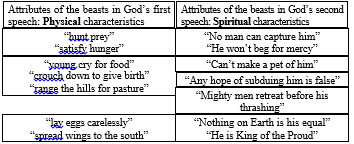
Table 13_1: Contrast between the physical characteristics of the beasts in God’s first speech with the spiritual characteristics of the beasts in God’s second speech.
Clearly the characteristics of Behemoth and Leviathan are spiritual and speak of overpowering man; alluding to a wildness he cannot control.
4) The personality traits match the pride of man very well. Consider:
- He ranks first among God’s works (Job 40:19)
This is most naturally interpreted as man, who was placed in supremacy above the creation (Gen 1:27-28). In fact, any interpretation except man, e.g. the hippopotamus, would be hard to justify.
- He has bones of bronze (Job 40:18)
I don’t want to over-speculate here, but I believe bronze (commonly coupled with iron) represents stubbornness to God in Scripture: simply because they were the two hardest metals known at the time (e.g. Deut 33:25; Psa 107:16; Jer 1:18). In ancient days bronze was commonly used for armour: a hard metal to protect the body (1Sam 17:5-6,38) and today bronze is the commonest material for casting sculptures; precisely because when the sculptor has finished molding the malleable clay, he or she uses the hardest material for casting so that the shape is preserved.
When God is looking to mold His people, bronze has a negative connotation, simply because it can’t be molded. It’s appropriate for casting the finished sculpture, but we are not finished objects! We are in need of continued molding all the days of our lives. So God uses bronze to describe the stubborn intractability of his people (e.g. Num 21:4-9, Isa 48:4-8, Lev 26:19, Jer 6:28).
- Fire shoots from Leviathan’s mouth (Job 41:19-21)
James refers us to the one creature who, metaphorically, sets the world ablaze with its mouth (James 3:5-6). It’s the proud man who does not curb his tongue!
- The opening line of the speech: “Behemoth who… I made along with you” (Job 40:15)
Effectively, God says: “I made you with your own free will. Implanted within you. The will to either humbly serve me or stubbornly resist my guidance.” That is to say: “Behemoth! …who I made along with you.” The plural nature of the word Behemoth assists in understanding that this beast lurks in every human heart. The continuation of the speech bears the message: “By direct consequence, if you are to be my child, some sort of beast-taming is going to be needed for you to move towards me. The Word of God can control that beast. Can you?” The book of Job thus beautifully encapsulates this central Bible message within its single, compact drama.
- The closing line of the speech: “He is King of the Proud” (41:34)
Undoubtedly the proudest creature on Earth is man. An obvious example is King Nebuchadnezzar. He had been warned in a dream that, because of his pride, the LORD God would humble him for a time, until his humility was restored (Dan 4:28-34). Fascinatingly, God chose to humble Nebuchadnezzar by making him live like a wild animal as a punishment for his brazen pride. God essentially says: “If you’re going to behave like a wild beast, I’ll make you live like a wild beast.” Two things derive directly from this. First, God sees pride as a wild beast. Second, only God’s Word, not human effort, can tame the Beast. This harmonizes perfectly with our interpretation of God’s second speech to Job.
Additionally, the ‘King of the Proud’ comment is the closing remark, the words left to reverberate in the ears and minds of the assembled audience. So it’s highly likely to be pertinent. And the phrase simply describes Leviathan: The King of Pride.
- Leviathan, the latter and more fearsome of Beasts, is from the sea. God defined the sea as the source of pride, which needed to be restrained by His direct control (Job 38:8-11). God refrained from including any sea beasts in that first speech, where He focused on the innocent wildness of the natural creation. He then segued into the second speech to speak of the thrashing, fiery, indomitable Beast that arose from the oceans of pride.
This picture connects well with scriptural imagery that portrays “seas” as the nations, especially those adrift from God’s guidance (e.g. Revelation 17:15, and I suggest it is useful to read Luke 21:25 this way). This strengthens the notion that the source of pride is from the hosts of men who are not able to be molded by the gentle parenting of their Loving Father. Interestingly, even Eden’s serpent, also referred to as Satan (Rev 12:9) can be shown to be a creature deriving from creation’s Day 5: the day of sea beasts.14
- In other scriptural references to Leviathan, the beast represents Egypt (Psa 74) and Babylon (Isa 27). The signature feature of these two nations is that they held the children of God captive, until God freed them. So to see the Leviathan in God’s second speech representing pride makes good sense. On the spiritual plane it is sin, the prideful decision to serve self rather than one’s Creator, which holds the disciple of God captive (Rom 7:24-25). As with captivity in Egypt and Babylon, the direct intervention of the Hand of God is the only mechanism by which the disciple can be freed.
Although we have done little more than articulate an understanding of Behemoth and Leviathan, we are now in a position to discern the message of God’s speeches to Job, and how Job understands them and is enriched by the understanding.
13.2 God Answers Job
The briefest of recaps tells us the main thread of the story so far. The Satan flaunts his prideful slanders of both Job and God before the Almighty. He then becomes locked in debate with the righteous man, inevitably, since they are natural enemies. The righteous man is able to rebut the Satan’s ill-thought reasoning, but is unable to overcome his pride — the very essence of the Satan — and becomes infected with pride himself.
Thus we can see that God spoke when He did to rescue Job. God had seen Job flagging under the persistent assaults of self-righteous Satan and, finally, succumbing in anger to self-righteous pride himself. God’s revelatory speeches highlight what has been happening, so that Job can be saved. God approaches this theme obliquely. “Do you have much success controlling wild beasts, Job?” is the vehicle of the first message. Job, not seeing where this train of thought is leading, feels hurt and offended, as if his appeals for reunion with God and justification of his blameless life have been ignored. So he sullenly refuses to answer in depth. But God displays more patience with Job and, transitioning His thoughts to the spiritual plane, He describes THE Wild Beast: Human Pride. The beast which has broken free and has been rampaging around centre stage in the drama; causing the inevitable damage signature to his being. “So if you can’t control physical wild beasts,” the LORD continues in His second speech, “how do you expect to control The wild beast, Job? Do you recognize this beast? Have you seen him anywhere recently?” And such is the brilliance of Job that, even on first hearing of the second speech, he understands!!
His restoration, and the salvation of those polluted by the Satan, can now begin in earnest.
Seeing Behemoth and Leviathan as manifestations of human pride, which no man can overcome, is essential to arriving at this conclusion. Consider the alternative: Job has been smitten physically and emotionally, covered in boils, bereaved of all his children and deprived of his wealth and social standing. He has then been attacked by his self-righteous friends and he has hollered to the heavens for deliverance. Is it even faintly credible that, when the LORD he has been seeking finally arrives, He expounds two speeches which culminate in the theme: “Look what a great job I did designing the crocodile”?! God’s speeches would be ludicrously off topic (Williams has vicariously noted this in his novel15) and His character self-centered and uncaring! Ask yourself: is this your God?
Of course it isn’t! We have seen God’s speeches are insightful, on topic and, above all, helpful to the cries from the disciple He loves.
Did we really expect any different?
- Atkinson, “The Message of Job,” 1991, Inter-Varsity Press, Leicester, UK, 151
- E.M. Spongberg, “The Book of Job,” 1965, private publication, 140-141
- N.N. Glatzer, “The Dimensions of Job,” 1969, Schocken Books Inc., New York, NY, USA, 3
- R. Gordis, “The Temptation of Job- Tradition versus Experience in Religion,” 1955, in N. N. Glatzer, Ibid, 83
- J. Balchin, “Sitting with Job,” 1998, Rhoswiel Books, Oswestry, UK, 101-102
- J. Strong, “A Concise Dictionary of the words in the Hebrew Bible with their Renderings in the Authorized English Version,” in “Strong’s Exhaustive Concordance,” 1997, Baker Book House, Grand Rapids, MI, USA, 19
- L.G. Sargent, “Ecclesiastes and Other Studies,” 1965, The Christadelphian, Birmingham, UK, 133
- G. Gutierrez, Ibid, 80
- P. Claudel, “Le Livre de Job,” 1946, in N. N. Glatzer, Ibid, 44
- N.C. Habel, “The Book of Job: A Commentary,” 1985, Westminster Press, Philadelphia, PA, USA, 559-561
- D. Baird, “The Education of Job,” 2002, Stallard & Potter, Torrensville, Australia, 290-294
- Gregory, Ibid, 30
- Renan, “Le Livre de Job,” 1859, in N. N. Glatzer, Ibid, 117
- J.A. Pople, “John’s Creation: A Model for Understanding the Gospel of John,” 2004, Trafford, Victoria, Canada, 17-19
- Williams, “War in Heaven,” 1947, Faber, London, UK, 24
 The Origin of the Organic World – Part One