
We continue our study of the gospel substance casting the shadows of the Tabernacle. In the last article, we had just entered the Holy Place, which represents our current lives in Christ.
The lampstand: The Word of God
The reality underlying the seven-branched lampstand is the light of the Word of God and the fellowship with God, Christ, and the saints.
Light represents the Word of God, His law, the gospel that lightens the world: “Thy word is a lamp unto my feet, and a light unto my path” (Psa 119:105).
“For the commandment is a lamp; and the law is light; and reproofs of instruction are the way of life” (Prov 6:23).
This is a favorite theme of Isaiah:
“Nevertheless the dimness shall not be such as was in her vexation, when at the first he lightly afflicted the land of Zebulun and the land of Naphtali, and afterward did more grievously afflict her by the way of the sea, beyond Jordan, in Galilee of the nations. The people that walked in darkness have seen a great light: they that dwell in the land of the shadow of death, upon them hath the light shined” (Isa 9:1-2; cf. Matt 4:12-17).
“I the Lord have called thee in righteousness, and will hold thine hand, and will keep thee, and give thee for a covenant of the people, for a light of the Gentiles” (Isa 42:6; cf. 49:6; Luke 2:32; Acts 13:47; 26:23).
“Hearken unto me, my people; and give ear unto me, O my nation: for a law shall proceed from me, and I will make my judgment to rest for a light of the people” (Isa 51:4; cf. 2:2-3; 60:1-3).
Paul and Peter pick up the same theme:
“But if our gospel be hid, it is hid to them that are lost: In whom the god of this world hath blinded the minds of them which believe not, lest the light of the glorious gospel of Christ, who is the image of God, should shine unto them” (2Cor 4:3-4).
“We have also a more sure word of prophecy; whereunto ye do well that ye take heed, as unto a light that shineth in a dark place, until the day dawn, and the day star arise in your hearts: Knowing this first, that no prophecy of the scripture is of any private interpretation. For the prophecy came not in old time by the will of man: but holy men of God spake as they were moved by the Holy [Spirit]” (2Pet 1:19-21).
The lampstand: Fellowship
Besides symbolizing the gospel, the light of the lampstand also typifies fellowship with God, Jesus, and the saints.
- God. “Fellowship” and “joy” (i.e., the joy of fellowship) are tied to “walking in the light” because “God is light”:
“That which we have seen and heard declare we unto you, that ye also may have fellowship with us: and truly our fellowship is with the Father, and with his Son Jesus Christ. And these things write we unto you, that your joy may be full. This then is the message which we have heard of him, and declare unto you, that God is light, and in him is no darkness at all. If we say that we have fellowship with him, and walk in darkness, we lie, and do not the truth: But if we walk in the light, as he is in the light, we have fellowship one with another, and the blood of Jesus Christ his Son cleanseth us from all sin” (1John 1:3-7).
To be in fellowship is to walk in the light of God.
- Jesus. Jesus is the true light that comes into the world to test every man:
“And the light shineth in darkness; and the darkness comprehended it not. There was a man sent from God, whose name was John. The same came for a witness, to bear witness of the Light, that all men through him might believe. He was not that Light, but was sent to bear witness of that Light. That was the true Light, which lighteth every man that cometh into the world. He was in the world, and the world was made by him, and the world knew him not” (John 1:5-10).
“And this is the condemnation, that light is come into the world, and men loved darkness rather than light, because their deeds were evil” (John 3:19).
“Again, a new commandment I write unto you, which thing is true in him and in you: because the darkness is past, and the true light now shineth. He that saith he is in the light, and hateth his brother, is in darkness even until now” (1John 2:8-9).
Throughout John’s gospel, Jesus proclaims himself to be the light of the world:
“Then spake Jesus again unto them, saying, I am the light of the world: he that followeth me shall not walk in darkness, but shall have the light of life” (John 8:12; cf. 9:4-5; 12:46).
In short, Jesus fulfills the first day of creation:
“For God, who commanded the light to shine out of darkness, hath shined in our hearts, to give the light of the knowledge of the glory of God in the face of Jesus Christ” (2Cor 4:6).
- The saints. Jesus explains that the saints are the children of light:
“Then Jesus said unto them, Yet a little while is the light with you. Walk while ye have the light, lest darkness come upon you: for he that walketh in darkness knoweth not whither he goeth. While ye have light, believe in the light, that ye may be the children of light. These things spake Jesus, and departed, and did hide himself from them” (John 12:35-36).
“Ye are the light of the world. A city that is set on an hill cannot be hid. Neither do men light a candle, and put it under a bushel, but on a candlestick; and it giveth light unto all that are in the house. Let your light so shine before men, that they may see your good works, and glorify your Father which is in heaven” (Matt 5:14-16).
Paul exhorts the ecclesias not to have fellowship with the works of darkness, but rather to walk as children of light:
“But ye, brethren, are not in darkness, that that day should overtake you as a thief. Ye are all the children of light, and the children of the day: we are not of the night, nor of darkness. Therefore let us not sleep, as do others; but let us watch and be sober. For they that sleep sleep in the night; and they that be drunken are drunken in the night. But let us, who are of the day, be sober, putting on the breastplate of faith and love; and for an helmet, the hope of salvation” (1Thess 5:4-8; cf. 2Cor 6:14-16; Eph 5:6-11; Col 1:12-13).
Peter summarizes the blessings of being called out of darkness into the marvelous light:
“But ye are a chosen generation, a royal priesthood, an holy nation, a peculiar people; that ye should shew forth the praises of him who hath called you out of darkness into his marvellous light: Which in time past were not a people, but are now the people of God: which had not obtained mercy, but now have obtained mercy” (1Pet 2:9-10).
Finally, in the symbolism of Revelation, there is a seven-branched lampstand whose candlesticks represent the seven (primarily Gentile) ecclesias in Asia:
“And I turned to see the voice that spake with me. And being turned, I saw seven golden candlesticks; And in the midst of the seven candlesticks one like unto the Son of man… The mystery of the seven stars which thou sawest in my right hand, and the seven golden candlesticks. The seven stars are the angels of the seven churches: and the seven candlesticks which thou sawest are the seven churches” (Rev 1:12-13, 20; cf. 11:4; Zech 4).
Our Lord identifies himself to the Ephesians as the one walking amid the candlesticks:
“Unto the angel of the church of Ephesus write; These things saith he that holdeth the seven stars in his right hand, who walketh in the midst of the seven golden candlesticks” (Rev 2:1).
He exhorts them to repent or else he will remove their candlestick:
“Remember therefore from whence thou art fallen, and repent, and do the first works; or else I will come unto thee quickly, and will remove thy candlestick out of his place, except thou repent” (Rev 2:5).
The table of shewbread: The weekly breaking of bread
Bro. Barling explains that the table of shewbread had both bread and wine:
“There were thus clearly six altar-offerings in all, and Drink Offering was one of them. It stood in natural affinity to Meal Offering, both together constituting the bread and wine of God’s table, that is, symbolizing that completeness of worship which gives Him full satisfaction. This principle almost certainly expressed itself in the Table of Shewbread: upon it were not only the Loaves (the bread) but also ‘flagons and chalices for pouring the libations’ (Exo [25]:29, Moffatt). These would be used for holding and pouring out Drink Offering (the wine) — otherwise their presence on the Table was pointless” (Law and Grace, 101-102).
The table of shewbread recalls the events on Mount Sinai:
“Then went up Moses, and Aaron, Nadab, and Abihu, and seventy of the elders of Israel: And they saw the God of Israel: and there was under his feet as it were a paved work of a sapphire stone, and as it were the body of heaven in his clearness. And upon the nobles of the children of Israel he laid not his hand: also they saw God, and did eat and drink” (Exod 24:9-11).
The bread and wine were eaten in the “presence of the LORD” (Exod 25:30; Lev 24:6, 8) just as had been done on the mount. As a result, the shewbread is properly called “the bread of the Presence” (RSV, NRSV, NASB, ESV, NIV, NET, etc.). The Jewish Study Bible has the following note, “The table was to hold the ‘bread of display,’ that is, ‘the Bread of the (Divine) Presence’ (also called ‘shewbread’), explained as bread placed ‘before (that is, in the presence of) God.’ ”
Jesus draws out the connection between himself and the shewbread:
“At that time Jesus went on the sabbath day through the corn; and his disciples were an hungred, and began to pluck the ears of corn, and to eat. But when the Pharisees saw it, they said unto him, Behold, thy disciples do that which is not lawful to do upon the sabbath day. But he said unto them, Have ye not read what David did, when he was an hungred, and they that were with him; How he entered into the house of God, and did eat the shewbread, which was not lawful for him to eat, neither for them which were with him, but only for the priests? Or have ye not read in the law, how that on the sabbath days the priests in the temple profane the sabbath, and are blameless? But I say unto you, That in this place is one greater than the temple” (Matt 12:1-6).
Jesus makes three arguments defending the actions of his disciples. First, David and his men ate the shewbread. David was not only a king, he was also a priest: he wore a linen ephod (2Sam 6:14), he offered sacrifices (2Sam 6:17), and his sons were priests (2Sam 8:18 mg). David was a priest after the order of Melchizedek (Psa 110:4; Gen 14:18-20) and as such he brought forth bread and wine (2Sam 6:19) and blessed the people (2Sam 6:18). Because David was a priest, he and his men could eat the shewbread, as long as they had kept themselves from women (1Sam 21:1-6).
Second, among other duties the priests performed on the Sabbath, they had to replenish the shewbread (Lev 24:8), which required them to bake bread on the Sabbath.
Third, Jesus is greater than the temple. God was dwelling in him (John 1:14-18; 2:13-22; 14:10-11), just as He had dwelt in the Tabernacle and the Temple (Matt 23:21).
Jesus was David’s Lord (Psa 110:1; Matt 22:41-46). Jesus was a priest after the order of Melchizedek (Heb 7; Psa 110:1-4). Jesus’ body was the tabernacle of God, where the shewbread was kept and eaten. So Jesus and his disciples could provide for their food needs on the Sabbath; they had not broken the law.
The weekly replenishment of the table of shewbread (Lev 24:5-9) points forward to our weekly memorial service:
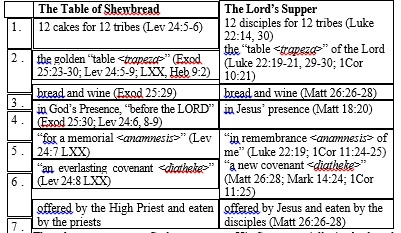
Though we cannot see God, we can see His Son, especially in the bread and the wine. And by seeing the Son, we see his Father (John 14:7-9). Through Christ, we have access to the Father (Rom 5:1-2; Eph 2:14-18), entering into the holiest by his blood, through the veil of his flesh (Heb 10:19-20).
There is an interesting rabbinic tradition about the “shewbread <03899 lechem> <06440 paniym>”, the bread of the Presence: “So what it tells us here is that they raised the table before pilgrims on the festival day and demonstrated the shewbread to them saying, See how God loves you!” (Menahoth 29a, The Talmud: A Selection, Penguin Classics, p. 590). In this way they fulfilled the command, “Thrice in the year shall all your menchildren appear before <06440 paniym> the Lord GoD, the God of Israel” (Exod 34:23). As we have seen, the shewbread represents Christ. It reminds us that we are to keep the weekly memorial service, the Agape (Love Feast), a joyful meal of fellowship shared with our brothers and sisters in the presence of our heavenly Father and His beloved Son, imitating their amazing love for us. Scripture connects this manifestation of love to God’s dwelling in us:
“Beloved, let us love one another: for love is of God; and every one that loveth is born of God, and knoweth God. He that loveth not knoweth not God; for God is love. In this was manifested the love of God toward us, because that God sent his only begotten Son into the world, that we might live through him. Herein is love, not that we loved God, but that he loved us, and sent his Son to be the propitiation for our sins. Beloved, if God so loved us, we ought also to love one another. No man hath seen God at any time. If we love one another, God dwelleth in us, and his love is perfected in us. Hereby know we that we dwell in him, and he in us, because he hath given us of his Spirit” (1John 4:7-13).
Our hymns, especially our breaking of bread hymns, celebrate this amazing love:
“Behold th’amazing gift of love The Father hath bestowed On us, the sinful sons of men, To call us sons of God! (Hymn 374; cf. 1John 3:1).
“When I survey the wondrous cross On which the Prince of Glory died, My richest gain I count but loss, And pour contempt on all my pride. See, from his head, his hands, his feet, Sorrow and love flow mingled down; Did e’er such love and sorrow meet, Or thorns compose so rich a crown? Were the whole realm of nature mine, That were an off ring far too small! Love so amazing, so divine, Demands my soul, my life, my all” (Hymn 223).
Recall that the Holy Place section of Leviticus (Lev 18-24) is the source of the second greatest commandment, “Thou shalt love thy neighbor as thyself” (Lev 19:18; Matt 22:39). The Spirit emphasizes the importance of this command because by it the whole law is fulfilled (Rom 13:8-10; Gal 5:13-14; James 2:8). This should be the core of our walk today.
The altar of incense: Prayer
Incense was offered on the golden altar twice daily (Exod 30:1-10) along with the dressing of the lampstand and the offering of the daily sacrifices. The offering of incense represents prayer:
“Let my prayer be set forth before thee as incense; and the lifting up of my hands as the evening sacrifice” (Psa 141:2).
“And the whole multitude of the people were praying without at the time of incense” (Luke 1:10).
“And when he had taken the book, the four beasts and four and twenty elders fell down before the Lamb, having every one of them harps, and golden vials full of odours, which are the prayers of saints” (Rev 5:8).
“And another angel came and stood at the altar, having a golden censer; and there was given unto him much incense, that he should offer it with the prayers of all saints upon the golden altar which was before the throne. And the smoke of the incense, which came with the prayers of the saints, ascended up before God out of the angel’s hand” (Rev 8:3-4).
The priests’ daily ministry is a pattern for us. The lighting of the lamps reminds us to do the daily readings and to preach to those around us; the offering of incense reminds us to do our daily prayers; and the sacrificing of the whole burnt offering reminds us that we should think on and follow the example of our Lord, giving ourselves fully to our heavenly Father. Bro. Roberts writes,
“The high priest was to replenish the oil-lamps of the seven-branch candlestick, and offer incense before the veil, every morning and evening: and on the great altar, he was to offer a lamb in sacrifice every morning and evening. These were perpetual services — things always in the life — things always before the mind. Remembering what they signify… what a lesson they convey: the combusted oil of the lamps, the radiation of the truth from an enlightened mind: the grateful odour of the fire-diffused incense, acceptable worship, thanksgiving and supplication: the offered lamb, the crucified Jesus recognized as the basis of approach” (The Law of Moses, p. 191).
We commit to this daily service when we sing, “‘Come, Lord’, thy waiting servants say, ‘Come quickly, set us free’: Meanwhile, in service day by day, We will remember thee” (Hymn 224:4).
 The Origin of the Organic World – Part One