
At last we are ready to see the connection between Leviticus and the physical layout of the Tabernacle. Let’s begin by reviewing a few things we have seen to this point.
The first article (December, 2010) highlighted that God repeats the elements of the Tabernacle and their arrangement seven times in the book of Exodus. He gives a detailed verbal blueprint in the “thou shalt make” section (Exod 25-30) and a near duplicate account of its execution in the “and he made” section (Exod 35:20-39:32). In addition, He gives five summaries (Exod 31:1-11; 35:1-19; 39:33-43; 40:1-16; 40:17-33), three in the last chapter and a half. With such emphasis, it is clear that God intends us to remember the layout of the Tabernacle.
The second article (January, 2011) showed that the Tabernacle was a portable continuation of the theophany on Mount Sinai. In both, God meets with His people. In both, the people, priests, and place are sanctified. In both, the LoRD manifests Himself in a cloud of glory. Finally, in both, there are three zones of holiness and restricted access. The Outer Court corresponds to the base of the mount, to which the people have access, and where there is an altar for offerings to the LoRD. The Holy Place, which only the priests can enter, corresponds to the location up the mount short of the summit, where Moses, Aaron, his sons, and the 70 elders saw God through the sapphire pavement under His feet. The Most Holy Place, to which only the High Priest was allowed to enter, corresponds to the summit, to which only Moses was allowed. The tables of the law that Moses received on Mount Sinai are kept in the Most Holy Place in the ark, reminding the children of Israel of their covenant relationship with the LoRD: they are His people, and He is their God.
The third article (February, 2011) demonstrated that the Tabernacle was also a microcosm of Creation. God will dwell in the earth just as He dwelt in the Tabernacle. The glory of the LoRD will fill the earth just as it filled the Tabernacle.
Moses called into the glory to receive instructions
As the LoRD had commanded him, Moses rears up the Tabernacle on the first day of the first month (Exod 40:2, 17). Once Moses finishes the work (Exod 40:33), events proceed as they did on Mount Sinai.
Cloud of glory: “Then a cloud covered the tent of the congregation, and the glory of the LORD filled the tabernacle” (Exod 40:34) echoes “And Moses went up into the mount, and a cloud covered the mount. And the glory of the LORD abode upon mount Sinai” (Exod 24:15-16a).
Delay: “And Moses was not able to enter into the tent of the congregation, because the cloud abode thereon, and the glory of the LORD filled the tabernacle” (Exod 40:35) parallels “and the cloud covered it six days” (Exod 24:16b).
God calls Moses and speaks to him: “And the LORD called unto Moses, and spake unto him out of the tabernacle of the congregation, saying…” (Lev 1:1) echoes “and the seventh day he called unto Moses out of the midst of the cloud… And the LORD spake unto Moses, saying…” (Exod 24:16c; 25:1).
Instructions: Continuing these two parallel sequences of events, we see that the instructions that Moses records in the book of Leviticus parallel the instructions concerning the Tabernacle that Moses records in Exodus 25-40. This parallel is a first clue that Leviticus aligns with the Tabernacle.
A spatial mnemonic
The rest of this article and the next show that there is indeed a profound alignment between the two: the physical layout of the Tabernacle provides a spatial mnemonic for the literary structure of Leviticus. Figure 3 positions the chapters of Leviticus on the floor plan of the Tabernacle. This diagram is like the map of a museum with numbered stations identifying the various exhibits. Think of Moses as a guide leading the children of Israel through the Tabernacle and reciting the relevant laws at each station.
This projection of a literary structure onto a physical space is similar to the zodiac (“circle of animals”), which specifies a celestial coordinate system defined by twelve easily recognizable signs. Sailors used this spatial mnemonic to help them quickly determine their location on the earth (this was long before today’s satellite-based Global Positioning System). Similarly, because God has drilled into our heads the layout of the Tabernacle, aligning Leviticus with the Tabernacle makes it easier to remember His law.
As Figure 3 indicates, Leviticus 1-17 corresponds to the Outer Court, Leviticus 18-24 to the Holy Place, and Leviticus 25-27 to the Most Holy Place. I have found it useful to keep track of the number of times key ideas occur in each of these three sections; I use the notation (x, y, z) to indicate that a word or phrase occurs
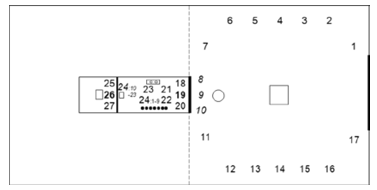
Figure 3. The chapters of Leviticus projected onto the floor plan of the Tabernacle; based on Mary Douglas, Leviticus as Literature, p. 223.
x times in the first section (Lev 1-17), y times in the second (Lev 18-24), and z times in the third (Lev 25-27).
The Outer Court (Lev 1-17)
Leviticus 1-17 forms a circle around the Outer Court: “the altar (of burnt offering)” (83, 2, 0) and “the door of the tabernacle” (22, 1, 0) are repeated throughout.
Leviticus 1-7 describes the altar offerings — we should think of these chapters being recited on the north side of the court with the hearers’ eyes focused on the altar itself; when they hear of washing, bathing, or rinsing with water, they would think of the laver. These seven chapters are summarized at the end of this section:
“This is the law of the burnt offering [Lev 1; 6:8-13; 7:8], of the meat offering [Lev 2; 6:14-18; 7:9-10], and of the sin offering [Lev 4:1-5:13; 6:24-30], and of the trespass offering [Lev 5:14-6:7; 7:1-7], and of the consecrations, and of the sacrifice of the peace offerings [Lev 3; 7:11-21, 28-34]; which the LORD commanded Moses in mount Sinai, in the day that he commanded the children of Israel to offer their oblations unto the LORD, in the wilderness of Sinai” (Lev 7:37-38; 6:9, 14, 25; 7:1, 11).
The allusions to Sinai remind us of the connections between the Tabernacle and the events on the mount.
Leviticus 8-10 describes the consecration of Aaron and his sons, followed by the execution of Nadab and Abihu for offering strange fire. This is the first of two narratives in Leviticus; the second is the blasphemy and execution of the son of an Egyptian man and Israelite woman (Lev 24:10-23). These narratives break up the detailed legal material that makes up most of the book. Figure 3 indicates that we should think of these two narratives being recited, respectively, just outside the door of the Tabernacle and just outside the veil that separates the Holy Place from the Most Holy Place. In both episodes, sinners are executed, thus preventing them from entering the next zone of holiness. The law of equitable retribution (lex talionis, cf. Lev 24:15-22) is followed in both: in the first, the burners are burnt (Lev 10), and in the second, the curser is cursed (by being stoned).
Leviticus 11-17 contains the laws of purification. Figure 3 indicates that we should think of these as being recited on the south side of the court. These chapters include laws for food (Lev 11), childbirth (Lev 12), leprosy of the skin, garment, and house (Lev 13-14), and issues (Lev 15), as summarized at the ends of these chapters:
“This is the law of the beasts, and of the fowl, and of every living creature that moveth in the waters, and of every creature that creepeth upon the earth: to make a difference between the beast that may be eaten and the beast that may not be eaten” (Lev 11:46-47).
“This is the law for her that hath born a male or a female” (Lev 12:7).
“This is the law for all manner of plague of leprosy, and scall, and for the leprosy of a garment, and of a house, and for a rising, and for a scab, and for a bright spot; to teach when it is unclean, and when it is clean; this is the law of leprosy” (Lev 14:54-57; cf. 13:59; 14:2, 32).
“This is the law of him that hath an issue, and of him whose seed goeth from him, and is defiled therewith; and of her that is sick of her flowers, and of him that hath an issue, of the man, and of the woman, and of him that lieth with her that is unclean” (Lev 15:32-33).
What does all of this have to do with the Outer Court? This question has two answers. The first is simple, yet vital: the purification laws frequently include altar offerings, establishing the fundamental principle that cleansing requires the shedding of blood for forgiveness and atonement. This principle is summarized succinctly in Hebrews, “The law requires that nearly everything be cleansed with blood, and without the shedding of blood there is no forgiveness” (Heb 9:22, TNIV).
The second answer is perhaps more surprising: having the purity laws recited in the Outer Court across from the altar offerings encourages hearers to see a parallel between the altar offerings and themselves as individuals. For example, individuals were not allowed to eat blood, just as the blood of the sacrifices was not consumed on the altar, but sprinkled on the furniture of the Tabernacle and poured out beside the altar. This connection between individuals and the offerings forms the basis of several challenging exhortations in the New Testament: “I beseech you therefore, brethren, by the mercies of God, that ye present your bodies a living sacrifice, holy, acceptable unto God, which is your reasonable service” (Rom 12:1) and “Ye also, as lively stones, are built up a spiritual house, an holy priesthood, to offer up spiritual sacrifices, acceptable to God by Jesus Christ” (1Pet 2:5).
This parallel is also the basis for the importance of obedience over sacrifice:
“And Samuel said, Hath the LORD as great delight in burnt offerings and sacrifices, as in obeying the voice of the LORD? Behold, to obey is better than sacrifice, and to hearken than the fat of rams” (1Sam 15:22).
“Sacrifice and offering thou didst not desire; mine ears hast thou opened: burnt offering and sin offering hast thou not required. Then said I, Lo, I come: in the volume of the book it is written of me, I delight to do thy will, O my God: yea, thy law is within my heart” (Psa 40:6-8; cf. Heb 10:5-10).
“O Lord, open thou my lips; and my mouth shall shew forth thy praise. For thou desirest not sacrifice; else would I give it: thou delightest not in burnt offering. The sacrifices of God are a broken spirit: a broken and a contrite heart, O God, thou wilt not despise” (Psa 51:15-17).
“For I desired mercy, and not sacrifice; and the knowledge of God more than burnt offerings” (Hos 6:6; cf. Matt 9:13; 12:7).
Further, it underlies the idea of song and thanksgiving being compared to sacrifices:
“I will praise the name of God with a song <7892 shiyr>, and will magnify him with thanksgiving. This also shall please the LORD better than an ox <7794 showr> or bullock that hath horns and hoofs” (Psa 69:30-31; notice the pun based on the similarity of the Hebrew words for “song” and “ox”).
“Take with you words, and turn to the LORD: say unto him, Take away all iniquity, and receive us graciously: so will we render the calves of our lips” (Hos 14:2).
“By him therefore let us offer the sacrifice of praise to God continually, that is, the fruit of our lips giving thanks to his name” (Heb 13:15).
Leviticus 16 records the laws for cleansing the high priest, the people, and the Tabernacle on the Day of Atonement. Much of the activity is to take place in the court at the altar and the laver. The path of the High Priest into the Most Holy Place within the veil and back out to the Outer Court is explicitly laid out.
Finally, Leviticus 17 completes the circle:
“What man soever there be of the house of Israel, that killeth an ox, or lamb, or goat, in the camp, or that killeth it out of the camp, and bringeth it not unto the door of the tabernacle of the congregation, to offer an offering unto the Lord … Whatsoever man there be of the house of Israel, or of the strangers that sojourn among you, that offereth a burnt offering or sacrifice, and bringeth it not unto the door of the tabernacle of the congregation, to offer it unto the LORD” (Lev 17:2-4, 8-9). ties back to the opening chapter:
“If any man of you bring an offering unto the Lord, ye shall bring your offering of the cattle, even of the herd, and of the flock. If his offering be a burnt sacrifice of the herd, let him offer a male without blemish; he shall offer it of his own voluntary will at the door of the tabernacle of the congregation before the LORD” (Lev 1:2-3).
Leviticus 17 also repeats the law forbidding the eating of blood (Lev 17:10-14; cf. 3:17; 7:26-27), which is another signal that it is closing the loop on the earlier chapters.
The next article will continue into the Holy Place and the Most Holy Place sections of Leviticus.
 The Origin of the Organic World – Part One