
The last article introduced the idea that the layout of the Tabernacle provides a spatial mnemonic for the book of Leviticus. It showed that Leviticus 1-17, with the descriptions of the altar offerings, the consecration of the priests, and the laws of purity, provides a circle of lessons appropriate for the Outer Court.
This article continues into the Holy Place and Most Holy Place sections of Leviticus. Figure 4 locates the chapters of Leviticus 18-27 on the floor plan of the tent of the Tabernacle, showing that Leviticus 18-24 corresponds to the Holy Place and Leviticus 25-27 to the Most Holy Place.
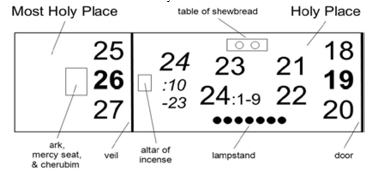
Figure 4. Leviticus 18-27 placed on the floor plan of the tent of the Tabernacle, showing the alignment of Leviticus 18-24 to the Holy Place, and Leviticus 25-27 to the Most Holy Place.
The Holy Place (Lev 18-24)
We should envision Leviticus 18-24 being recited in the Holy Place.
Leviticus 18-20 forms a “doorway composition”, a sequence of three chapters where the first (Lev 18) and third (Lev 20) discuss the same topic, thus providing a frame that focuses attention on the second (Lev 19). The framing chapters are like pillars for the door in the middle; compare them with Jachin and Boaz, the pillars in the porch of the temple (1Kgs 7:21).
In this case, the framing chapters (Lev 18; 20) contain laws concerning the sins of worshipping Molech and of having inappropriate sexual relations with near of kin. The word “Molech” (0, 5, 0)1 occurs five times in Leviticus, and all five are in these two chapters:
“And thou shalt not let any of thy seed pass through the fire to Molech, neither shalt thou profane the name of thy God: I am the Lord” (Lev 18:21).
“Again, thou shalt say to the children of Israel, Whosoever he be of the children of Israel, or of the strangers that sojourn in Israel, that giveth any of his seed unto Molech; he shall surely be put to death: the people of the land shall stone him with stones. And I will set my face against that man, and will cut him off from among his people; because he hath given of his seed unto Molech, to defile my sanctuary, and to profane my holy name. And if the people of the land do any ways hide their eyes from the man, when he giveth of his seed unto Molech, and kill him not: Then I will set my face against that man, and against his family, and will cut him off, and all that go a whoring after him, to commit whoredom with Molech, from among their people” (Lev 20:2-5).
The words “uncover” (0, 24, 0) and “nakedness” (0, 32, 0) occur throughout these two chapters, and nowhere else in Leviticus:
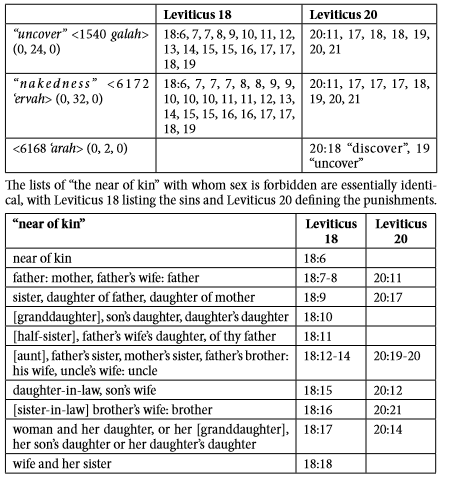
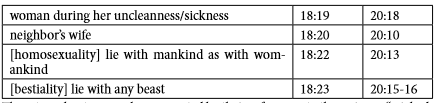
These two chapters are also connected by their references to these sins as “wickedness’, “abomination’, and “confusion’:
“Thou shalt not uncover the nakedness of a woman and her daughter, neither shalt thou take her son’s daughter, or her daughter’s daughter, to uncover her nakedness; for they are her near kinswomen: it is wickedness… Thou shalt not lie with mankind, as with womankind: it is abomination [cf. vv. 26, 27, 29]… Neither shalt thou lie with any beast to defile thyself therewith: neither shall any woman stand before a beast to lie down thereto: it is confusion” (Lev 18:17, 22, 23).
“And if a man lie with his daughter in law, both of them shall surely be put to death: they have wrought confusion; their blood shall be upon them. If a man also lie with mankind, as he lieth with a woman, both of them have committed an abomination: they shall surely be put to death; their blood shall be upon them. And if a man take a wife and her mother, it is wickedness: they shall be burnt with fire, both he and they; that there be no wickedness among you” (Lev 20:12-14).
These detailed connections between Leviticus 18 and 20 show that they are a frame, centering attention on the middle chapter, Leviticus 19. The importance of Leviticus 19 is obvious.
First, this chapter includes the second greatest commandment: “Thou shalt love thy neighbor as thyself” (Lev 19:18; cf. Matt 22:39; Mark 12:31; Luke 10:27). This by itself makes the chapter worth highlighting.
Second, Leviticus 19 reiterates the Ten Commandments:
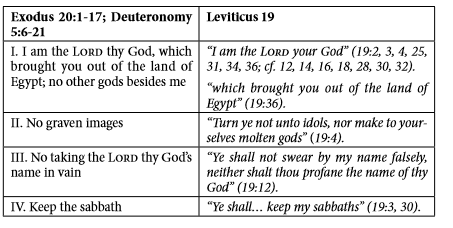
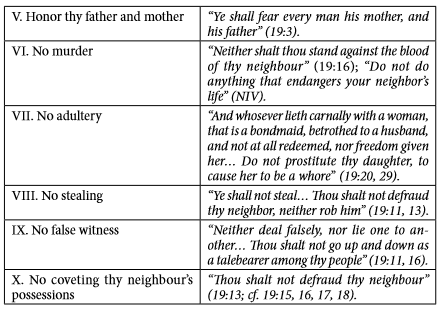
Finally, Leviticus 19, like several other chapters in Leviticus, includes the command to be holy because God is holy: “Ye shall be holy: for I the LORD your God am holy” (Lev 19:2; cf. 11:44-45; 20:7, 26; 21:6, 7, 8; 1Pet 1:15-16).
Leviticus 21-22 contains laws specific to priests, making these chapters appropriate to be read in the Holy Place, which was restricted to the priests.
Leviticus 23 is the Calendar of Holy Convocations, the Feasts of the LORD. These days were full of activity for the priests; these Bible-School-like holidays for Israel were times of double duty or more for the priests.
Leviticus 24:1-9 describes the daily lighting of the lamps and the weekly replenishment of the table of shewbread, both of which were housed in the Holy Place. The people of Israel would mentally have their eyes on these pieces of furniture as Moses recited the laws about them.
Finally, Leviticus 24:10-23 is the narrative of the man stoned for blasphemy; as the previous article showed, these verses would be appropriate for reading before the veil.
The Most Holy Place (Lev 25-27)
Leviticus 25-27 is another doorway composition: Leviticus 25 and 27 frame Leviticus 26. In the book of Leviticus the words “jubilee”, “redeem”, “sell”, and “wax poor” occur only in chapters 25 and 27; and the words “possession”, “buy”, and “servant” are used almost exclusively in these two chapters:
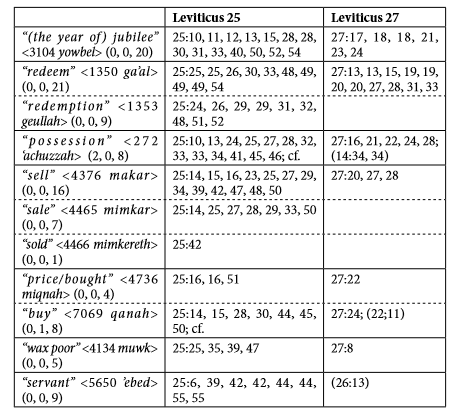
These topics are appropriate for the Most Holy Place. For example, in the year of Jubilee, liberty was to be proclaimed throughout the land (Lev 25:10): this command is associated with the covenant (Jer 34:8-22) and the kingdom age (Isa 61:1; Ezek 46:17).
These two framing chapters (Lev 25; 27) focus attention on Leviticus 26, which rehearses the stipulations of the covenant between God and His people Israel. The word “covenant” <1285 beriyth> (1, 1, 8) occurs eight times in this chapter, reminding us of the tables of the covenant in the ark of the covenant in the Most Holy Place:
“For I will have respect unto you, and make you fruitful, and multiply you, and establish my covenant with you” (Lev 26:9).
“And if ye shall despise my statutes, or if your soul abhor my judgments, so that ye will not do all my commandments, but that ye break my covenant” (Lev 26:15).
“And I will bring a sword upon you, that shall avenge the quarrel of my covenant: and when ye are gathered together within your cities, I will send the pestilence among you; and ye shall be delivered into the hand of the enemy” (Lev 26:25).
“Then will I remember my covenant with Jacob, and also my covenant with Isaac, and also my covenant with Abraham will I remember; and I will remember the land… And yet for all that, when they be in the land of their enemies, I will not cast them away, neither will I abhor them, to destroy them utterly, and to break my covenant with them: for I am the Lord their God. But I will for their sakes remember the covenant of their ancestors, whom I brought forth out of the land of Egypt in the sight of the heathen, that I might be their God: I am the Lord” (Lev 26:42, 44-45).
Leviticus 26:11-12 summarizes the very essence of the Tabernacle and Most Holy Place:
“And I will set my tabernacle among you: and my soul shall not abhor you. And I will walk among you, and will be your God, and ye shall be my people” (Lev 26:11-12; cf. Exod 25:8, 21-22; 29:45-46; Num 7:89; Psa 80:1; 99:1; Rev 21:3).
The following concepts related to the provisions of God’s covenant with Israel occur in Leviticus only in chapter 26: “enemy” <341 ‘oyed> (26:7, 8, 16, 17, 25, 32, 34, 36, 37, 38, 39, 41, 44), “remember” <2142 zakar> (26:42, 42, 45), “sword” <2719 chereb> (26:6, 7, 8, 25, 33, 36, 37), “punish/reform/chastise” <3256 yacar> (26:18, 23, 28), “despise” <3988 ma’ac> (26:15, 43, 44), “abhor” <1602 ga’al> (26:11, 15, 30, 43, 44), and “contrary” <7147 qeriy> (26:21, 23, 24, 27, 28, 40, 41).
Finally, Leviticus 25-27 has three explicit reminders that these are the words the Lord spoke to Moses in Mount Sinai:
“And the Lord spake unto Moses in mount Sinai… These are the statutes and judgments and laws, which the Lord made between him and the children of Israel in mount Sinai by the hand of Moses… These are the commandments, which the Lord commanded Moses for the children of Israel in mount Sinai” (Lev 25:1; 26:46; 27:34).
 The Origin of the Organic World – Part One