
The children of Israel arrived at Mount Sinai in the third month, seven weeks after Passover. Here God constituted them as His holy nation. The Lord revealed Himself to them and established His covenant with them. On their part, they proclaimed their intent to obey Him in all things. This exchange of vows confirmed that they were His people and He was their God.
The theophany was magnificent. God came down on the mount and made His presence known in power that the Spirit describes using the language of a severe thunderstorm, a massive earthquake, a raging fire, and a piercing trumpet blast:
“And the Lord said unto Moses, Lo, I come unto thee in a thick cloud… the third day the Lord will come down in the sight of all the people upon mount Sinai… And it came to pass on the third day in the morning, that there were thunders and lightnings, and a thick cloud upon the mount, and the voice of the trumpet exceeding loud; so that all the people that was in the camp trembled… And mount Sinai was altogether on a smoke, because the Lord descended upon it in fire: and the smoke thereof ascended as the smoke of a furnace, and the whole mount quaked greatly. And when the voice of the trumpet sounded long, and waxed louder and louder… And the Lord came down upon mount Sinai, on the top of the mount” (Exod 19:9-11, 16, 18-20).
This unnatural event was awesome. It made a lasting impression on the children of Israel, and was remembered in hymns and prayers like these:
“The mountains melted from before the Lord, even that Sinai from before the Lord God of Israel” (Jdgs 5:5).
“The earth shook, the heavens also dropped at the presence of God: even Sinai itself was moved at the presence of God, the God of Israel… The chariots of God are twenty thousand, even thousands of angels: the Lord is among them, as in Sinai, in the holy place” (Psa 68:8, 17).
“The Lord reigneth… Clouds and darkness are round about him: righteousness and judgment are the habitation of his throne. A fire goeth before him, and burneth up his enemies round about. His lightnings enlightened the world: the earth saw, and trembled. The hills melted like wax at the presence of the Lord, at the presence of the Lord of the whole earth” (Psa 97:1-5).
“Thou camest down also upon mount Sinai, and spakest with them from heaven, and gavest them right judgments, and true laws, good statutes and commandments” (Neh 9:13).
The Tabernacle and Mount Sinai
Yet the time would come that Israel would leave this “mount of God” (Exod 24:13; Num 10:33; cf. Exod 3:1; 4:27; 18:5; 1Kgs 19:8). This departure could easily make them think that they were leaving God behind. As long as they were at Mount Sinai, the nearness of God remained firmly established in their minds. As they withdrew from the site of the theophany, how would God make them know that He was still with them? What tangible sign would God give that He was dwelling among them? The answer, of course, is the Tabernacle. This connection is made plain by the following analogies between the Tabernacle and the events at Sinai.
God and His people. At Sinai, God declared, “Now therefore, if ye will obey my voice indeed, and keep my covenant, then ye shall be a peculiar treasure unto me above all people: for all the earth is mine: And ye shall be unto me a kingdom of priests, and an holy nation… And God spake all these words, saying, I am the Lord thy God, which have brought thee out of the land of Egypt, out of the house of bondage” (Exod 19:5-6; 20:1-2). The Tabernacle has the same purpose: “And I will dwell among the children of Israel, and will be their God. And they shall know that I am the Lord their God, that brought them forth out of the land of Egypt, that I may dwell among them: I am the Lord their God” (Exod 29:45-46).
Place to meet with God. At Mount Sinai, God met with His people: “And Moses brought forth the people out of the camp to meet <7125 qir’ah from 7122 qara> with God” (19:17). Likewise, He would meet with them in the Tabernacle:
“And there I will meet <3259 ya’ad> with thee, and I will commune with thee from above the mercy seat, from between the two cherubims which are upon the ark of the testimony, of all things which I will give thee in commandment unto the children of Israel… This shall be a continual burnt offering throughout your generations at the door of the tabernacle of the congregation before the Lord: where I will meet <3259> you, to speak there unto thee. And there I will meet <3259> with the children of Israel, and the tabernacle shall be sanctified by my glory” (Exod 25:22; 29:42-43; cf. 30:6, 36).
The frequent phrase “the tabernacle (of the tent) of the congregation <4150 mow’ed from 3259>” or “meeting” (see RV, RSV, NRSV, NASB, NKJV, NIV, ESV, and others), emphasizes that the Tabernacle was the place where the children of Israel met with the LORD.
People, priests, and place sanctified. Concerning Sinai:
“And the Lord said unto Moses, Go unto the people, and sanctify <6942 qadash> them to day and to morrow, and let them wash their clothes… And Moses went down from the mount unto the people, and sanctified <6942> the people; and they washed their clothes… And let the priests also, which come near to the Lord, sanctify <6942> themselves, lest the Lord break forth upon them. And Moses said unto the Lord, The people cannot come up to mount Sinai: for thou chargedst us, saying, Set bounds about the mount, and sanctify <6942> it” (Exod 19:10, 14, 22-23).
Concerning the Tabernacle:
“And let them make me a sanctuary <4720 miqdash from 6942>; that I may dwell among them… The tabernacle shall be sanctified <6942> by my glory. And I will sanctify <6942> the tabernacle of the congregation, and the altar: I will sanctify <6942> also both Aaron and his sons, to minister to me in the priest’s office” (Exod 25:8; 29:43-44; and many others).
The cloud, the glory of the Lord. Sinai was enveloped by the cloud of God’s glory: “And a cloud covered the mount. And the glory of the Lord abode upon mount Sinai, and the cloud covered it six days: and the seventh day he called unto Moses out of the midst of the cloud. And the sight of the glory of the Lord was like devouring fire on the top of the mount in the eyes of the children of Israel” (24:15-17). Similary, the Tabernacle was filled with His cloud of glory: “Then a cloud covered the tent of the congregation, and the glory of the Lord filled the tabernacle. And Moses was not able to enter into the tent of the congregation, because the cloud abode thereon, and the glory of the Lord filled the tabernacle” (Exod 40:34-35).
In these four essentials — God and His people; place to meet with God; people, priests, and place sanctified; and the cloud, the glory of the LORD — the Tabernacle was a portable continuation of the theophany at Mount Sinai. Just as God had tangibly manifested Himself in the mount, the Tabernacle was a tangible manifestation of God dwelling among the Israelites. He would be with them wherever they went. Beyond these four general analogies, there are detailed analogies as well.
Three Zones of Holiness
Mount Sinai. God established three zones of holiness and restricted access relative to the theophany on Mount Sinai (see Figure 1).
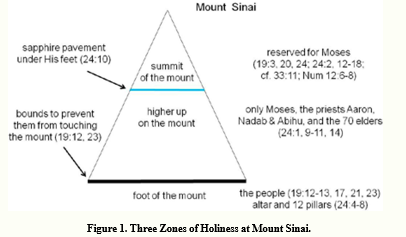
First, the people were allowed to come to the foot of the mount; they were not allowed to touch the mount, but could only come up to the border where bounds were set to prevent them from going up further; they stood at the nether part, and were unable to gaze upon the LORD:
“And thou shalt set bounds unto the people round about, saying, Take heed to yourselves, that ye go not up into the mount, or touch the border of it: whosoever toucheth the mount shall be surely put to death… And Moses brought forth the people out of the camp to meet with God; and they stood at the nether part of the mount… And the Lord said unto Moses, Go down, charge the people, lest they break through unto the Lord to gaze, and many of them perish… And Moses said unto the Lord, The people cannot come up to mount Sinai: for thou chargedst us, saying, Set bounds about the mount, and sanctify it” (Exod 19:12, 17, 21, 23).
Moses built an altar (for sacrificing burnt offerings and peace offerings unto the LORD) and twelve pillars (representing the twelve tribes) at the foot of the mount, under the hill:
“And Moses wrote all the words of the Lord, and rose up early in the morning, and builded an altar under the hill, and twelve pillars, according to the twelve tribes of Israel. And he sent young men of the children of Israel, which offered burnt offerings, and sacrificed peace offerings of oxen unto the LORD. And Moses took half of the blood, and put it in basons; and half of the blood he sprinkled on the altar. And he took the book of the covenant, and read in the audience of the people: and they said, All that the Lord hath said will we do, and be obedient. And Moses took the blood, and sprinkled it on the people, and said, Behold the blood of the covenant, which the Lord hath made with you concerning all these words” (Exod 24:4-8).
Next, Moses, Aaron, Nadab, and Abihu, and the seventy elders were allowed to come to a point further up the mount, where they saw God (from below, through the crystal-clear sky-blue sapphire pavement under His feet), and where they did eat and drink:
“And he said unto Moses, Come up unto the Lord, thou, and Aaron, Nadab, and Abihu, and seventy of the elders of Israel; and worship ye afar off… Then went up Moses, and Aaron, Nadab, and Abihu, and seventy of the elders of Israel: And they saw the God of Israel: and there was under his feet as it were a paved work of a sapphire stone, and as it were the body of heaven in his clearness. And upon the nobles of the children of Israel he laid not his hand: also they saw God, and did eat and drink” (Exod 24:1, 9-11).
Finally, only Moses was allowed to enter the cloud of glory at the summit of the mount, where he and God communicated directly, face-to-face, mouth-to-mouth, as friends:
“And Moses went up unto God, and the Lord called unto him out of the mountain… And the Lord came down upon mount Sinai, on the top of the mount: and the Lord called Moses up to the top of the mount; and Moses went up… And the Lord said unto him, Away, get thee down, and thou shalt come up, thou, and Aaron with thee: but let not the priests and the people break through to come up unto the Lord, lest he break forth upon them… And Moses alone shall come near the Lord: but they shall not come nigh; neither shall the people go up with him… And the LORD said unto Moses, Come up to me into the mount, and be there: and I will give thee tables of stone, and a law, and commandments which I have written; that thou mayest teach them. And Moses rose up, and his minister Joshua: and Moses went up into the mount of God. And Moses went up into the mount, and a cloud covered the mount. And the glory of the LORD abode upon mount Sinai, and the cloud covered it six days: and the seventh day he called unto Moses out of the midst of the cloud. And the sight of the glory of the LORD was like devouring fire on the top of the mount in the eyes of the children of Israel. And Moses went into the midst of the cloud, and gat him up into the mount: and Moses was in the mount forty days and forty nights” (Exod 19:3, 20, 24; 24:2, 12-18; cf. 33:11; Num 12:6-8; Deut 34:10).
The Tabernacle. The structure of the Tabernacle follows the same pattern (see Figure 2); its three zones of holiness are the Outer Court, the Holy Place, and the Most Holy Place (or Holy of Holies).
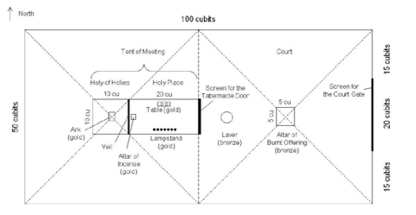
Figure 2. Floor Plan of the Tabernacle; based on Nahum Sarna, Exploring Exodus, p. 192. The Tabernacle had three zones of holiness: the Outer Court, the Holy Place, and the Most Holy Place (or Holy of Holies).
The Outer Court compares to the foot of the mount: the people were allowed to come into the Outer Court, where the altar of burnt offering was located (Exod 27:1-8; 38:1-7; 40:6, 19). The Holy Place corresponds to the location on the mount short of the summit: only the priests were allowed into the Holy Place to minister unto the LORD (Exod 28-29; 39:1-31; Num 18:1-7; Heb 9:6). The table of shewbread recalls the priests and elders eating and drinking on the mount. The Most Holy Place is analogous to the summit of the mount: only the High Priest, and only once a year on the Day of Atonement, was allowed to enter into the Most Holy Place (Lev 16; Heb 9:7; Exod 30:10). As the LORD conversed with Moses in the top of mount, so He does in the Most Holy Place.
The most significant reminder of the Sinai theophany was provided by the two tables of stone (Exod 24:12, 31:18; 32:15-16; 34:1, 4) which were kept in the ark (Exod 25:16, 21; 40:3, 20; cf. Deut 31:26). This tangible symbol of the covenant was the heart and focus of the entire structure, and gave rise to the phrases “the ark of the testimony” and “the ark of the covenant”.
As we will see in future studies, the three zone structure of the Tabernacle is the basis for the literary structure of Leviticus. Moreover, it foreshadows the reality of Jesus Christ and the saints, the stages in the life of a believer, and the fulfillment of the purpose of creation in the Kingdom.
 The Origin of the Organic World – Part One