
Unlike Most Biographers, Robert Roberts gives us very little information on Dr. Thomas’ family, or his means of support. I have been asked several times about these more personal aspects of the founder of our movement, so I will summarize what little I and others have gleaned from the records; the financial aspects will have to await another occasion. I will not here attempt to give an account of the early life of Dr. Thomas. (Incidentally, a few have written with personal accounts of Dr. Thomas, mostly gleaned from their Grandparents: if any others have similar stories, I would appreciate them for a future article.)
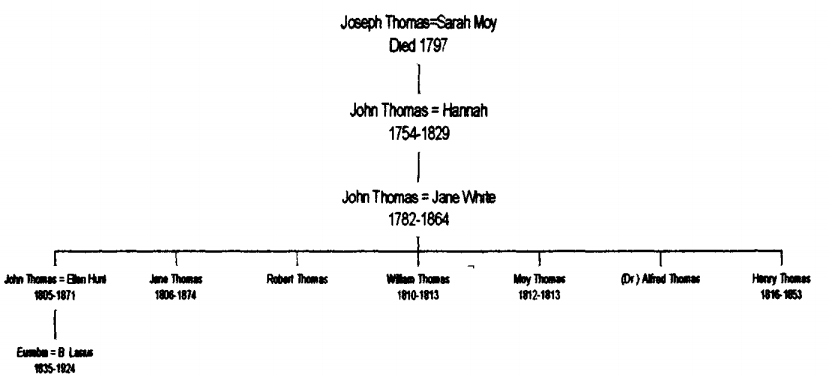
Note that the positions of Robert and Alfred are conjectural. I have no certain information on their birth or their deaths.
The Relatives of Dr. Thomas
Dr. Thomas’ paternal great-grandfather, Joseph Thomas, was a mariner from Bristol, England, but little is know of him. His grandfather, John, moved to London, where his father, also called John, was born in 1782. He married a Jane White on May 4, 1804, and on April 12, 1805 they had a first-born son, whom they not surprisingly called John. Thus “our” John Thomas was the third to bear his name in his family.
Reverend John Thomas. Dr. Thomas’ father, whom we will call the Rev. John Thomas, was a man of many trades, but was primarily a minister, latterly of the Baptist persuasion, and a schoolteacher. He arrived in America, presumably with the rest of the family, only three days after his son in April, 1832 and briefly became a Baptist minister in Cincinnati. He never was fully reconciled to his son’s beliefs, opposing Dr. Thomas’ baptism as a Campbellite, and, according to the Reverend’s diary “quarreled, for I could not but resent it and remain m Cincinnati under such circumstances I could not “He therefore left to return to England He came back to become a Baptist minister m Philadelphia in 1833, where his son was also preaching from a Campbellite pulpit He did not stay long, returning to England again sometime in the mid 1830’s He was dependent on his son, Henry, for his entire support by 1848, according to his diary.
His last transatlantic voyage for him, his wife and daughter seems to have been soon after 1853, when the last son to remain in England, Henry, died In any event, we next find him m Dubuque, Iowa, writing another anti-Catholic tract that was advertised m Dr Thomas’ Herald of the Kingdom of 1853 Dr Thomas also records a visit to that city in 1854, that took him 450 miles out of his way — but never mentions the obvious reason for the visit Dr Thomas and his father were a little more friendly late m his life.
The Rev Thomas published several works during his life, all religious, all exhibiting an anti-Catholic and pro-Calvinistic stance He died in Washington, D C in the spring of 1864, at the age of 82, probably at the home of his son Alfred Much additional information about his life is recorded in the various histories, particularly Lippy’s book Christadelphians in North America.
Jane Thomas (White). Little is recorded about Dr Thomas’ mother, who was the daughter of William White of Rotherhithe, a suburb of London, England Dr Thomas says “our moral training at the hands of a kind and pious mother was the best education the Calvinism of the Scottish Kirk could enable her to give” Robert Roberts (presumably from the mouth of Dr Thomas ) records a “mild and amiable lady, of a religious turn” There is an account of how she ensured her husband left Huntly, near Aberdeen, Scotland, a place she disliked According to a local history, Mrs Thomas, on the morning when a meeting was held to consider his resignation, hid all his clothes, fear-mg that he might be persuaded to stay It would indeed be difficult to remain after such an event, Dr Thomas records his mother and his sister, Jane, had “put on Christ” m 1834, presumably m the Campbellite faith She must have accompanied her husband on his transatlantic crossings, for she is recorded in New York in 1832, and died there many years later
Jane Thomas. Born in 1806, one year after John, Jane was the main help among his family in his religious activities She appears to have become a Campbellite in 1834, and presented him to at least one Campbellite Church when Dr Thomas came to England to stay with his brother, Henry, m 1848 She was the one member of the family who appears to have grasped Dr Thomas’ message, at least partially Never being married, as far as I can tell, she came to America, to Washington, D C, presumably when all her remaining family were here in the USA She was listed among the members there in 1870 as “Jane Thomas, Schoolteacher, sister of the doctor,” but in 1871 the comment was “she accepted truth, but cooperated with the Adventists” Her death m 1874 was recorded in the Christadelphian with somewhat neutral words by Eusebia Lams, Dr Thomas’ daughter “She believed in the truth in most material matters”
Robert Thomas. This younger brother of Dr Thomas is the one that appeared to spend the most time with his sibling He is recorded as working m the printing operation of Alexander Campbell in 1833, and joined his brother soon after this, I believe It seems also likely he used his experience m Campbell’s print shop in helping Dr Thomas establish his printing operation in Virginia, publishing the Apostolic Advocate and various other publications. He certainly is notorious for twice nearly killing his brother in rifle accidents once by overcharging Dr Thomas’ rifle, the other because he was such a poor shot that the Doctor took the gun, which accidentally discharged as he attempted to shoot an eagle He accompanied Dr Thomas in his journey to Illinois in 1839, and remained there when Dr Thomas returned to the East in 1843 As far as I know, the two had no further personal contact, although Robert acted as Dr Thomas’ agent in Illinois to wrap up affairs there
William and Moy Thomas. These brothers of Dr Thomas died in infancy, on the same day, March 27, 1813, when Dr Thomas was only eight Moy, who died at eleven months, bore the old family name of his great-grandfather It must have been William that Dr Thomas recollects in his pamphlet Odology as “a child of three years old, standing with a ruler in his hand, with which he had Just struck me over the head” Written in 1852, the child was then 39 years m the grave — “over thirty years” as Dr Thomas said (Odology was written as an antidote to spiritualism )
Alfred Thomas Also a medical doctor, he was to be found residing in Richmond, Virginia in the 1840’s when Dr Thomas was there He wrote in defense of Dr Thomas when Alexander Campbell accused him of being “an undutiful son, bad husband, and disgraceful brother” He said ma letter dated March 10, 1845 “(Dr Thomas) has always sustained among his relatives and friends, a character for the strictest integrity, honor, and veracity” Alfred subsequently moved to Washington, becoming the superintending surgeon of the Kalozama Hospital there Dr Thomas went to see him quite frequently m the 1860’s, but became increasingly estranged from his brother over the refusal of Alfred to have anything to do with the gospel Despite this, he went to see him and his sister Jane in July of 1870, “before he took his final departure for England,” (which he never accomplished, dying m March of the next year) I would assume Alfred or his descendants emigrated to California, for that is where some old records of the Rev Thomas were passed on to Christadelphians m the 1920’s “from the family of Dr Thomas’ brother”
Henry Thomas. This youngest brother remained in England, becoming the Secretary of the English RSPCA (Royal Society for the Prevention of Cruelty to Animals) m 1835 He invited his brother to stay with him, and his was the house at 3 Brudnell Place at which Dr Thomas and his daughter stayed while he was in England 1848-50 It was also the place where Elpis Israel was composed the location disappeared in 1863 His death m 1853 at the age of 37 from tuberculosis was reported to the annual meeting of the Society thus:
“Your Committee have to mention with regret the death of their respected secretary, Mr. Henry Thomas, who, during the years he was in the service of the association, displayed much zeal in its interests, and evinced so much discrimination in conducting its prosecutions, as to fairly entitle him to the grateful recollections of the Society.”
He was fearless, we are told, in enforcing the law against cockfighting, going out with his inspectors with the full knowledge they would be attacked upon recognition. Like his older brother, he was tireless in upholding his principles even at the risk of life and limb.
Ellen (Hunt) Thomas. This long-suffering wife of Dr. Thomas was quite overshadowed by her husband, being afflicted with tuberculosis (pithisis) from about the time of the birth of her daughter, Eusebia Jane, in 1835. Married to Dr. Thomas on January 1, 1834, the marriage records have not come to hand, perhaps because the marriage took place not in Philadelphia where Dr. Thomas was, but in either Cincinnati or New Jersey. She was first baptized by one David Burnett, presumably in Cincinnati, and it seems likely she was related to Rebecca Hunt Lawrence, the wife of Daniel Gano. Gano was the first friend of Dr. Thomas, at whose house he stayed in 1832. It seems probable she met her husband-to-be in Cincinnati. She appeared to have been a loyal and devoted follower of her husband, being re-baptized in 1834 from her sick-bed, but only after prayerful reading of the scriptures and study by herself.
After his death she commented on her husband that “The Doctor belonged to the public and was not much of a woman’s man.” She seemed to endure being left alone at friend’s houses for lengthy periods without complaint, aware her husband was on the Lord’s duties. Her family was from close to Trenton, New Jersey: she went to stay there in 1845, but had a relapse and her husband had to go and fetch her home.
Her brother, James, went from the East to Naperville, Dupage County, Illinois around 1836, and enticed Dr. Thomas and his family to join him in 1839 through a letter to his sister, Ellen, with promises of a fertile land and great opportunities. She survived her husband by ten years, despite her invalid status, dying on Sept. 7, 1881. At her death, one correspondent wrote.
“Our beloved Sister Thomas has fallen asleep after along period of suffering. She left an example of suffering affliction and patience which all who know her can testify…That grace which beautifies and adorns all other graces (humility) shone most brightly in her character; her sympathetic nature, her benevolence, and, in fact, all the characteristics which go to make up the true believer seemed to be fully developed in her. A mother in Israel has passed away; God help us to follow her as she followed Christ.” She was lain to rest beside her husband, to wait in the sleep of death the sure hope of resurrection she shared with him.
Eusebia Jane Lasius (nee Thomas). This only daughter of John and Ellen was undoubtedly the strongest, most devoted, and most prominent proponent of Dr. Thomas’s views among his relatives. Born in 1835, her private life is almost a complete mystery we assume she married a B Lams around 1854, as there is an article from one with that initial in the Herald for 1861 There exists a strong tradition m the Washington, D C meeting that Sis Lasius, as she was always known, and her husband were members there in the 1850’s, but by the time Dr Thomas left for England m 1867 she was a widow, with the marriage being childless I have been quite unable to find any traces of her husband or of her marriage The surname is not known m the USA today! It is probably of Germanic origin, but the immigrant records led nowhere.
As Robert Roberts comments “a slim lady in black” accompanied her father on the journey to England, and her accounts are to be found m the Christadelphian for 1868 She was a well-known writer, some of her books becoming popular, one in particular, Yahweh Elohim, still being in print. Another well known work is Covenants of Promise, written m 1885 She died m 1924, after a long and devoted life m the truth This life was not, however, without its difficulties She was, for many years, somewhat reclusive, only meeting with a few close acquaintances The ecclesial situation m New York, where she spent her last years, was particularly complex at that time, with at least four groups all calling themselves Christadelphians, but none fellowshipping each other.
She was an extremely frequent correspondent m the Christadelphian, be-mg m effect the keeper of her father’s flame in America She was book agent, corresponding secretary, and hostess to those she knew and trusted She remained aloof from the divisions m America, was alert mentally to the end, but physically somewhat crippled At her death, Bro Walker, editor of the Christadelphian, commented “She was not skilled in matters of finance, and was often a difficult problem to her best friends But we learn to bear with one another in this imperfect world, and she was always ready to appreciate and acknowledge kindness shown to her for her father’s sake” She is buried beside her father and mother, and Robert Roberts, m Greenwood Cemetery, New York It seems poignantly sad to us that the direct line to Dr Thomas m our fellowship ended with her death
Conclusion
A number of family traits inherited from their forefathers were shared by Dr Thomas and his siblings and daughter determination, wanderlust, high principles, and m a few, a deep religious attitude He is remembered, however, not by his family, who have turned over records and memorabilia to Christadelphians, but by those of us who have studied the word of God through the help of his writings Though he was “a prophet without honor” among them, yet will John Thomas, along with many disciples down through the ages, see his spiritual seed, born of the “travail of his soul,” and he “shall be satisfied”
Note on Sources The little book by Charles Blore Dr Thomas – His family gives, in a very idiosyncratic way, much valuable information, including the family tree reproduced here Much of the rest is gleaned from the pages of Dr Thomas’ writings, especially the Herald of the Future Age Some details of Mrs Ellen Thomas’ early life were obtained from old Campbellite writings.
 The Origin of the Organic World – Part One