
The term “Christadelphian” as a name for our denomination is one we have all struggled with, at one time or another. I will deal with the well-known account of its origin, first describing the Federal Conscription Act that forced Dr. Thomas to come up with a denominational name. I will also give a brief account of the Coffmans, at whose isolated farmhouse in Ogle County, Illinois, our name was coined, and who also gave considerable financial support to Dr. Thomas over the years. We have already seen how Dr. Thomas used the term “Brethren in Christ” to describe those who were opposed to the bearing of arms. Now he was to take the same expression and translate it into Greek — as he was wont to do. One has only to think of Elpis Israel (hope of Israel), Phanerosis (manifestation), Anastasis (rising up), even Eureka (I have found it) — no major work of Dr. Thomas carried a title in English, and neither does our denomination.
The Federal government and conscription
Unlike the situation in the south, in the north conscription was for several years handled at the state level, and there was no particular pressure on conscientious objectors until 1863 or so. In this year, the first federal conscription act, without any provision for objection on account of conscience, was issued on March 3. This was despite efforts on behalf of the Quakers to add specific language concerning those with religious objections to bearing arms. In fact, prior to this act, the legal opinion was: “The Society of Friends, and others entertaining similar sentiments, may find relief from their scruples in the employment of substitutes, or the payment of $300.” You can tell from this that the Quakers were almost alone in their opposition to military service.
Later, on February 24, 1864, the Congress passed a conscription act that included a section (# 17) dealing with “persons conscientiously opposed to bearing arms, etc., if drafted how to be treated.” The act also provided, “That no person shall be entitled to the provisions of this section unless his declaration of conscientious scruples against bearing arms shall be supported by satisfactory evidence that his deportment has been uniformly consistent with such declaration.” Either non-combatant service or the payment of $300 was required: the other requirement of the act was that any members of religious denomination who objected must affirm that they are “prohibited from doing so (bearing arms) by the rules and articles of faith of said religious denomination.”
The visit to Ogle County
It was some time in August, 1864, when Dr. Thomas arrived in Ogle County, Illinois, to be made welcome at Cold-water Spring farm, home of Bro. Samuel Coffman. Situated about 30 miles from Rockford, Illinois, the nearest town is Adeline, with a present population of 163, probably not much different from Coffman’s day. The farm still exists, on the north side of Coffman Road, between Bluff and Lone road, the present building dates back only to the 1930’s. Dr. Thomas was conveyed to this mini-estate from Freeport, about ten miles away, and arrived to find the brethren much troubled by the upcoming draft on September 19, which would be governed by the conscription act as discussed above. It will be clear that, according to the recently passed act, it was essential to belong to an established denomination to appeal against conscription; individual conscience was not allowed for at that time. Dr. Thomas accurately related the contents of the act to Bro. Samuel Coffman, and, after having slept on the problem of the name, continued, “There was a denomination not known to the ignorance of legislative wisdom. It was relatively very small, but nevertheless a Denomination and a Name, contrary to, and distinct from, all others upon the earth… It would be necessary to give the Name a denominational appellation, that, being so denominated, they might have the wherewith to answer the Inquisitors… I did not know a better denomination that would be given to such a class of believers than Brethren in Christ. This declares the true status; and as officials prefer words to phrases, the same fact is expressed by the word Christadelphians, or Xpιóτou αδελ∅οι Christ’s Brethren.”
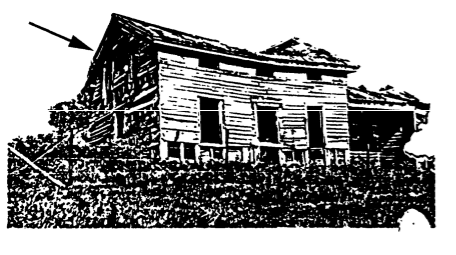
He came up with the name after spending overnight in an upstairs room of the Coffman’s house, as shown with an arrow on the old photograph. It is a poor picture of the old farmhouse, about to be demolished, taken 70 years ago by Sis. May Harris. On its site she constructed a baptismal tank, which was used to baptize several Christadelphians, some of whom are still living. It has now become quite overgrown.
 Dr Thomas went on to write a certificate which said, in part, “This is to certify that S W Coffman (the names of the ten male members m full here) and others constitute a Religious Association denominated herein for the sake of distinguishing them from all other ‘Names and Denominations,’ Brethren in Christ, or in one word `Christadelphians Note that the quotation is exactly how the letter appears m the Ambassador, nowhere are the names of the other nine given.
This account is fairly well known, although usually the name of S W Coffman is omitted There are several little sidelights
- The Coffmans are called “Christ Adelphine’s” in old histories Were the historians confusing “Christadelphian” with “Adeline,” the local town? Or did Dr Thomas, in pondering the name overnight, think of the local town?
- At almost the same time, two other denominations were named, for similar reasons of objection to military service A group called themselves “Brethren in Christ” in Lancaster County, Pennsylvania, in 1864, who are more commonly known as the “River Brethren,” a denomination with an Anabaptist background And of course at about this time Benjamin Wilson, a few miles away in Geneva, Illinois, coined the term “Church of God of the Abrahamic Faith”
The Coffman family
The two Coffman brothers with whom we are concerned, Abraham and Samuel W, were both born m Maryland Their father, John, was in fact born on board ship as his parents emigrated from Germany The family moved to Illinois m 1840, and seemed to have prospered greatly (unlike Dr Thomas, who moved to Illinois at almost the same time). The Coffmans and Dr Thomas soon met They took his magazine and corresponded, but it was not until 1860 that Abraham was baptized by Dr Thomas, and 1861 before Samuel, the eldest, followed suit At the time, there were far more followers of Benjamin Wilson in the area than Dr Thomas, but the Coffman family proved to be staunch and generous supporters of Dr Thomas over the years to come Essentially, they underwrote the publication of the third volume of Eureka, contributing over $1,200 from their little group As Robert Roberts commented when he visited m 1871, “He (Samuel) is an Abraham on a small scale Brother Coffman’s whole house is in the faith, with several of his servants On the farm (800 + acres) he has built a meeting place, and opened a burying place (still existing), in which the doctor, during life, spoke frequently of being laid to rest”
This farm was indeed where the name “Christadelphian” originated, and the property was passed down eventually to Sis May Hams Her grandfather was Abraham Coffman, and her mother was Elizabeth Harris, nee Coffman, who died early When she died, she willed half the proceeds of the farm (sold back to the Coffman family, none of whom were still in the Truth) to the Rockford, Illinois Ecclesia — so one can say the wealth of the Coffmans not only helped Dr Thomas, but continues to help Christadelphians in our own day!
There were, as far as I can tell, six surviving sons of Abraham and Samuel Coffman in 1864, and together with the two elder Coffmans their names must have represented eight of the ten members listed in the original certificate: presumably the other two were servants, names unrecorded. Thus the eight names are (all surnamed Coffman): Abraham, Samuel W., John D., Adison, Henry, Isaiah, John N. and Eugene. The family tree is shown below.
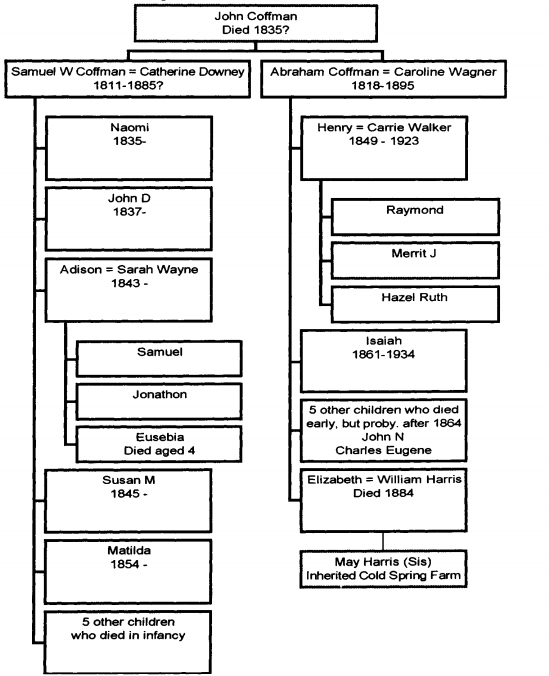
(There was another brother of Samuel and Abraham, Nathaniel, but there is no information as to whether he was ever baptized a Christadelphian.)
By the time Robert Roberts visited the group in 1871, after Dr Thomas’ death, they were able to attract more than 40 people to hear Bro Roberts and his companions expound the truth It is clear, from frequent correspondence in the Ambassador, afterwards the Christadelphian, that the topic of God manifestation greatly concerned the local brethren – indeed Robert Roberts had to address the topic before the breaking of bread Only after the brethren declared themselves a unit on the question was bread broken – the particular topic dealt with was the erroneous doctrine that Jesus was a mere man.
The little ecclesia maintained its viability for many years, eventually probably becoming part of the Rockford, Illinois ecclesia The only traces now left in the area are the old records, the overgrown baptismal tank on the site of the old house, and the graveyard, where Dr Thomas expected to be buried, it being the “only piece of virgin mother earth available for such a purpose, without the intervention of the soul merchants of the apostacy,” in Bro Roberts’ words
Petition to United States Congress
The certificate prepared by Dr Thomas was basically only for the use of the brethren m Ogle County To bring the story to a natural conclusion, he also drafted a petition, dated March 12, 1865, addressed to the United States Congress As printed m the Ambassador, Vol 11, p 169, the petition is about 1,000 words To summarize, it says we “respectfully affirm that they (the petitioners) are of that class especially provided for m the Enrollment Act as conscientiously opposed to the bearing and use of ‘weapons of war’ and to the shedding of human blood, and as Brethren of Christ owing allegiance only to Him as King of Israel, positively refuse, under any circumstances whatever, to engage in the armies and navies of any government”
Dr Thomas also wrote, “in accordance with apostolic teaching, that all the real children are the Brethren of Jesus (a relationship in which their brethren in all ages have glorified), your petitioners choose to be known as Christadelphians, or Brethren Of Christ“
Although the petition was never presented, as the end of the Civil War made it moot, it forms the pattern for most of the petitions since It is also of interest that Dr Thomas appears to have changed slightly his definition of the meaning of “Christadelphian,” from Brethren in Christ to Brethren of Christ There are some who are reluctant to claim a brotherhood with Jesus – but Dr Thomas was clearly not one of those
Conclusion
Throughout its history, our denomination has consistently made it clear that military service is totally incompatible with being a Christadelphian Often (but not always) this firm declaration of our objection to war has made it possible for our members faced with conscription to obtain the recognition that most countries now provide We must thank our early brethren, and particularly Dr Thomas, for his explicit and systematic explanation of the fact that “Brethren must not fight!”
Sources. To add to the sources cited in the previous article (#23 – Conscientious Objection before the name Christadelphian) the Congressional Globe for 1863-4, various old histories of Ogle County, and much information from Bro Glen Johnson, who was baptized in 1937 on Coldwater Spring Farm.
 The Origin of the Organic World – Part One