
In my accounts of the life and times of Dr. Thomas, I have made frequent references to the beliefs of Dr. Thomas, and pointed out how they changed over the years. It is undoubtedly true that Dr. Thomas had arrived at the kernel of his and our understanding of the gospel by 1847, when he published his Confession and Abjuration. It is not true that he had by then arrived at a correct understanding of many elements we would consider “first principles” by that date. However, the whole subject is too big to be adequately covered in the space of one article, so all I will do is summarize the evidence in a tabular format I also include what I believe is a reasonably correct bibliography of Dr Thomas’ literary output.
The way I have approached the topic is to look at the various “statements of faith” that Dr Thomas produced over his lifetime, and compare them with one of our current statements, the BASF Most other writers have analyzed Elpis Israel and Eureka for the beliefs of Dr Thomas, so I have included those works for completeness However, the statements are much simpler to analyze, and presumably reflect his thinking on the crucial elements of the Gospel at the time when written I must point out I could write an article on almost every line item and check mark in the table, and sometimes the statements of Dr Thomas and those of Robert Roberts approach the same doctrinal point from different perspectives (Robert Roberts wrote the bulk of what is now known as the BASF around 1873) I apologize in advance for any errors in the tables, but I think they give a valuable insight into the development of the beliefs of Dr Thomas They also warn us as to the great dangers of quoting Dr Thomas out of context!
Sources of the “Statements”
It helps to appreciate the table to know something of the background of each of the statements of Dr Thomas for they were all written for somewhat different audiences and for different purposes.
- 34 Questions, 1834 This was truly the start of Dr Thomas’ individual journey in search of the Truth Written only two years after he arrived in America, they were originally a letter to his father, who had gone back to England Basically, the questions were written based on mostly independent inquiry, and were concerned mainly with two topics the kingdom of God on earth, and the nature of the soul They were published in his Apostolic Advocate.
- Confession and Abjuration, 1847 Published in the March issue of his Herald of the Future Age, Dr Thomas stressed his differences from his former colleagues among the Campbellites It therefore was not intended to be an all encompassing statement of his beliefs, but a declaration of where he believed he was formerly astray from the Truth.
- What Ought to be done at this Crisis, 1849. This was first published while Dr Thomas was in England in 1849, and reprinted m his Herald of the Kingdom, 1851 It was intended m the first place to help instruct a congregation of former Millentes in how to profitably search the scriptures for the true Bible message, but was widely circulated by Dr Thomas while he was in England.
- Summary of the Christianity revealed in the Bible, 1855. Published in the Herald of the Kingdom, 1855, it was, as far as I can tell, the first time Dr Thomas has systematically laid down a complete statement of his beliefs There is no comment in the magazine as to any occasion that called out its publication.
- Synopsis of the One Faith, 1867 This synopsis is still in print I have not found its origin in Dr Thomas’ writings, but it is a brief summary of his beliefs. It has been used as a statement of faith by some Christadelphian ecclesias, but, by its very brevity, cannot cover all the erroneous doctrines that have plagued our brotherhood.
- Letter to the Rock: “Concerning This New Sect, The Christadelphians. ” 1870. Written in December, 1869, from Manchester, England, the “Statement of Faith” was the touchstone for Christadelphians until mostly replaced by the Birmingham Statement of Faith in the late 1870’s: it was in fact used by many ecclesias for at least 30 years. It was written to a Christian magazine in England while Dr. Thomas was there on his third and last visit, to answer a query as to who this new sect was in London.
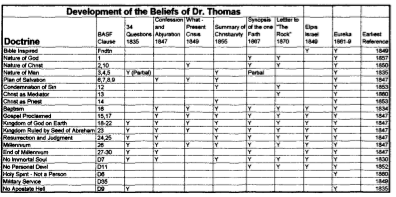
Notes: The numbers refer to the clauses of the BASF, with D7, etc., referring to the “Doctrines to be rejected.”
Comments on some doctrines
- Bible Inspired. This belief was never explicitly stated by Dr. Thomas, but it underlies his whole approach to the Bible. The Bible is the only source of our knowledge of God and His plan for mankind, and was to be understood by comparing scripture with scripture, the Old Testament and New Testament being equally valid.
- This was the doctrine that first caused a rift between Dr. Thomas and the Campbellites, the denomination he joined when he arrived in America in 1832. Dr. Thomas was insistent on intelligent belief before immersion and consequently re-baptized several Campbellites from 1834 on.
- Immortal Soul. Thomas had thought on this topic, and differed from conventional Christianity well before his crisis of conscience on board ship in 1832 (He published an article on the topic m the medical journal The Lancet in 1830) It was not surprising he arrived at the doctrine of conditional immortality in his 34 questions of 1834 This ultimately led to his being driven out of the Campbellites a decade later
- Nature of Christ and God. Until 1846, Dr Thomas had not questioned the conventional trinitarian view of God and Christ He began to question it m that year, but did not fully develop his beliefs until he came into contact with a group of Christian Jews in 1857 He published a series of articles in his Herald, 1857-9, and it was these articles that formed the basis of Phanerosis, his best-known work on the subject.
- Promises to Abraham to be fulfilled on Earth The development of this doctrine, over the period 1842-47, led to the realization how far he had come in his understanding of the Truth, and how much he differed from the Campbellites It formed the central theme of his Confession and Abjuration in 1847 and also Elpis Israel two years later.
- Nature of the Devil. I can find no evidence of Dr Thomas having thought much on the nature of the Devil until he wrote Elpis Israel in 1848/9 In that book he clearly teaches that the Devil is sin personified.
- Immortal Emergence. Dr Thomas did not consider this matter until it was forced on him in the late 1850’s He then was forced to write a whole book on the subject, Anastasis. It is interesting that Robert Roberts, after Dr Thomas’ death, edited Elpis Israel to change passages capable of misinterpretation – which Dr Thomas did not do, although his introduction to the fourth edition, 1869, made clear his views on the subject.
- Military Service You will find no mention of his opposition to this in his “statements of faith,” but it is clear he was opposed to true Christians taking part in the wars of this world from at least 1849 on The other natural consequences of “Our Kingdom is not of this world” — voting, service as a policeman, being a Justice of the Peace, working in munitions factories — did not trouble Dr Thomas m his lifetime And indeed this sensitization of our conscience is perhaps still taking place Almost no Christadelphian today would serve on a jury – yet most of our forbears, Robert Roberts among them, were happy to do so.
Bibliography of Dr. Thomas
It seems appropriate to include all the works of Dr Thomas that I know of, whether I have seen them or not It is considerably larger than most lists of the writings of Dr Thomas, as I have tried to include all the publications that Dr Thomas wrote in his lifetime Of course, there have been many reprints of selected articles by Dr Thomas since his death m 1871, but I restricted myself to books, broadsides, and other writings published prior to that date The column “Have?” refers to whether or not I possess a copy of the item m question.
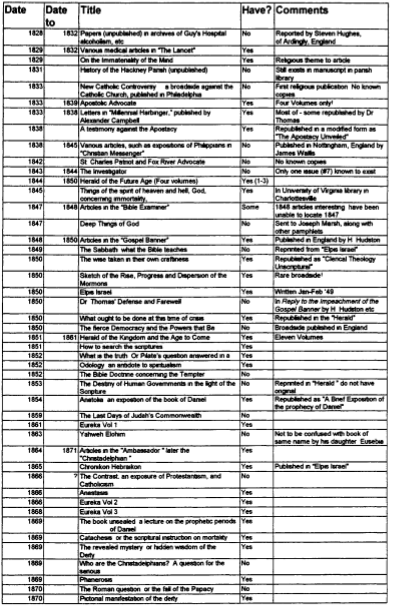
There is little doubt that some of these items have been lost, but I would be very grateful to receive copies of any of these I do not have, or to be informed of items that I am not aware of.
Conclusion
In this brief article, I cannot really do justice to the range of expositions of the beliefs of Dr. Thomas. Only occasionally did he write what we would consider exhortations, preferring as he did to let the word of God speak directly to the heart of his listeners. But I have attempted to show that his beliefs evolved and advanced over most of his life. They were not all fully developed by 1847, when he published his “confession and abjuration” and was re-baptized. Indeed, his major theological treatise on God Manifestation, Phanerosis, was not published until 1866, although it had previously appeared in 1858 as a series of articles entitled Mosaic and Nazarene Teaching Concerning God. His views, with this exception, were perhaps mostly in place by the time he wrote Elpis Israel, although his thinking on what is now known as the doctrine of “Immortal Emergence” was not formulated until the late 1850’s. I am always very careful when I quote from Dr. Thomas about his beliefs, because his opinions and emphasis changed considerably over his lifetime. His first “unorthodox” thought was about the significance of baptism, then the immortal soul, followed by the promises to Abraham and the place of the true believers in those promises. It was the logical consequences of these key points that drove him to develop further the truth about the Devil, the nature of God, Jesus, and man, and the significance of judgment. From these basic doctrines Robert Roberts developed our statement of faith, amazingly little changed from its first draft in 1873. We can be eternally grateful to Dr. Thomas for his struggle to uncover the Truth, which essentially occupied his whole life, energy, and devotion from 1832 on.
 The Origin of the Organic World – Part One