
Timothy in Thessalonica
There were determined foes of the Gospel in Thessalonica. The Bible indicates they managed to have Paul banned from the city (1 Thess 2: 18), and they posed a tremendous challenge to the ecclesia that had formed there. Timothy was given the responsibility of establishing and exhorting the new believers in Thessalonica in person since Paul could not travel there himself.
1 Thess 3 indicates how Timothy went about his work in Thessalonica: “And sent Timotheus, our brother, and minister of God, and our fellow labourer in the gospel of Christ, to establish you, and to comfort you concerning your faith” (1 Thess 3: 2). Timothy is called a “brother” in this verse. It characterizes how Timothy viewed himself and how he acted in Thessalonica. It is an indicator of his humility.
It is worth noting that throughout the pages of the New Testament, Timothy is never rebuked for being filled with pride. That is remarkable, especially since he was given the tremendous responsibility of guiding the Thessalonian ecclesia at a young age. The Scriptures warn that it is hard for young men not to become prideful, in particular, when given positions of responsibility (1 Tim 3:6). Plus, Timothy was very close with the Apostle Paul. That relationship could have made him feel “special,” entitled, and puffed him up. But there is no evidence of that happening. Timothy must have been exceptionally grounded in the Truth — and kept the Lord Jesus as his standard — to have maintained his perspective and remained humble. His humility was probably an important contributor to his success in leading the Thessalonians.
Timothy is also called a “minister” in 1 Thess 3: 2. The Greek word means “a servant.” It was clear to the Thessalonians that Timothy was among them to help them and not with the intention of personally benefiting from them. His leadership took the form of service.
Timothy had a very challenging message to deliver in Thessalonica. He called on the members of the ecclesia to be willing to suffer loss for the Truth. The fact that he came to them with an intention to serve was probably one of the reasons they responded so well to his message and his guidance.
Paul wrote 1 Thessalonians in response to the good report he received from Timothy. Timothy returned to Thessalonica bearing that Epistle. Then after spending more time with the Thessalonians, Timothy again returned to Paul with a report. Paul wrote 2 Thessalonians in response. Timothy also carried that Epistle, which contains a greeting from him. In total, Timothy visited Thessalonica at least four times during the Second Missionary Journey. His four visits were
- the initial trip in Acts 17 that ended with Paul being banned,
- the trip referred to in 1 Thess 3: 1-5,
- the trip where he carried 1 Thessalonians,
- the trip where he carried 2 Thessalonians
Lessons from the Letters
The two letters to the Thessalonians reveal additional aspects of Timothy’s character. First, they show that he noticed, rejoiced in, and was eager to speak about the good that his brothers and sisters were doing, even when they had problems. Timothy was the one who shared with Paul how well the Thessalonians were doing, and he did it in a way that brought Paul great joy: “But now when Timotheus came from you unto us, and brought us good tidings of your faith and charity, and that ye have good remembrance of us always, desiring greatly to see us, as we also to see you: Therefore, brethren, we were comforted over you in all our affliction and distress by your faith” (1 Thess 3: 6-7). It is noteworthy that Timothy did not just convey generalities to Paul. He did not merely report, “The Thessalonians are doing fine.” He observed specifics and talked about them. He noticed and shared, for example, how highly the Thessalonians thought of Paul and how much they missed him.
It is all too easy to find fault with our brothers and sisters and to criticize them in our thoughts or in private conversation. But focusing on the good that our brothers and sisters are doing — even when they have shortcomings — can motivate us and challenge us in our discipleship.
Timothy helped to build up the Thessalonians by noticing their faith and the positive things that they were doing and joyfully sharing the news with others. But while Timothy focused on the good in Thessalonica, he was not blind to problems. He recognized the importance of sound doctrinal understanding. When error began to creep into the Thessalonian ecclesia, he did not ignore it.
Some of the Thessalonians had developed a misunderstanding of the timing of Christ’s return. They thought it was imminent. Timothy reported back about the problem to Paul, and that was a reason why Paul penned 2 Thessalonians, which is where he explained that Christ would not return before “the man of sin” was revealed:
“Now we beseech you, brethren, by the coming of our Lord Jesus Christ, and by our gathering together unto him, That ye be not soon shaken in mind, or be troubled, neither by spirit, nor by word, nor by letter as from us, as that the day of Christ is at hand. Let no man deceive you by any means: for that day shall not come, except there come a falling away first, and that man of sin be revealed, the son of perdition” (2 Thess 2: 1-3).
Ephesus
Timothy delivered 2 Thessalonians near the end of the Second Missionary Journey. It is likely that he re-joined Paul at some point because they were together again early in the Third Missionary Journey: “So he sent into Macedonia two of them that ministered unto him, Timotheus and Erastus; but he himself stayed in Asia for a season” (Acts 19:22).
The Third Missionary Journey began in about 54 AD. Timothy was approximately 24 at that time. Paul and his company departed from Antioch: And when he had landed at Caesarea, and gone up, and saluted the church, he went down to Antioch. And after he had spent some time there, he departed, and went over all the country of Galatia and Phrygia in order, strengthening all the disciples (Acts 18: 22-23). Galatia was an early stop on the Third Missionary Journey. Timothy was probably with Paul at that point and had the opportunity to see his mother and grandmother. If so, that would have been the first time that he had seen them in three years.
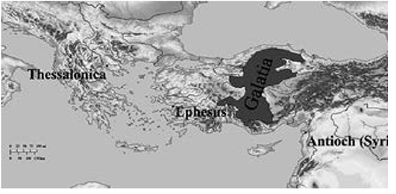
Map: Key Locations in Timothy’s Life
The Third Missionary Journey lasted about four years. Timothy spent much of that time in the city of Ephesus in the Roman province of Asia. Ephesus was an important commercial center and one of the largest cities in the Empire. It was the base from which many of the other ecclesias in the province of Asia — Colossae and the ecclesias to which Revelation was written — were founded. Timothy ended up spending many years of his life in Ephesus and eventually became the leader of the ecclesia there.
While Paul was in Ephesus, he performed “special miracles.”
“And God wrought special miracles by the hands of Paul: So that from his body were brought unto the sick handkerchiefs or aprons, and the diseases departed from them, and the evil spirits went out of them” (Acts 19: 11-12).
This is the only occurrence of the phrase “special miracles” in the Bible. What made Paul’s miracles in Ephesus “special” was that he healed people from a distance by sending them items — such as sweat cloths and work clothes — that he had with him.
It would have been particularly remarkable for the Ephesians to witness items from Paul healing people since Paul himself was not well. Timothy was not well either. When Timothy was in Ephesus, Paul could only encourage him to “Drink no longer water, but use a little wine for thy stomach’s sake and thine often infirmities” (1 Tim 5:23). But Paul could not actually heal Timothy.
There is no record of Timothy complaining about the situation or of characterizing it as “unfair.” But it is easy to imagine that it could have been a struggle for him to witness other people being healed while his own infirmities limited the work that he wanted to do in the Truth.
There was, however, a larger benefit that came from Timothy’s struggles with illness in Ephesus while people all around him were being made well. The fact that Paul healed so many people but did not heal his beloved companion, Timothy, would have been compelling proof that the miracles he performed were not due to any power that he personally possessed. Instead, they were incredible signs confirming the existence of the God about whom he preached. This point would have been extremely important to emphasize in Ephesus where there were many tricksters who claimed to perform miraculous healings by their own power:
“Then certain of the vagabond Jews, exorcists, took upon them to call over them which had evil spirits the name of the Lord Jesus, saying, We adjure you by Jesus whom Paul preacheth. And there were seven sons of one Sceva, a Jew, and chief of the priests, which did so. And the evil spirit answered and said, Jesus I know, and Paul I know; but who are ye? And the man in whom the evil spirit was leaped on them, and overcame them, and prevailed against them, so that they fled out of that house naked and wounded. And this was known to all the Jews and Greeks also dwelling at Ephesus; and fear fell on them all, and the name of the Lord Jesus was magnified” (Acts 19:13-17).
Timothy’s health in Ephesus is a reminder that we sometimes have to endure trials that can be hard to understand. But the challenges that we experience may be part of a greater plan that is drawing other people to God and bringing glory to His Name. Timothy wanted God to be glorified even if it meant hardship for him, as the next episode in his life illustrates.
 The Origin of the Organic World – Part One