
On to Thessalonica
In the previous article in this series, we considered Timothy’s faithful service when Paul and Silas were arrested in Philippi and throughout their time in that city. Following Paul and Silas’ release from prison, Timothy accompanied them as they left Philippi. Their next major stop was Thessalonica. Paul labored to support himself financially while he was in Thessalonica: “For ye remember, brethren, our labour and travail: for labouring night and day, because we would not be chargeable unto any of you, we preached unto you the gospel of God” (1 Thess 2:9). Note the pronoun Paul used. He wrote “we.” In fact, he did it more than once and also used “our.” Paul’s use of language is probably significant. Paul’s wrote opening greetings from Silas and Timothy: “Paul, and Silvanus, and Timotheus, unto the church of the Thessalonians which is in God the Father and in the Lord Jesus Christ: Grace be unto you, and peace, from God our Father, and the Lord Jesus Christ” (1 Thess 1:1). Paul appears to be deliberate in his use of “I” and “we” in 1 Thess. For example, when he refers to his situation and his travels, he uses the word “I” (e.g., 1 Thess 2:18, 3:5). But he appears to switch to “we” when he refers to Silas and/or Timothy as well. Paul’s use of the pronoun “we” in the verse about his labors, therefore, suggests Timothy may have followed Paul’s practice of working to earn money to help support himself financially in addition to all of his preaching activities. If that was the case, then there are at least two lessons we can gain from that aspect of Timothy’s life.
The first is how central spiritual considerations should be to do what we do. The Truth is not something that should be relegated to the outskirts of our lives. It should be the heart of our existence. Everything in Timothy’s life revolved around the Truth. It seems even his secular work was done so with the furtherance of the Gospel in mind — so it could be made available to people without charge. Timothy’s goal was to bring glory to God. His secular pursuits were a means to that end and not an end themselves. As we consider the choices we make in our lives, we need to make sure we have our priorities straight. The Truth must come first, and the activities of our lives should aim to further it. The fact that there are so many diverse opportunities for service in the Truth helps makes this possible. If we love sports, for example, we can help organize and support youth study weekends where a sport is played (e.g., the football challenge, soccer challenge, etc.). If we have a gift for music, we can create and perform the spiritual music that is an encouragement to so many. If we have a talent for making movies, we can help produce outreach videos. Whatever our particular strengths are, there are opportunities to use them to bring glory to God and strengthen others.
Second, we should be careful in letting ourselves off the hook because we are weary, so to speak, when it comes to work in the ecclesia. The Bible’s record indicates Paul and Timothy maintained an absolutely exhausting schedule with their missionary work. Any secular labors were in addition to their preaching activities.
Paul, Timothy, and their companions must have worked as they did because they recognized what a wonderful gift the Truth was, what an extraordinary opportunity they had to share it, and because they knew that God was with them. We need to remember that we too have been put in a wonderful position. Reflecting on how blessed we are can stir us up to give more in our service to God and to push ourselves as hard as we can.
“Certain lewd fellows of the baser sort”
There was a positive response to the proclamation of the Gospel in Thessalonica (Acts 17:4). However, the Jews of the city were filled with envy at the interest the people showed in the Truth. Acts 17:5 records they reacted by taking “unto them certain lewd fellows of the baser sort.”
The Greek word rendered “lewd” means “atrociously wicked.”1“Of the baser sort” is one word in Greek. It is agoraios and means “relating to the market-place.”2It is a reference to the people who loitered about in the market places of cities looking for opportunities to agitate and cause trouble.
In tandem with the Jews, these people created a huge disturbance. They claimed the Christians were engaged in sedition and were teaching people to disobey Caesar (Acts 17:6-7). Sedition was a serious offense in Roman times. Just being charged with it could ruin a person.3
The city authorities were “disturbed” at the accusations made against the Christians (Acts 17:8, ESV).4The Bible indicates they banned Paul from the city. Later when Paul wanted to return to Thessalonica, he wrote to the believers there that he could not because “Satan hindered us:” “Wherefore we would have come unto you, even I Paul, once and again; but Satan hindered us” (17 hess 2:18). The hindrance of “Satan” is probably a reference to the prohibition against him returning to the city.
Paul, Timothy, and Silas had to leave Thessalonica following the disturbance. Timothy later ended up playing an extremely important role in supporting the believers there since Paul was not allowed to return to the city.
Berea
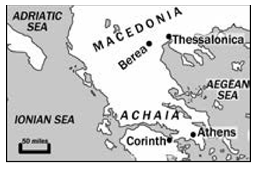
After departing from Thessalonica, Timothy’s next stop was Berea. Acts 17 records the Jews there were more receptive to the Gospel (verse 12). However, when the opponents of the Truth in Thessalonica heard about the preaching in Berea, they sent agitators to stir up trouble: “But when the Jews of Thessalonica had knowledge that the word of God was preached of Paul at Berea, they came thither also, and stirred up the people” (Acts 17:13).
The enemies of the Gospel in Thessalonica were relentless. They acted as determinedly as Paul had once been to destroy the fledgling Christian community, and Paul had indeed been a ferocious foe. Just as Paul had done, they were willing to travel to other cities to persecute the believers (c.f., Acts 26:11). That was the character of the opponents Timothy had to repeatedly contend with.
After the arrival of the agitators from Thessalonica, the brethren in Berea became extremely concerned about Paul. The situation was so bad that they sent him away “immediately” to Athens, which was over 200 miles to the south (Acts 17:14-15).
When Paul fled, he left Silas and Timothy behind in Berea to continue the work: “And then immediately the brethren sent away Paul to go as it were to the sea: but Silas and Timotheus abode there still” (Acts 17:14). Silas and Timothy had the extremely important task of confirming and exhorting the young ecclesia in the face of the dangerous opposition that had gathered against them.
The fact that Timothy agreed to the assignment is an indicator of his willingness to sacrifice of himself for the Truth. He had seen the toll Paul’s labors had taken on him. It appears that when Paul left Berea he could not even travel on his own. He had become so frail that he had to be accompanied by brethren from Berea (Acts 17:15). But even though Timothy had witnessed firsthand what Paul’s work had done to him — he had seen him forced to flee the city in a really weakened condition — Timothy was still willing to take up that work and continue it when Paul no longer could. Timothy’s decision to do so showed how much he was willing to give of himself to help his brothers and sisters and to advance the work of the Truth.
Timothy did not remain in Berea for long. From Athens, Paul sent for him and Silas to join him: “And they that conducted Paul brought him unto Athens: and receiving a commandment unto Silas and Timotheus for to come to him with all speed, they departed” (Acts 17:15). The reason for Paul’s request is indicated in the First Epistle to the Thessalonians.
“To establish you, and to comfort you”
Paul was quite worried about the Thessalonian ecclesia. They had only recently “turned to God from idols to serve the living and true God” (1 Thess 1:9). Yet they faced tremendous opposition:
“For you, brothers, became imitators of the churches of God in Christ Jesus that are in Judea. For you suffered the same things from your own countrymen as they did from the Jews, who killed both the Lord Jesus and the prophets, and drove us out, and displease God and oppose all mankind” (1 Thess 2:14-15, ESV).5
Paul was worried the faith of some in the fledgling ecclesia would wilt in the face of such opposition and they would be tempted to return to their former beliefs and practices to escape persecution.6To try to prevent that from happening, Paul sent Timothy back to Thessalonica after he had called him to Athens from Berea:
“Wherefore when we could no longer forbear, we thought it good to be left at Athens alone; And sent Timotheus, our brother, and minister of God, and our fellow-labourer in the gospel of Christ, to establish you, and to comfort you concerning your faith: That no man should be moved by these afflictions: for yourselves know that we are appointed thereunto. For verily, when we were with you, we told you before that we should suffer tribulation; even as it came to pass, and ye know. For this cause, when I could no longer forbear, I sent to know your faith, lest by some means the tempter have tempted you, and our labour be in vain” (1 Thess 3:1-5).
Paul needed someone “to establish” and “to comfort” the Thessalonians. The Greek word translated “comfort” in vs 2 is parakaleo. It means “to exhort.”7In fact, that is exactly how it is translated when it appears in Acts 14: “Confirming the souls of the disciples, and exhorting them to continue in the faith, and that we must through much tribulation enter into the kingdom of God” (Acts 14:22). Recall the context of that passage. It is about Timothy’s home ecclesia! When Timothy had been a new convert in Lystra, he had personally heard Paul give the same message about faithfulness through tribulation that needed to be given to the Thessalonians.
Who could be better to deliver that message in Thessalonica than someone who had both heard it before and who had personally followed the guidance that was given? The Truth was quite young in the Roman world at that point. There were not many people who had endured trials for the Truth over an extended period of time. But Timothy had.
So, Paul sent Timothy to help the Thessalonians. What Timothy asked them to do was very challenging. He called on them to be willing to suffer great loss for the Truth. Leading them required courage, compassion, and the wise application of spiritual principles. Timothy was quite young and would have had to interact with and try to help people from a wide variety of backgrounds and who were in very different stages of life than him. It is an indicator of the great trust that Paul had in Timothy that he sent him to help the Thessalonians during such a critical time in their development.
Timothy was successful in his mission, and Paul was overjoyed at what he heard from Timothy about how the Thessalonians had responded: “And when Silas and Timotheus were come from Macedonia, Paul was pressed in the spirit, and testified to the Jews that Jesus was Christ” (Acts 18:5).
The KJV rendering “pressed in the spirit” is quite literal. However, it does not fully convey the sense of what Paul was feeling. The Greek word translated “pressed” is a word associated with very strong emotion.8Timothy’s arrival and the good news he brought about the Thessalonians energized Paul. It enthused him and compelled him to increase his efforts in Corinth — where he was based at the time — even more.
The success of Timothy’s mission to Thessalonica is an illustration of the power of a good example and of the importance of sound leadership in an ecclesia. The Thessalonians obviously benefited greatly from Timothy’s presence among them.
Paul’s reaction to Timothy’s mission is a reminder of how inter-connected we all are and should be. Good news about others in the Brotherhood should truly fill us with joy, and the positive example of our brothers and sisters should motivate us to increase our own service.
- The Greek word is G4190. The definition is from Mickelson’s Enhanced Strong’s Greek and Hebrew Dictionaries.
- The Greek word is Strong’s Number G60. The definition is from Mickelson’s Enhanced Strong’s Greek and Hebrew Dictionaries.
- F. Bruce. 1955. Commentary on the Book of the Acts, page 344.
- As indicated by Acts 17:7, the agitators probably made a point of emphasizing the Christians’ belief in the coming Kingdom of Jesus. They had in their hands a brother named “Jason,” which is the Latin version of “Jesus.” His presence combined with all of the shouts about the Christians wanting to have “Jesus” as king probably added to the confusion. See H.P. Mansfield. 2006. The Story of the Bible. Volume 8, page 226.
- 1 Thess 3:5 records that Paul was concerned that “the tempter” may “have tempted” the Thessalonians so that his labor among them had been in vain. Orthodox Christianity tends to offer a simplistic and inaccurate interpretation of this passage because they do not compare Scripture with Scripture. The People’s New Testament commentary writes, “The tempter is Satan.” Matthew Henry concurs. In commenting on this passage, he states, “The devil is a subtle and unwearied tempted, who seeks an opportunity to beguile and destroy us.” The historical context, however, makes it quite clear that the Apostle’s concern was the foes of the Gospel in Thessalonica. They had demonstrated their determination to oppose the Christian community, and they had not hesitated to use violence in trying to achieve their ends.
- That is a concern that appears throughout the epistles of the New Testament. See, for example, Heb 12:4-8.
- The Greek word is Strong’s Number G3780. The definition is from Mickelson’s Enhanced Strong’s Greek and Hebrew Dictionaries.
- The Greek word is Strong’s Number G4912. It is used, for example, in Luke 8:37 and 45, Luke 12:50, Luke 19:43, and 2 Cor 5:14.
 The Origin of the Organic World – Part One