
Verse 22:31: The Glory That Should Follow (I Peter I 11:12)
The darkness enshrouding Golgotha is lifted and the last conscious moments of our Savior’s mortal life are ones of joy. More clearly than ever before can he fore see the joy set before him buoyed up in this way he endures the cross to the very end (Heb 12:2). His words prophetically recorded by David in this last portion of Psalms 22, indicate that his vision was of the Marriage Supper of the Lamb.
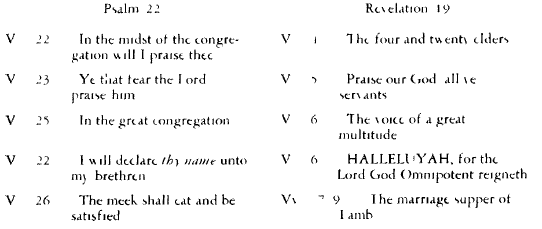
Verses 22 25 Messiah Praises God
Verse 22: “I will declare thy name unto my brethren in the midst of the congregation (qahal = an assembly called together) will I praise thee” It is a fundamental principle of the Truth that Christ in his death declared the righteousness of God and thereby provided a basis for the forgiveness of man’s sins ( Rom. 3:23-26). To declare God’s righteousness is to declare His name, because God’s name expresses His w ill and purpose and character, and our God is a God of lose (John 3:16; 1 John 1:8, 16 ) and salvalion. We give thanks that the Holy One, Who dwells afar off in unapproachable light, has come near to man through His Son, declaring His name bs the wondrous works of that Son ( Psa. 75:1).
Christ stood in the midst of the entire congregation of Israel; his appeal was public and national in its scope. Nothing was done in a corner or a closet, but as it w ere on the housetops. Yet the trumpet calling the nation to repentance and life brought only a relative few to answer it. These the Savior gathered close around him, as a shepherd would his flock, or a mother hen her chicks. To these he further unfolded the glory of the Father’s name manifested in a Son of flesh. At their final feast of fellowship, he prayed:
“I have manifested thy name unto the men which thou gayest me out of the world … For I has e go en unto them the words which thou gayest me . . . and I has e declared unto them thy name (in life), and will declare it ( in death and resurrection ): that the love wherewith thou hast loved me may be in them, and I in them” ( John 17:6, 8, 26).
Christ is not ashamed to call these disciples his brethren, for both sanctifier and sanctified have become one by his act of redemption (Heb. 2: 11, 12 ). After his resurrection, his first message was one of encouragement to his brethren ( John 20 :17).. Joined together in one body with Christ, his brethren rejoice even now in prospect of glory; but the prospect will become reality in the future age, when the nice of a great multitude will be heard, w ith ( hrisl their head declaring God’s name:
| 1. | Hallelujah, for the | Yahweh: the Memorial Name |
| 2. | Lord… | Adonai: Lord, ruler |
| 3. | God… | Elohim: Mighty ones |
| 4. | Omnipotent (Almighty)… reignth” (Rev, 19:6) | Sabboth (Tz vaoth): Hosts, armies |
All the names of Deity, fused together, become a message of inexorably purpose, a ,message of hope: “As surely as I live (can anything be more sure?), the earth shall be filled with My glory” in the person of a host of mighty, redeemed, righteousness Spirit-beings (Num. 11:21; Isa. 11.9; Hab. 2:11). Here will be the name of God brought to full flower in the earth.
Verse 23: “You unto fear the Lord, praise him.” All you sons of Jacob, glorify him, and stand in one of him, all your sons of Israel” (R.S.V.): This alternate rendering is preferable, since the two “fears” in the Authorized Version are different Hebrew words. When the difference is understood, then we may ,more easily recognize the beautiful and striking progression of the three clauses:
- (1): Those who fear: The healthy fear of God is the beginning of true wisdom (Prov. 9:10). Here is where we must all start: advanced scholars may go on to other lessons, but they must never forget this first principle. Those who fear God are commanded to praise him. If as yet they are still just learning how to serve Him, nevertheless even those with the most rudimentary knowledge can praise God. Children must first be taught to sing praises; then, as they grow older they may endeavor to master other services, even the glorifying of His great name.
- The seed of Jacob: Jacob was the first name of the patriarch father of the Jews. It was the name he received at birth, when he laid hold on the heel of his elder brother; “Jacob” signifies “he who grasps the heel.” We become like Jacob at our baptism which is a form of birth when we take hold of the bruised heel of our Elder Brother Jesus (Gen. 3:15). Thus the simple praise we gave as children is expanded, hopefully, into a life of discipleship; now by our deeds we glorify Like Jacob we may wander far from home and experience trials and weaknesses; we may fail more often than not. But our journey is ever onward and upward; as we go, we learn obedience by the things we suffer; we learn to rely less upon our own strength and cleverness and more upon our Heavenly Father,
- The seed of brad: When Jacob finally prevailed with God – in prayer and supplication he received a new name: “Israel,” “Prince with God”. When the time comes that, like Jacob before us, we are stripped of our pride and strong in the Lord, when His strength is made perfect in our weakness, and His will is our own, then we have become “Israel” and we are ready to be rulers in God’s kingdom. These are commanded to reverence the name of God, to stand in awe of His glorious redemptive work. Gathered round the throne they will do this every thing, singing a new song:
“Thou hast made us unto our
God kings and priests …
Blessing, and honour, and
glory, and power, be unto him
that sitteth on the throne” (Res. 5:10, 13).
Verse 24: Praise God and reverence Him, for He has not despised nor abhorred the affliction of His Son ( Heb. 12:6); neither hath the Father hid His face from the Son who cried unto Him. This is in stark contrast to the men who scorned and mocked Jesus upon the cross (Vv. 6-8). Even those who had professed discipleship forsook him and fled, hiding their faces from him. (Isa. 53:3), as did even Peter. His Father alone remained true to Jesus, because in Jesus was His name and His purpose. Just as the Spirit of God moved upon the face of the primordial waters and brought forth light and life, so the Spirit hovered over Jesus on the cross and in the tomb: darkness was made light and death was transformed by that Power into life again. Jesus cried to the Father, and even when his voice was silent in death, his words still echoed in heaven, and the Father heard, Thus was brought to birth the new, or spiritual, creation.
Verse 25: “All praise shall he of thee in the great congregation” (as in V. 22): During these years of his ministry Christ always used the great feasts for the public proclamation of the gospel embodied in himself. Standing in the courts of He-rod’s temple, he was himself the true temple, built by God and not by man (Heb, 8:2). In him may be discerned, in one facet or another, the priest and the altar and the ark and the offering. In him all the shadows became substance as he hung on the cross, and the Father’s saving name was written in bold letters for all to read. Those who come unto him, who serve God in the true temple of His Son, will stand at last in the great congregation of spiritual Israel the new Jerusalem. The 144,000 who constitute the spiritual temple of the multitudinous Christ will assemble upon mount Zion in the literal millennial temple, and their praise will be of God in a new song which mortals cannot learn (Rev. “‘I will pay my tour before them that fear him– (as in V. 23): The vow implicit in his baptism was fulfilled without fault in his life and then also in his death. Prophetically, he had been baptized into this death. He was faithful in all things; he deferred not to pay that which he had vowed (Eccl. 5:1.) He drank to the very dregs the cup of suffering prepared for him.
Spiritually, though not legally, Christ took up the vow of a Nazarite (Num. 6): separation from sin and dedication as a priest. Although he did experience death, he fulfilled the Nazarite sow in that death could not defile him. He who was free from sin could not be held in the clutches of death.
Finally, in keeping with the obvious theme of this section, it may be suggested that there is also an allusion here to marriage vows. At his baptism Jesus was proclaimed the Lamb of God, and therefore the one who would be the Bridegroom at the Marriage of the Lamb. That public act was his betrothal or engagement to his prospective bride, the nation of Israel. From that time forward Jesus offered his life as the dowry to buy his wife from her natural father, the old Adam. The dowry was made up in full only by his poured-out blood. In his death he performed the vows and sealed the marriage covenant with all believers.
While Christ “like the first Adam, in a warden” “there was taken from his wounded side a woman: the spiritual bride, partaker of his sufferings. Even today God is continuing to fashion this multitudinous bride out of the wounded side of His firstborn. Each constituent passes through a baptismal death, and by faith in the last Adam becomes “bone of his bones and flesh of his flesh.” When the Bridegroom returns to claim this bride, then those who are worthy will become one body and one spirit, glorying in perfect union with their Lord and Master forever.
 The Origin of the Organic World – Part One