
The man who went to the cross was a man who had already begun his sacrifice. By this time he had no form or beauty that might lead natural men to desire him. The flame of his life burned low; his zeal for his Father’s “house” had consumed him (Psa. 69:9). He had willingly spent all: there was no need to hold any strength in reserve.
His emaciated condition, his extended position upon the cross and his nakedness all contrived
Brethren and sisters, this is the sad arena to which we must come if we would enjoy the fellowship of the Father and the Son. The cross is the meeting place. Let the love of Christ constrain us to live no longer for ourselves, but unto him that died for us. Do we relax in our comfortable homes, enjoying as though it were our right all the abundance of God’s blessings? Can divine desires arise within our pampered flesh? Can the mind find unity with God which grovels after earthly gratifications? Are indolence and worldliness and self-pleasing the means of amassing spiritual and eternal riches? Are we “soldiers of Christ” who never fight? Is there a race set before us, and we cannot budge from our relining chairs to run it? Is there a cross to bear, and we have never even tested its weight? Look here at the dying Lord of all man-kind, worn to a shadow in God’s service! Let us consider carefully our ways and our thoughts, before we even dare to suggest that we might be called followers of Christ.
Verse 17: “I may tell (count R.S.V.) all my bones”: The several months and especially the last week before his crucifixion were times of most intense activity. No doubt he had always been very busy, but at the end of his public ministry there was the last great national appeal as he proceeded from Galilee throughout the land, finally coming to the Holy City. And the last week he probably obtained no rest other tha the solace of nightly prayer and communion with his Father. The days were spent in warning the city, the nights in solitude as the shadow of the cross loomed even larger.
“My knees are weak through fasting, and my flesh faileth of fatness” (Psa. 109:21).
“My heart is smitten, and withered like grass: so that I forget to eat my bread. By reason of the voice of my groaning, my bones cleave to my skin (Psa. 102: 1, 5)
“They (i.e.. the evil men Vs. 13, 16) look and stare upon me”: the man whose intelligence and purity must have made him the most modest among men, here becomes a public spectacle, a laughing-stock to thugs and bullies.
Verse 18: “They part my garments among them” (John 19:21): Here was the sum total of Christ’s wealth his few modest garments, and even these must be rudely stripped from him.
“For we brought nothing into this world, and it is certain we can carry nothing out’ (1 Tim. 6:7).
This is the second hint (See V. 17) of Christ’s total nakedness a great shame. Nakedness is a readily recognized symbol of sin (Rev 3:17, 16:15) Christ was cursed by the Moses law in being hanged upon a tree (Deut 21:23 Gal 5:15) the public nakedness to which he was subjected may also be seen is a part of that curse. It is one of the echoes of the early scenes of Genesis to be found in Christ’s death in many respects Christ became the last Adam to remove the curse brought by the sin of the first.
The veil upon my return. The normal Roman custom was to consider the criminal’s personal effects the property of his executioners it was part of their wages. The division of his few garments was began but it last the four soldiers to the most valuable garment Christ’s time. It was seamless throughout (John 19:23) like the robe of the high priest (Exod 28: 31,32) to rend it would be to destroy it. Its seamless unity mirrored his blameless life. They east lots and Christ’s last possession passed into the hands of a nameless sinner. He now faced death with nothing but his holy character and his indomitable spirit.
It seems turly certain that among the extreme trials of crucifixion Christ experienced the humiliation and shame of nakedness. This is implied in the counting of his bones (V:17) and the parting of his garments (V:18). We read of the women who were there standing afar off (Matt 27:33) Mark 15:10) possibly due to their natural modesty at the sight. Nakedness is symbolic in Scripture of the sin nature (which Christ possessed) and sin itself (of which he was accesed. Complete nakedness was not the ordinary custom for executed criminals in the first century but it is not difficult to conceived to Christ’s influential enemies arranging this in order to degrade and defile him to the uttermost. Thus is in other ways the leaders of Israel unwittingly contributed to the force of the symbolism Christ as a partaker of the effects of our sins knowing the bitterness of all that sinful flesh in herits.
The licentious society in which we live comes quite close to idolizing the naked body but the whole tone of Scripture is in the opposite direction. The priests for example were commanded to wear breeches and not robes when they officiated so that even the sight of a naked leg would not mar their service. Women in the ecclesias were to be modestly covered and no doubt that went for legs is well is heads. In short flesh is nothing to be proud of it is far better for our sisters (and brothers) to cover theirs with a fur amount of clothing instead of a carefully nurtured suntan.
For Christ the shame was not just in the nakedness. As the brutally hot hours wore on he became increasingly afflicted by bitter sweat and by the blood that oozed from open wounds. The callous crowds starred up great clouds of choking dust which became caked to his body (Hymn 168 is certainly in error if read literally. Golgotha was a green hill only in the writers imagination or else prophetically green with the hope of eternal life beyond the grave). Finally the body’s natural functions could no longer be held in check and odor and flies would contribute to the agony of his last mortal hours. All the signs of corruption attached themselves one by one to this man of sign. In him we see ourselves for what we are creatures shrouded in corruption and decay. Let us look at ourselves brethren. Dying thou shalt die is more than a Hebrew colloquialism. We are dying every minute of every day and there is only one cure.
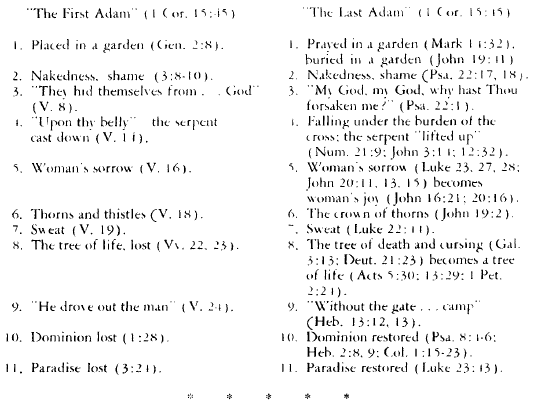
Nakedness is only one of an astounding number of links with the early part of Genesis in many ways Christ fulfilled the type of the last Adam. In providing a way of escape from the Pdeniccure our Saviour fell under that curse in every conceivable way For as by me man’s disobedience many were made sinners so by the obedience of me man shall many be made righteous (Rom 8:19). Let us survey the cross with a sense of wonder; here the prince of glory died to provide what our richest gains cannot. In the shadow of the cross our pride shrivels to nothingness and contempt. The following chart might be the most graphic way to present the many points of comparison between Genesis and Golgotha:
Seven times was Christ’s blood shed. Seven is the number of perfection and completeness, and without shedding of blood there can be no remission of sins. In shedding his blood seven times Christ became the perfect sacrifice and completed in himself, once and for all, the whole Mosaic system of bloodshed. The seven times are as follows:
| The Messiah’s Sacrifice | The High Priest’s Consecration (Exodus 29:20) |
| Head: the crown of thorns | Blood of a ram, upon tip of right ear |
| Back: the Roman scourage | |
| 4 Hands: The Roman spikers | Blood upon thumb of right hand |
| 6. Feet: spike(s). | Blood upon “great toe” of right foot |
| Side (after death): the Roman spear | Blood “sprinkled upon the altar round about. |
Between the sacrifices of all animals and that of Christ there is another Christ was a “living sacrifice” (Rom. 12:1,2). Only in the last of the seven instances of bloodshed was he unconscious. Paul tells us that to some degree we must emulate this sacrifice, as our “reasonable” (reasoning, intelligent) service. Christ’s sacrifice was not a suicide, where with a last knowing breath he cast himself headlong into death. Rather it was a conscious drawn out process done in accordance with God’s will. From his head and hands and feet flowed not only blood but also sorrow and love. He give his heart and mind on the cross not just his body.
Perhaps it is appropriate here before proceeding to the last sections that we review by another table the animals of Psalm 22
| Verses | Animal | Symbolism | Of whom spoken |
| 6 | Worm (toolath) | Lowliness (Job 25:6) or scarlet (V. 6) | Christ |
| 13:21 | Lion | Royalty (Gen 19:9-10) | Jewish princess and rulers |
| 12 | Bull | Sacrifice | Jewish Priest |
| 16:20 | Dog | Unclean (Rev, 22:18) Matt. 15:26-27) | Gentiles |
| 21 | Wild ox | Strength (Num 23:22) | The Strong ones (both Jews and Gentiles) |
Against the lowly worm Jesus the Lordly beasts of Rome and Jerusalem took counsel together
| Psalm | Acts 4:27 |
| V, 2 Rulers (Jewish princes) | Both Herod |
| V. 2 Kings of the earth (Roman) | Pontius Pilate |
| V. 1 Heathen (Goyam = Gentiles) | The Gentiles |
| V. 1 People (Jews) | The people of Israel were gathered together |
And yet though Gentiles participated to his execution there seem to be some flashes of Roman insight which may be seen is prophetic of the Gentiles subsequent gospel enlightenment. This may be called The Great Paradox.
- The Jews become Gentiles
Rulers: We have no king But Caesar (John 19:15)
People: Crucify him (Mark 15:13).
- The Gentiles become Jews
Rulers: Pilate wrote a title (John 19:19)
People: Truly this was the Son of God (Matt 27:84)
Let us examine ourselves We are first of all Gentiles after the flesh who have seen the king of the Jews lifted up acknowledging his authority we have become spiritual Jews. Do we subsequently became Jews who through pride or indifference or lack of truth testify that we really have no king but the Caesar of this world. It we are of this latter class then Paul says of us that like the mob in the Holy City that fateful morning we also crucify the Son of God and put him to an open shame (Heb 6:6)
verse 10:21: Plea For Deliverance From Death
In three short intense verses Christ pleads again for that which he has sought from the beginning of the psalm his Fathers visible favor. In strong crying and tears he multiplies his petitions. In V 21 finally comes the answer to his prayers and the breaking point of the psalm. Thous hast heard me. The darkness which has shrouded Golgotha for some time the coming of which brought forth that desperate cry My God my god is now broken by light. His last few minutes are ones of exultation is reflected in the last section of the Psalm. Christ faces death triumphantly knowing he has conquered the final enemy. His work is finished and in his last minutes he catches a bright vision of the glory chat will follow (Vv:22:31).
Verse 9: Is a cry for help as death approaches. It is a repetition of V 11 Be noo far from me, O Yahweh God’s presence constitutes the only deliverance which he desires. May our prayers be imitations of this great prayer of our Teacher in constant importunity, steadfast faith and assurance of reply God never yet forsook in need the man that trusted Him indeed.
Verse 20: “Deliver my soul (nephesh) from the word my darling from the power (pari) of the dog”. The word darling is yachied signifying single or only one (as in Gen 22 & 12,16) of Isaac Psa 68:6, Zech 12:10). By implication it signifies the beloved one that which cannot be replaced, or ones life.
Verse 21: Save me from the lion’s mouth. The lion was mentioned also in V 13, a ravening beast, also the symbol of the tribe of Judah. The leaders of Judah had become voracious beasts in their treatment of this man who dared to call their ways in question.
“Thou hast heard me” This is in direct contrast to Vv 1:2. The God Who had seemed to forsake him to die in the darkness now at last sheds light upon him for a final time. Prayer moves the hands that moves the world. This phrase initiates the last halt of the psalm filled to overflowing with exceeding great joy, just as the first half was agony and sorrow Christ looks in vision upon the seed to be born of his sufferings, the fruit of his toil and travail, and he rejoices.
From the horns of the unicorn Father the wild ox (as in R S V) or the rhinoceros . The unicorn is the Scriptural symbol of great strength (Num 23:22, Job 29:9,10). It is a symbol of death, our strongest enemy. Samson faced the strong lion and slew him and subsequently found honey in the carcass Christ (the typical Samson) faced death the strong one, he faced the horns of the altar (Psa 118:27) and emerged victorious. Out of the jaws of death came meat for the world. Out of the strong one came forth the sweetness of renewed life, eternal life (Judges 11:11). Out of weakness the Saviour was made strong (Heb 11:31) so that true Israel may be delivered from its last and greatest enemy. Thanks be to God for the unspeakable gift of His Son, that even death itself holds no terror for His beloved children.
 The Origin of the Organic World – Part One