
As a Number Of Our Studies so far have shown, the book of Esther is all about reversal. It is a principle which works through the book in various ways as God takes what is not and makes it be, and eradicates things that are. But there is one particular point, one decisive moment of turning, which acts like a hinge for the whole narrative. It is in chapter 6 and is brought about by as inconsequential a thing as a sleepless night!
On that night could not the king sleep, and he commanded to bring the book of records of the chronicles; and they were read before the king. And it was found written that Mordecai had told of Bigthana and Teresh, two of the king’s chamberlains, the keepers of the door, who sought to lay hand on the king Ahasuerus. And the king said, What honour and dignity hath been done to Mordecai for this? (6:1-3).
God in control
Up to this night of sleeplessness, everything had been going Haman’s way. Mordecai’s loyalty had gone unrewarded while Haman had been promoted; the two had then clashed irreconcilably. Haman was the one who wielded the greater political might and his cruel edict to annihilate the Jews had quickly been sanctioned by the king and communicated throughout the empire. But now, by the mere and apparently coincidental (!) sleeplessness of Persia’s king, everything is about to change. God’s ability to exert His control over the most minor matters of human affairs is no less significant than His power over the big.
Haman, too, is present at the scene, waiting impatiently in the courtyard to gain approval for the latest machination of his evil heart: a 50 cubit gallows on which he might execute his personal vendetta against Mordecai. But before he can get to that he is offered another opportunity: to give advice on how best to glorify someone the king wants to honour, someone who Haman takes to be himself.
The book signals the reader
That we have reached a crucial stage in the book is signaled by a five fold repetition in the space of four verses:
And the king said unto Haman, What shall be done unto the man whom the king delighteth to honour? (6:6)
Now Haman thought in his heart, To whom would the king delight to do honour more than to myself? (6:6)
And Haman answered the king, For the man whom the king delighteth to honour, Let the royal apparel be brought (etc etc). (6:7) that they may array the man withal whom the king delighteth to honour…” (6 : 9)
…Thus shall it be done to the man whom the king delighteth to honour (6:9).
Four of these repetitions come out of the mouth of Haman himself; he is obsessed by the idea of receiving honour. He is so excited by the anticipation of what he expects to receive that he is almost salivating.
And then the coup de grace! The one to be honoured is none other than his arch-enemy! How can he possibly ask permission to use his gallows now?! nstead, the laugh on Haman grows yet louder:
Then the king said to Haman, Make haste, and take the apparel and the horse, as thou hast said, and do even so to Mordecai the Jew, that sitteth at the kings gate; let nothing fail of all that thou hast spoken (6:10). Particularly poignant is the way Ahasuerus unintentionally embeds the phrase ‘Mordecai the Jew’ in his dialogue as he refers to Mordecai. Ahasuerus is probably too slow to realize the irony that Mordecai belongs to the race that he is just about to kill off. But Haman knows it, and senses it may spell disaster for his plan. Small wonder that, having miserably carried out Mordecai’s procession, leading him about the streets of the city like a page boy, he now returns to his house “mourning, and having his head covered” (6:12).
Complete reversal
From now on, nothing is the same. Haman’s fortunes turn from bad to worse as his ignoble fate descends upon him. As Haman descends, Mordecai waxes greater and greater, replacing and then surpassing Haman in the king’s affections.
The scene in chapter 6 is so crucial because everything revolves around it. It is the moment of turning. Before it, Haman had the king’s ear, made edicts, wrote letters in the king’s name, and approved them with his ring. After it, it is Mordecai who advises, who commands, who writes, and who seals. Before it, Haman’s wife and family offer support and encouragement; after it, they have nothing to say except to predict the inevitability of his demise.
The contrast between the before and after is brought out intricately by the text in a series of passages, one group before and one group after, which mirror one another quite meticulously in their wording. The only (crucial) difference is that in one, Haman is in power and the Jews’ fate looms ever larger, whereas in the other, it is Mordecai who leads, and the Jews’ salvation draws ever closer until it is finally achieved. For reasons of space I shall not quote the parallels here, but the two sets of passages are well worth comparing in order to bring out this key theme:
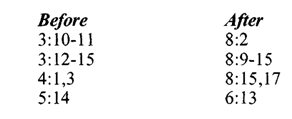
The comparison between the creation of the edicts of 3:12-15 and 8:9-15 is particularly powerful because of the laborious repetition in each passage of the scribal and postal machinery. The point of such extensive repetition is to raise to the fore the theme of reversal.
Haman’s collapse
There is one further step in Haman’s downfall which is so powerful that it demands comment. The scene is the second of Esther’s exclusive banquets at which Esther has revealed the threat she and her people are under. ‘Who could possibly have dared imagine such a scheme,’ the king asks, ‘what monster could have dared hatch such a plan right under my nose?!’ In his incredulity, little did he realise that he himself had been complicit in the plan. Yet the real adversary was ‘this wicked Haman’ (7:6).
Then Haman was afraid before the king and the queen. And the king arising from the banquet of wine in his wrath went into the palace garden; and Haman stood up to make request for his life to Esther the queen; for he saw that there was evil determined against him by the king. Then the king returned out of the palace garden into the place of the banquet of wine;
and Haman was fallen upon the bed whereon Esther was. Then said the king, Will he force the queen also before me in the house? As the word went out of the king’s mouth, they covered Haman’s face (7:6-8).
Haman is at a loss. He doesn’t know whether to stand up or to fall down — so he does both, yet neither seems to be effective! The king, steaming with rage, goes into the garden to cool off, only to return to find what he mistakes to be an even steamier scene — Haman attempting to force the queen on the bed before him! Ahasuerus has never given the impression of being the most astute character in the book, but his mistaking of Haman’s prostration on the bed now serves appropriately to seal Haman’s fate. Hapless Haman. The humour in the passage hammers the point home. Haman is over.
A work of God
The power of reversal, then, is God’s domain. Human categories and stations, human wealth, power and achievement, are nothing to Him. In fact, He even delights in reversing them when they lead to pride and self-love as they so often do. It is at the moment of direst despair, when there seems to be absolutely no remedy, that God is to be found. He is the One Who turns the world upside down and calls things that are not as though they were. This is the very point made in so many psalms, in the prayer of Hannah, and in the song of Mary. He scatters the proud in the imagination of their hearts, He puts down the mighty from their seats and exalts those of low degree. He fills the hungry with good things and sends the rich away empty. He helps His servant Israel in remembrance of His mercy (Luke 1:51-54). When God is on your side, things are not as they used to seem.
 The Origin of the Organic World – Part One