
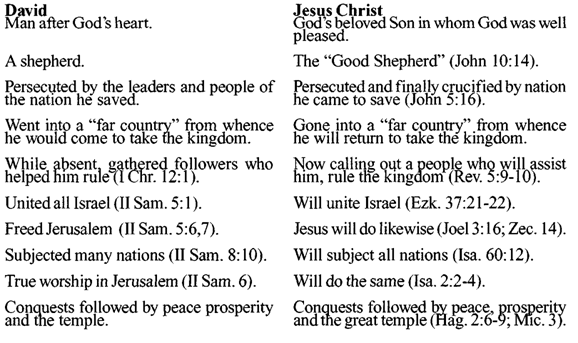
The Life Of David – shepherd, psalmist, general, and king of Israel — is an extended parable or picture of the Lord Jesus Christ.
The Goliath of sin
As was seen in an earlier article in this series, the skills, character, faith, and courage exhibited by the young shepherd David were used by God in a higher purpose: the defeat of the great enemy of Israel, Goliath. We noted that this plainly typified the defeat of the greater giant — Sin —by the greater Son of David.
This victory over the giant set David on a course which brought him, after some twists and turns, to the throne of Israel, even as God directed him. “First a shepherd, then a king” becomes a pattern of Scripture — as it was true of David, so it was of Christ, and so it will be of those who are “in Christ.”
Ideal picture of a redeemer
“I am the good shepherd. The good shepherd lays down his life for the sheep”
(John 10: 1 1).
There is scarcely any picture to be found in Scripture, that so beautifully and completely conveys the essence of the Redeemer as does the picture of the Shepherd. The men (and women) who lived in tents, and moved from place to place, seeking green pastures for their flocks, speak to our hearts of the pilgrim life; they express the reality “our kingdom is not of this world.” These shepherds who put the welfare of their charges first, remind us in graphic terms of love, devotion and service. Those who took up staffs or smooth stones to face lions or bears because they threatened the helpless sheep, sketch a powerful picture about self-sacrifice.
To say that Jesus was a shepherd is to say all this and more. Also, to say that Jesus was (and is!) a shepherd is to say that we, who profess to follow him, are his sheep!
Exhortation for ourselves
“The sheep listen to his voice” (John 10:3).
This is the mark of identification for the true sheep. Many claim to be his sheep who refuse or neglect to listen to his voice, or — hearing it –
straightway forget what they have heard. Or they allow the gentle but stern voice of the Shepherd to be drowned out and finally lost in the clamor of competing “voices” from the world around them.
The true sheep are eager to learn and to conform to the holy spirit of his teachings. They freely recognize their helpless inability to direct their own
steps unaided. Though the path along which he leads them is narrow and hard, and many stray from it and wander away to the pleasant and seductive paths of the world, the true sheep say with Peter, “Lord, where shall we go? You only have the words of eternal life” (John 6:68).
There are many voices calling to the sheep — desirable, appealing voices. But there remains the one voice of the true Shepherd of Life, one gentle voice which says, “Regardless of all your natural, animal feelings, this is the best, and highest, and most joyful way. Walk in it, and don’t turn aside!”
A personal call
“He calls his own sheep by name and leads them out” (v. 3).
He is calling us by name. It is not a formal, impersonal invitation, but a warm, loving, intimate approach.
He knows and addresses each one separately and affectionately, as a close and beloved friend. He knows each one of us if we are his. He knows all our problems and hopes, our sorrows and joys, as no human being of our acquaintance, however intimate, can possibly know them.
The personal relationship between the Shepherd and each sheep is the key to the living power of the gospel of salvation. Salvation is a matter of personal communion and unity with Christ. We must establish that personal unity: everything depends upon it.
Christ must be real and close to us. We must live constantly in the atmosphere of this close companionship — always pausing to renew it as we awake each morning; always closing the day with thankful remembrance of its consolations. For we are like sheep, and we need a shepherd. Left to ourselves, we are helpless, defenseless, dangerously curious, and often silly — in need of wise leadership and firm guidance. These sheep-like qualities are not ones which our carnal minds readily accept, but it is wise for us to understand what we are made of, and to act accordingly. It is only those who truly know their own “weaknesses” who may become truly “strong” in the only strength that is meaningful — the strength of the Lord (II Cor. 12:9).
Psalm 23
For believers, Psalm 23 will always be the simplest and truest “statement of faith” for the Lord must be now, and forever, our Shepherd.
In the psalm are highlighted wonderful traits, qualities, and blessings. There, we see:
- Faith: The LORD is my shepherd.
- Assurance: I shall not be in want.
- Contentment: He makes me lie down in green pastures.
- Peace: He leads me beside quiet waters.
- Life: He restores my soul.
- Divine guidance: He guides me in paths of righteousness for his name’s sake.
- Confidence: Even though I walk through the valley of the shadow of death.
- Courage: I will fear no evil.
- Companionship: For you are with me.
- Comfort: Your rod and your staff, they comfort me.
- Providence: You prepare a table before me in the presence of my enemies. 1. Favor: You anoint my head with oil.
- Happiness: My cup overflows.
- Blessings: Surely goodness and love will follow me all the days of my life.
- Immortality: And I will dwell in the house of the LORD
The story is told of a Mutual Improvement Class where a night was given over to reading practice, and the reading was Psalm 23. Two members of the class were called upon to read the psalm. Each read it faultlessly, but there was a subtle, yet significant difference. The older brother was later asked privately about this, and why his rendering was clearly superior to that of the younger brother. The reply was simple yet profound: “He knows the psalm, but I know the Shepherd.”
May we, the sheep of His pasture, know our Shepherd, and abide in his flock forever.
 The Origin of the Organic World – Part One