
It Is Essential that this allegory is seen as the climax of Paul’s argument against Judaism, or the logic of his argument may be missed and the allegory not understood. In this epistle, Paul’s first step was to make the Galatians fully aware of the serious consequences of departing from the gospel which they had been taught. They were, in fact, turning their backs on God, for it was His gospel, not Paul’s. He assured them that the gospel was no personal idea nor was it received by him from the other apostles. It came to him direct from the risen Lord and from God who had raised Jesus from the dead. Their choice was not between human teachers, but between man and God!
Having established the authority of the gospel and warned of the serious consequences of departing from it, Paul’s next step was to expose the fallacies in the teaching of the Judaisers. His argument has been watertight and devastating to his opponents.
Paul’s argument against Judaism
- They had turned from the Law –
because it could not justify them, and
to be justified by faith they had been baptized into Jesus. If they now turned to the Law, it was tantamount to saying that Christ had died in vain and that they had made sinners of themselves by turning from the Law in the first place. - The Spirit gifts and all their accompanying blessings had not come to them through the Law but through Christ. Therefore, the work of the Holy Spirit among them was proof that they had not made a mistake in turning to Christ.
- Paul then introduced an unexpected theme which was absolutely fatal to the opposition — Abraham’s relationship to Jesus Christ, which had nothing at all to do with the Law
God confirmed His covenant with Abraham 430 years before the Law and that covenant could not be disannulled by any subsequent law. And, Paul says, even human contracts cannot be disannulled once they have been made.
Abraham’s justification did not come by works of the Law but by faith. He believed that God could do what was humanly impossible.
The blessings which the Jews hope to share with their father Abraham did not come by the works of the Law but by faith.
Abraham’s true children are not by natural descent but are the children of promise.
The blessings ofAbraham which the Judaisers were strictly appropriating to themselves and their converts were available to all nations by faith in Jesus Christ.
All who were born under the Law or who were converted to it were cursed by it, since none was able to keep it.
Even if they could have kept the Law, it could not have brought them salvation since it was not possible for the blood of bulls and goats to take away sin.
The prophet Habakkuk foretold, “The just shall live by faith,” while the Law was for “the man that doeth them.”
The work of Jesus had been to redeem man from the curse of the Law and free him to share the hope of Abraham.
It is therefore by baptism into Jesus that men and women become related to “the seed” promised to Abraham and therefore heirs with him of salvation.
Paul’s introduction of Abraham to the argument is masterful since it shows the Law to have been a temporary measure, added because of transgression. Because of the weakness of the flesh, the Law condemned all under it to death and therefore prepared its adherents for the coming of Jesus.
The spiritual over the natural
The logic of Paul’s argument shows how the Law had to give way to Christ, and that those who are baptized into Christ become Abraham’s seed and heirs according to the promise. This means that the natural descendants of Abraham do not inherit the promises by birth. They can only do so by being baptized into Christ and only in that way do they become the seed promised to Abraham. Like Isaac, they then become the children of promise.
This teaching would not be very agreeable to those who had been brought up to think that, by birth, they were automatically in line for the promises and had commended themselves to God by keeping the Law. It was the zeal of these Judaisers which had influenced the Galatians to feel that they, too, must have the same respect for the Law and to show their sincerity by being circumcised.
Going backward — Galatians 4
Paul meets this problem by first drawing out a few crisp points from his previous arguments, and then by inviting the defectors to really observe what the Law had to say for itself.
God had sent His own son, born of a woman, made under the Law, to redeem them from its curse and to make them into His sons by adoption (Gal. 4:4-5). In Christ they were now free, and more than that, they were now “heirs of God through Christ” (4:7). Yet, having known God and all He meant to them, they were desiring to return to “the weak and beggarly elements” of the Law (weak because the Law could not save them and beggarly because it was bereft of the rich spiritual blessing available in Christ) and return to bondage.
The irony was that they had previously served gods, which were not gods, but they had not served the true God. Now that they had come to know the true God, they were turning away from Him to once again rely on that which could not save (4:8-11).
Paul then makes a strong appeal to them: if they desired to be under the Law, they must listen to what the Law has to say. It is at this point that Paul very skillfully draws an allegory from the incidents surrounding the lives of Ishmael and Isaac.
The allegory
His first statement (4:22) that Abraham had two sons would immediately give them food for thought. Did not the scriptures say repeatedly that Isaac was Abraham’s only son? In fact, at the time Abraham was told to sacrifice Isaac, God said with emphasis, “Take thy son, thine only son…” They would have remembered how Abraham had sent away Hagar and her son, Ishmael, thus disinheriting them and leaving Isaac to be his only heir (Gen. 21:9-14).
So it was that the Jews boasted in their father Abraham and their natural descent. It was this very boast which Paul now turned upon them — the casting off of the seed of the bondwoman was typical of God casting off natural Israel in favour of the children by promise!
The point of the allegory is very often missed. In order that we might give emphasis to Paul’s argument, we will list what is said of each son.
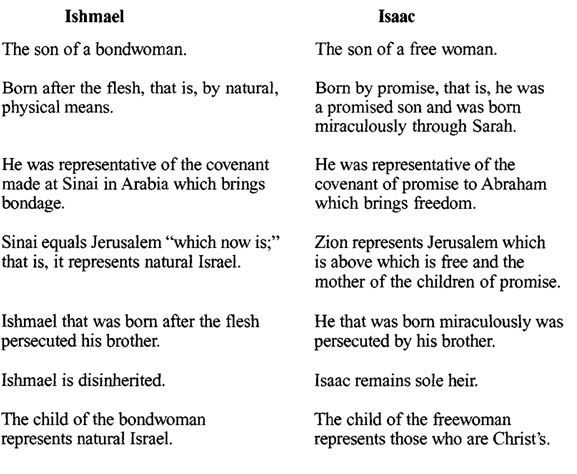
The application of the allegory
Just as Ishmael was disinherited in favour of Isaac, so the natural seed of Israel has been cast off in favour of the children of promise and they can only be grafted back into the olive tree through Jesus Christ. To desire to go back to the Law was to give up their freedom in Christ for the bondage of the Law — to desire death rather than life.
This does not mean that God no longer has a purpose with natural Israel. The teaching of the prophets is full of detail showing God’s purpose with the nation right into the millennial age. It does mean that their individual salvation will not come by natural descent or though the Law, but by their faith in the Lord Jesus Christ (Rom. 11:17-25).
 The Origin of the Organic World – Part One