
Confusion over whether the Beloved Disciple would die (John 21:20-23)
“Then Peter, turning about, seeth the disciple whom Jesus loved <25 agapao> following; which also leaned on his breast at supper, and said, Lord, which is he that betrayeth thee? Peter seeing him saith to Jesus, Lord, and what shall this man do?Jesus saith unto him, If I will that he tarry till I come, what is that to thee? follow thou me. Then went this saying abroad among the brethren, that that disciple should not die: yet Jesus said not unto him, He shall not die; but, If I will that he tarry till I come, what is that to thee?” (John 21:20-23).
When this was written, the Beloved Disciple must have already fallen asleep. This episode explains that his death did not contradict Jesus’ prediction about him. This confusion is far more likely if the Beloved Disciple is Lazarus rather than John Z.
Jesus prophesied that James and John, the sons of Zebedee, would be executed:
“Jesus said unto [James and John, the sons of Zebedee, v 35], Ye know not what ye ask: can ye drink of the cup that I drink of? and be baptized with the baptism that I am baptized with? And they said unto him, We can. And Jesus said unto them, Ye shall indeed drink of the cup that I drink of; and with the baptism that I am baptized withal shall ye be baptized” (Mark 10:38-39).
We know that for James Zebedee this meant an early death at the hands of Herod: “Now about that time Herod the king stretched forth his hands to vex certain of the church. And he killed James the brother of John with the sword” (Acts 12:1-2). There is a tradition that his brother John Zebedee was also martyred early:
“Papias, bishop of Hierapolis, a disciple of John the theologian, and friend of Polycarp, wrote The Lord’s Gospel in five books… Papias says in the second book that John the Evangelist and his brother James were slain by the Jews [cf. Mark 10:39]” (Philip of Side, Christian History).
Witherington writes,
“Papias Fragment 10.17 has now been subjected to detailed analysis by M. Oberweis (NovT 38, 1996) and Oberweis, rightly in my judgment, draws the conclusion that Papias claimed that John son of Zebedee died early as a martyr like his brother (Acts 12:2). This counts against both the theory that John of Patmos was John of Zebedee and the theory that the latter wrote the Fourth Gospel… we should take very seriously what Papias says. He knew what he was talking about in regard to both the earliest and latest of the Gospels.”1
The suggestion that John Z lived to old age likely resulted from confusing John Z with John the Elder (2John 1; 3John 1), who were in fact two different people (see below).
In contrast, Lazarus had been raised from the dead. If brethren had been confused to think someone would live till Christ’s return, then surely Lazarus would have been the natural candidate for such confusion, especially given the words of Jesus to Martha:
“Then said Martha unto Jesus, Lord, if thou hadst been here, my brother had not died. But I know, that even now, whatsoever thou wilt ask of God, God will give it thee. Jesus saith unto her, Thy brother shall rise again. Martha saith unto him, I know that he shall rise again in the resurrection at the last day. Jesus said unto her, I am the resurrection, and the life: he that believeth in me, though he were dead, yet shall he live: And whosoever liveth and believeth in me shall never die. Believest thou this?” (John 11:21-26).
Of course, this saying applies generally, and concerns eternal life in the kingdom after Christ’s return, but one could see how it might be misunderstood to imply that Lazarus in particular wouldn’t die again.
The eyewitness source of the gospel (John 21:24)
“This is the disciple which testifieth of these things, and wrote these things: and we know that his testimony is true” (John 21:24).
The first person (“we”) is used to refer to the author and his community, and the third person (“his”) is used to refer to the eyewitness source. This latter practice corresponds to the earlier declaration: “And he that saw [the crucifixion] bare record, and his record is true: and he knoweth that he saith true, that ye might believe” (John 19:35). By using third person pronouns (“he that saw… his record… he knoweth that he saith… his testimony…”), rather than first person pronouns (“I saw… my record… I knoweth that I saith… my testimony…”), the author of the gospel distinguishes himself from the Beloved Disciple, who is his eyewitness source for much of the information in the gospel. From John 21:24, we also learn that the Beloved Disciple provided a written record of his testimony, which was incorporated in the gospel we have now.
It is unlikely that John Zebedee was the eyewitness source behind the fourth gospel. There are ten special episodes involving John Z in the synoptic gospels.
- Calling of the first disciples (Mark 1:19-20; Matt 4:21-22).
- Healing of Peter’s mother-in-law (Mark 1:29-34).
- Selecting of the twelve (Mark 3:13-19; Matt 10:1-4; Luke 9:12-16).
- Raising of Jairus’ daughter (Mark 5:37-43; Luke 8:51-56).
- The Transfiguration (Mark 9:2-8; Matt 17:1-8; Luke 9:28-36).
- Forbidding others and asking for fire to consume Samaritans (Mark 9:38 41; Luke 9:49-56).
- Request to sit on right and left sides (Mark 10:35-41).
- Olivet prophecy (Mark 13:3-37).
- Preparing the Passover meal (Luke 22:8-13).
- Gethsemane (Mark 14:32-42; Matt 26:36-46).
None of these ten events is included in the gospel according to John. These omissions are difficult (impossible?) to explain if John Z is the eyewitness behind the fourth gospel.
The details in item (1) above, in which John Z is one of the first four disciples called, contrast with John 1 in which John Z is not mentioned. Although some commentators suggest that he is the unnamed disciple, there are reasons to think instead that this is Philip, who Jesus finds in John 1:43 (cf. the same verb “find” in John 5:14; 9:35; in both of these situations Jesus finds someone he had recently been interacting with). Philip and Andrew are connected with each other again in John 12:22 (see also John 6:5-9).2In this case, John Z is not mentioned in the fourth gospel until John 21:2. That Lazarus would have witnessed these events is likely because they took place in his hometown of Bethany (John 1:28).3
In general, the episodes recorded in this gospel make sense if Lazarus is the eyewitness. For example, in contrast to the synoptic gospels, which focus on Jesus’ ministry in Galilee, the fourth gospel pays much more attention to his activities in and around Jerusalem (John 1; 9; 11), especially during the feasts (John 2:13-4:3 Passover; John 5 a feast of the Jews; John 7-8 Tabernacles; John 10 Dedication; John 12-20 Passover). Only four chapters (John 2; 4; 6; 21) recount events in Galilee. This focus on Jerusalem and the feasts is understandable if Lazarus is the eyewitness source for the gospel: Lazarus lived in Bethany, less than two miles from Jerusalem (John 11:18). Conversely, this focus is odd if the eyewitness is John Zebedee, who was a fisherman from Galilee.
Jim Harper observes:
“The gospel of eternal life: John’s gospel is the gospel of eternal life; eternal life first given by God to Jesus and then made accessible to us through him. The language that John uses compared with the other gospel writers underscores this fact:
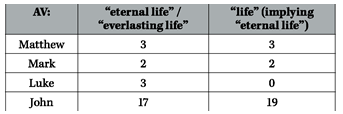
“Given John’s emphasis on eternal life through Jesus Christ, it is entirely fitting that he begins his gospel by declaring that eternal life with God was first ordained for Christ. And it is this that gives Christ his due preeminence throughout John’s Gospel”
(“In the Beginning was the Word,” The Tidings, Dec 2012, p. 566) Lazarus had personally experienced being raised back to life, which, if he is indeed the Beloved Disciple, would explain this emphasis on “eternal life” (cf. John 1:4; 3:15-16, 36; 4:14, 36; 5:24, 26, 29, 40; 6:27, 33, 35, 40, 47, 48, 51, 53, 54, 63, 68; 8:12; 10:10, 28; 11:25, 50; 14:6; 17:2-3; 20:30-31).
Filson writes:
“The first readers… as soon as they discerned that Lazarus was the Beloved Disciple, saw a real unity in the Gospel. His resurrection, the climatic act of Jesus’ public ministry, fixed attention upon the beloved and favored person who then is present at the anointing of Jesus and a few days later is naturally present at the Last Supper. Moreover, there is no lack of fitness in this prominence of Lazarus. What is the theme of the Gospel? It is life, eternal life, given through Christ the Son of God to those who believe in him. The resurrection of Lazarus stands at the climax of the public ministry as the supreme illustration of the fact that Jesus is ‘the resurrection and the life.’ As Jesus gave life to Lazarus, so in a deeper sense he will give to all who believe in him the divine gift of eternal life. He who is ‘the resurrection and the life,’ who came to give life and give it abundantly (10:10), concludes his public action and ministry by raising Lazarus from the dead. It is but natural that this disciple, in who this life-giving work of Christ has been supremely illustrated and symbolized, should be present at the anointing, at the Last Supper, and so at the final teaching concerning the nature of that life. It is but natural that he should be at the Cross as the disciple who through the gift of life which he has received is peculiarly able to understand the meaning of the work of Jesus. It is especially fitting that he should be the one who first senses the fact of the resurrection of Christ. Lazarus is the one figure who ties together the public ministry, the Last Supper, the Cross, and the empty tomb, and so gives the Gospel a structural unity which scholars have often failed to find.”4
Likewise, Stibbe writes:
“Many of the gospel’s puzzles are solved if we see the BD [Beloved Disciple] as Lazarus. The distinctive theme of ‘life’ (zoe) in John’s story is but one example. If the eye-witness authority behind the fourth gospel is a man who has been raised to new life, then it is not hard to infer that his theological reflection on that experience greatly influenced the character and the emphases of the gospel.”5
Summary
The evidence is overwhelming — Lazarus is much more likely to have been Jesus’ Beloved Disciple than the apostle John, the son of Zebedee.
Lazarus represents an ideal disciple, following the example of Jesus
Having shown the likelihood that Lazarus is the Beloved Disciple, we can now identify at least seven ways in which Lazarus mirrors Jesus:
- Jesus loves Lazarus (John 11:3, 5, 11, 36; 13:23; 19:26; 21:7, 20) as God loves Jesus (John 3:35; 5:20; 10:17; 15:9; 17:23-26).
- Jesus raises Lazarus from the dead (John 11) as God raises Jesus from the dead (John 20-21), in both cases leaving their burial “napkins” behind (John 11:44; 20:7).
- The people of the Jews come to see Lazarus (John 12:9, 17-18) as well as Jesus (John 12:9, 12-16, 19).
- The Jews seek to kill Lazarus (John 12:10-11, v10 “also”) as they seek to kill Jesus (John 5:16, 18; 7:1, 19-20, 25; 8:28, 37, 59; 10:31-39; 11:46-53; 12:32-33; 18:14, 31-32); at least in part for the same reason, because of them many Jews believed on Jesus (John 12:11; 11:48).
- Lazarus is in the bosom of Jesus (John 13:23) as Jesus is in the bosom of God (John 1:18).
- Lazarus remains at Jesus’ side throughout the rest of the gospel (John 12-21).
- Lazarus testifies to the truth (John 19:35; 21:24) as Jesus testifies to the truth (John 3:11, 31-36; 5:31, 34; 7:7, 16; 8:13-18, 26; 18:37).
With respect to item (6), Griffith writes:
“In his article ‘Lazarus’ in the Dictionary of Christ and the Gospels, Dr. David Smith says: ‘It might be expected that Lazarus of all men should have stood by Jesus during the last dread ordeal, but he never appears after the banquet in Simon’s house. His name is nowhere mentioned in the story of the Lord’s Passion. What is the explanation? Enraged by the impression which the miracle made, and the support it brought to Jesus, the High Priests plotted the death of Lazarus (John 12:10-11), and it is probable that ere the final crisis he had been compelled to withdraw from the vicinity of Jerusalem.’ If the above conjecture [i.e., that Lazarus is the Beloved Disciple] be correct, that stigma is removed from the character of Lazarus. He did not leave Jesus, he did not forsake Him. He was with Him to the end, with Him at the trial, with Him at the Cross, and was early at the tomb. It is to his house that Mary goes, to his house that Peter, having denied his Lord, returns to be ‘healed of his wounds,’ and to be preserved for the Church and the Kingdom.”6
With respect to item (7), the concept of a lawsuit is a major motif of the fourth gospel.7Throughout, Jesus is on trial: is he a false prophet or not? On the other hand, all who hear Jesus are themselves being judged too: will they believe him and receive eternal life, or will they reject him and be condemned (e.g., John 3:16-21, 36; 5:19-47)?
There are seven witnesses called to testify in the trial of Jesus:
- John the Baptist (John 1:6-8, 15, 19-27; 3:25-28; 5:32-33, 35).
- Jesus himself (John 3:11, 31-36; 5:31, 34; 7:7, 16; 8:13-18, 26; 18:37).
- The woman of Samaria (John 4:39).
- The works of Jesus (John 5:36; 10:25).
- The Father (John 5:37-38).
- The Scriptures (John 5:39).
- The people who witnessed Jesus’ raising of Lazarus (John 12:17).
In addition to these seven witnesses, Jesus exhorts his disciples that the Spirit of truth, whom he would send to them from the Father, would testify of him (John 15:26; 1 John 5:6, 8-11; cf. John 14:16-17, 26; 16:7, 14). The disciples themselves would also bear witness (John 15:27), the Beloved Disciple (Lazarus as shown above), being the premier example (John 19:35; 21:24).
Final Note: Who wrote “the gospel according to John”?
So if Lazarus is the Beloved Disciple, why then is the book labelled “the gospel according to John”? The simple answer is because the author was John the Elder, of Ephesus. The name “John” was common during the first centuries in Palestine; for example, the Bible refers to John the Baptist (many times), John Zebedee (many times), John Mark (Acts 12:12, 24; 15:37; etc.), John the high priest (Acts 4:6), and John the seer (Rev 1:1, 4, 9; 21:2, 8).
Two of the three epistles of John are said to have been written by “the elder <4245 presbuteros>”: “The elder unto the elect lady and he children…” (2 John 1); “The elder unto the well-beloved Gaius…” (3 John 1). This designation is important because Papias distinguishes between two Johns, John the Apostle and John the Elder.
Eusebius reports:
“Papias has left us five volumes entitled The Sayings of the Lord Explained… Papias himself in the preface to his work makes it clear that he was never a hearer or eyewitness of the holy apostles, and tells us that he learnt the essentials of the Faith from their pupils:
‘I shall not hesitate to furnish you, along with the interpretations, with all that in days gone by I carefully learnt from the presbyters and have carefully recalled, for I can guarantee its truth. Unlike most people, I felt at home not with those who had a great deal to say, but with those who taught the truth; not with those who appeal to commandments from other sources but with those who appeal to the commandments given by the Lord to faith and coming to us from truth itself. And whenever anyone came who had been a follower of the presbyters, I inquired into the words of the presbyters, what Andrew or Peter had said, or Philip or Thomas or James or John or Matthew, or any other disciple of the Lord, and what Aristion and the presbyter [i.e., the elder] John, disciples of the Lord, were still saying. For I did not imagine that things out of books would help me as much as the utterances of a living and abiding voice.’
“Here it should be observed that he twice includes the name of John. The first John he puts in the same list as Peter, James, Matthew, and the rest of the apostles, obviously with the evangelist in mind; the second, with a changed expression, he places in a second group outside the number of the apostles, giving precedence to Aristion and clearly calling John a presbyter. He thus confirms the truth of the story that two men in Asia had the same name, and that there were two tombs in Ephesus, each of which is still called John’s. This is highly significant, for it is likely that the second—if we cannot accept the first—saw the Revelation that bears the name of John” (History of the Church, Book III, 39, highlighting and underlining added)
As Eusebius underscores, Papias mentions two Johns, and the second of these, John the Elder, is not among the apostles. It was not John Zebedee the Apostle who wrote the Gospel of John; it was John the Elder. Based on this evidence, Eller writes:
“The epistles of 2 John and 3 John each open with the writer’s identifying himself as ‘the Elder’… it does not seem too incautious a move to suggest that ‘the Elder’ of 2 & 3 John is tradition’s ‘John the Elder’ and is the Writer of the Gospel, though not the Beloved Disciple who is its Source.”8
The testimony of Papias is very early (c. 95-120 AD). It wasn’t till a generation later (c. 180 AD) that Irenaeus, in his arguments against the Gnostics,9conflated these two Johns and the Beloved Disciple, “Afterwards, John, the disciple of the Lord, who also had leaned upon his breast, did himself publish a Gospel during his residence in Ephesus in Asia.”10Such conflations are not uncommon; for example, quoting Polycrates, Eusebius conflates Philip the Apostle and Philip the Deacon: “Among these are Philip, one of the twelve apostles, who sleeps in Hierapolis, and his two aged virgin daughters, and another daughter who lived in the Holy Spirit and now rests at Ephesus” (Church History, 3.31.3). It was Philip the Deacon who had virgin daughters and was buried in Hierapolis. Furthermore, Irenaeus had an ulterior motive for attributing the fourth gospel to John the Apostle — he was trying to stave off Gnostic attacks, and he was confident that apostolic authority would do the trick.
John the Elder’s primary source and authority for his gospel was the (written) eyewitness testimony of Jesus’ Beloved Disciple Lazarus. So, “Lazarus is to John what Peter (it is argued) was to Mark.”11

Distinguishing between the writer and the source solves a problem with the title “the Beloved Disciple”, which would be presumptuous if used of oneself, but not if used of you by others. Lazarus did not call himself the Beloved Disciple; rather, that was what others called him, like his sisters Mary and Martha, Jesus himself, and consequently the author of the fourth gospel, John the Elder, and his ecclesia in Ephesus. Eller reasons:
“If the Writer was a close colleague and follower of the Source, it is quite understandable that he would refer to his master by using the honorific title ‘the disciple whom Jesus loved.’ If, however, the Writer was the same person as the Source (was himself the Beloved Disciple), it is hard to believe that he would be so presumptuous as to write a document identifying himself, against all others, as ‘the disciple whom Jesus loved.’ ”12
The distinction between the author and his source also solves another oddity. The fourth Gospel is filled with details of Judean geography and Jewish religious traditions.13On the other hand, there are many examples of simple Aramaic/ Hebrew names being translated.14Now we are able to provide a reasonable explanation for this incongruity. All the local details come from Lazarus of Bethany and the explanations come from John the Elder of Ephesus, whose gospel was aimed at Greek-speaking people in Asia Minor.
- Ben Witherington (2007) “Was Lazarus the Beloved Disciple?” blog post on January 29, 2007, http://benwitherington.blogspot.com/2007/01/was-lazarus-beloved- html, who refers to a Novum Testamentum article written in German by Michael Oberweis on the Papias-witness to the death of John Zebedee.
- Marie-Emile Boismard (1993) Moses or Jesus: An Essay in Johannine Christology, translated by B. T. Viviano, Fortress Press: Minneapolis, pp. 23-25
- For a serious study, see Pierson Parker, “Bethany Beyond Jordan,” Journal of Biblical Literature, pp. 257-261. Parker summarizes his results: “A correct paraphrase of John 1:28 would be: These things took place in Bethany, which is across from the point of the Jordan where John had been baptizing” (p. 258, emphasis in the original). See RV, RSV, NRSV, NASB, NIV, ESV, NET, Phillips, and many others except KJV, NKJV, and YLT.
- Floyd V. Filson (1949) “Who was the Beloved Disciple?” Journal of Biblical Literature, pp. 87-88.
- Stibbe (1992) John as Storyteller: Narrative Criticism and the Fourth Gospel, Cambridge University Press: New York, p.81.
- B. Grey Griffith (1920-1921) “The Disciple whom Jesus loved”, The Expository Times, 379 381.
- Andrew T. Lincoln (2000) Truth on Trial: The Lawsuit Motif in the Fourth Gospel, Hendrickson: Peabody, MA.
- Vernard Eller (1987) The Beloved Disciple and His Name, His Story, His Thought: Two Studies from the Gospel of John, William B. Eerdmans Publishing Company: Grand Rapids, Michigan, p. 44.
- Gnosticism comes from the Greek word “gnosis” meaning “knowledge.” The Gnostics were a collection of Christian sects who believed that salvation required a kind of enlightenment that only they possessed. This special knowledge pertained, among other things, to elaborate definitions of the Godhead including emanations associated with His various character traits (cf. “genealogies” in 1Tim 1:4; Titus 3:9). These emanations corresponded to hierarchical classes of angels who acted as intermediaries between God and man (ct. 1 Tim 2:5). Jewish Christian Gnostics combined these ideas with the traditions of the Jewish elders, teaching these as if they were commandments from God (cf. Mark 7:7-8; Col 2:2, 8; Titus 1:14).
- Irenaeus, Against Heresies, Book III, Chapter I, Paragraph 1.
- Stibbe (1992), pp. 85-86.
- Eller (1987), pp. 43-44.
- Martin Hengel (1989) The Johannine Question, SCM Press: London, pp. 110-111, 209-210. E.g., Geography: Bethesda (John 5:2); Siloam (John 9:7, 11); Cedron (John 18:1); Gabbatha (John 19:13); Golgotha (John 19:17); etc. Jewish religion: “waterpots of stone, after the manner of the Jews” (John 2:6); animosity between Jews and Samaritans (John 4:9, 7; 8:28); manna haggada (John 6:1-59); circumcision takes priority over the Sabbath (John 7:22); circumcision goes back to the fathers (John 7:22; cf. Gen 17); Sadducee chief priests versus Pharisees (John 7:47-49); Passover (John 2:12, 23; 6:4; 11:55-56; 12:1; 13:1; 18:28, 39; 19:14, 31-37; cf. Exod 12:46; Num 9:12; Psa 34:20); Feast of Tabernacles (John 7:2); the last day, that great day of the feast (John 7:37); Feast of Dedication (Hanukkah) in the winter (John 10:22; see 1 Macc 4:56, 59, 54, 57; 5:1; 2 Macc 10:1-8; cf. 1:9).
- E.g., Rabbi = Master (1:38; 20:16); Messiah = Christ (1:41); Cephas = Stone (1:42); Siloam = Sent (9:7).
 The Origin of the Organic World – Part One