
Bible games are educational and fun, and this gives them a special value. When education and fun are combined in Sunday school, positive attitudes can develop. Bible games also give children an opportunity to put life lessons into practice. Teamwork, fair play, rejoicing in the success of others; these and other life skills are part of a game that is well played.
There is no end to the kinds of Bible games that creative teachers come up with. A few are described here, with thanks to the Sunday school teachers who shared them with me. Have you tried any of these? Take a look at the ones that follow and plan some educational fun for your children!
Seek and Find
When our kids were little, they each had a file folder of Bible cut outs: a harp, a bow, a sheep, a boat, a fish, etc. From time to time, especially on rainy Saturdays, the cut outs were hidden around the house, and the kids had great fun trying to find them. Who would be first to find all their cut outs and return them to the file folder? If they got stuck, they could help each other find a missing item. When this happened, everybody was a winner.
You may not have a lot of room to hide things in your Sunday school area, but with a bit of imagination it may be possible to play a “seek and find” game in the space that you have. In the process, think about ways the Bible objects can be connected with the children’s Sunday school lessons.
Bible Baseball
Bible Baseball is an active indoor game that can be played several ways depending on how many players you have. Set up chairs to make a playing field as shown.
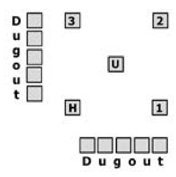
Prepare questions on four levels of difficulty: single, double, triple, and home run. Write these on four different colored file cards. When a batter comes to the plate (by sitting in chair H), he chooses the level of question he wants to try. The umpire (U) selects and asks the question. If the question is answered correctly, the batter moves to the appropriate base (and sits in chair 1, 2, or 3; a home run lets him touch all the bases and score!). When the batter gets “a hit”, players already on base move up the same number of chairs or score by touching home. If the question is answered incorrectly, the batter is out and goes back to the dugout.
Bible baseball can be a fun way to review an entire year’s worth of Sunday school lessons. (Thanks to some game Sunday school teachers in the Meriden, CT, Ecclesia.)
Ground rules. It probably won’t be necessary to lay down many rules for Bible Baseball, but here is something for the umpire to keep in mind: (1) limit the number of easy questions a team may use during each turn at bat, or (2) agree ahead of time that a team must use questions on all four levels during its turn at bat.
Variations. (1) Play Bible Baseball with two bases instead of three. Use single, double, and home run questions. A two-base game makes it easier to score. It also works better with small teams. (2) Don’t count the number of outs. Instead, a half inning ends when every player on a team has had one or two turns at bat. (3) If you have lots of players, form a third team. An inning lasts until all teams have had a turn at bat.
Multiple choice Bible games
Organize small teams. Give each team four cards labeled A, B, C, and D. Read out a multiple choice question and its four answer choices. On the count of ten, each team holds up an answer card. Correct answers get a point.
Variations. (1) Seat the teams equidistant from you. Read out a multiple choice question. The first team to bring the correct answer card to you wins the point for the question. But be prepared. This is a very active way to play the game! (2) The same as (1), except every team that brings a correct card to you earns a point. This restores some sanity to the game!
More ideas. (1) Project the multiple choice questions on a screen using a data projector. This adds a visual component to the game and helps make sure that the questions are clearly understood. (2) Fast moving games keep things interesting. Occasionally, though, you might want to slow the pace a little and include questions that require teams to open their Bibles.
A lesson review game
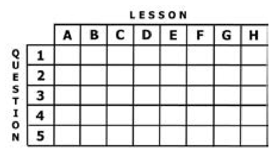
Prepare a chart like this on a piece of Bristol board or poster stock and laminate it.
The letters across the top stand for Sunday school lessons the children have had, and the numbers down the left side represent questions based on the lessons. Once the chart is ready, it can be used over and over again. You will also need a few water soluble markers for the children to use.
When it comes time to review a set of Sunday school lessons, the children take turns requesting questions (e.g., C-4, F-1, etc.). The question is read, and if the child answers it correctly they write their initials in the corresponding box on the chart. When a child gets their initials in three boxes in a row (horizontally, vertically, or diagonally), they get a point.
This makes for an interesting review game; it can also be a study in human nature. Sometimes players choose questions to get points for themselves and at other times they choose questions to block the progress of someone else (a bit like playing tic-tac-toe). I think we allow this behavior by calling it strategy!
When the game is over, the board can be wiped clean with a damp sponge and it is ready to use again. Keep in mind that you do not have to use the entire board every time you play the game. If you want to review fewer lessons or have fewer questions for each lesson, just block off the boxes you do not need. (Thanks to a Vernon, BC, Sunday school teacher.)
How well do you know …?
How well do you know Genesis? How well do you know Jesus? How well do you know the Acts? How well do you know the books of the Bible? This game has many possibilities and is easy to prepare. Develop a set of questions on any Bible subject. Write each question on one side of a file card. Place the cards face down in a pile. The children take turns drawing the top card and reading out the question that is on it. If they answer the question correctly, they keep the card. If not, the card must be returned face down at the bottom of the pile. At the end of the game, the number of cards a child has determines his or her score. As an added incentive, let the children turn in their cards at the end of the game for treats or small prizes.
Variation. This game can also be played as a game of concentration. Spread out the cards, face down, on a table. The children take turns picking up a card and trying to answer the question that is on it. Again they keep the card if they answer the question correctly. Otherwise they must return the card to its place on the table. Another child who knows the answer to the question can pick up the same card when his or her turn comes around. (Thanks to a Vernon, BC, Sunday school teacher for this idea.)
Hang Haman!
This is the well-known “Hangman” game with a Biblical twist, and it gets the children using their Bibles. After studying the book of Esther, give the children a homework assignment: supply each of them with four or five file cards on which to write questions and answers about the story of Esther. Assign different chapters of Esther for each child to prepare questions from. Prepare some questions yourself.
When it comes time to play the game, all you need is a black board (white board nowadays?) or flip chart and the prepared questions. Draw a set of gallows to get started and then let the children take turns asking their questions. Every time the class answers correctly, the questioner gets to draw a part of Haman on the gallows (head, ear, arm, etc.). The game continues until Haman is hanged!
Variations. (1) Get some noisemakers for the children! Tell them the story of Purim. Each year, at the feast of Purim, the Jews read the book of Esther. Every time the name of Haman is mentioned, the Jewish children hiss and jeer. Your children can enjoy their own variation of this. Every time they get a correct answer to an Esther question, let them celebrate with the noisemakers! (2) Playing Hang Haman does not have to be limited to the book of Esther. The game can provide an opportunity for the children to prepare review questions after any subject they have studied in Sunday school. Letting them prepare the questions is good educational practice. You may want to find a different way for them to celebrate their correct answers, though! (Thanks to Melinda Flatley, Paris Avenue, OH.)
Nearly all the games described above involve the use of questions and answers. There are other kinds of games as well. With an endless variety imaginable, please let me know about a game that your Sunday school kids like to play. I will be happy to tell others about it.
 The Origin of the Organic World – Part One