
In Gen 3:11, God asks Adam, “Did you eat of the tree that I commanded you not to eat of?” If Adam confesses, God has a basis upon which to extend his forgiveness and mercy, and thus spare Adam’s life. If Adam fails to take responsibility for his misdeed, God will enforce the prescribed death sentence. The question gives Adam an opportunity for life and by itself is an act of mercy, showing how God invites confession.
The conventional view
Both Adam and Eve mention another party in their responses. The common view is that Adam and Eve evade responsibility for their sin: Adam blames Eve, and indirectly God; Eve straightforwardly blames the serpent. This reading, however, has many difficulties. Even authors who allow for some attempt at a confession believe that Adam and Eve temper their confessions with extenuating circumstances, and that they try to show that they are not fully responsible.
Below are some typical interpretations of this passage. This list could be twice as long, all stating the same general position:
“If,” he says, “Thou hadst not joined this woman to me, I would not have eaten.” Thus he again traces the sin he himself had committed back to God and accuses God of his own sin… In short, Adam does not want to acknowledge his sin; he wants to be regarded as pure and innocent.”1
Adam sought to lay whatever blame he could on others. Whilst he did not deny that he had done wrong, he tried to convince the angel that it was not altogether his fault… Adam sought to shift some portion of blame on to both the woman and the God-given responsibility. Thus, he attempted a measure of self-justification.2
The man endeavors to lessen the gravity of his offence by emphasizing in the preface to his confession that it was not on his own, but on the woman’s, initiative that he committed the wrong… Possibly there is also to be noted an attempt on Adam’s part to exculpate himself by alluding to the fact that it was the LORD God Himself who gave the woman to be with him, as though to say: Thou didst give the woman to be with me, and she gave me of the fruit of the tree. This, too, is characteristically human: people are inclined to justify their conduct by pointing to the circumstances and fate that God has allotted to them in life.3
The repeated verb [gave] nicely catches the way the first man passes the buck, not only blaming the woman for giving him the fruit, but virtually blaming God for giving him the woman. She in turn of course blames the serpent.4
The garden of delight has become the garden of dread, and their newly found fear initiates a tragic sequence of blame. The woman is excoriated by the man for offering the fruit. The woman, in turn, blames the snake for deceiving her.5
The lame reply that he does make causes us to blush for him… It is a reply that in cowardly fashion refuses to admit plain guilt and in an entirely loveless fashion lays the blame for it all first on his wife and then by a wicked charge upon God himself. Evasion characterizes also the woman’s attitude . . . She knows what she did was done of her own volition, yet she charges the serpent with it exclusively . . . by laying the blame upon the serpent she indirectly also charges the Creator for having let the creature cross her path.6
These writers accuse Adam and Eve of blame-shifting, cowardice, false accusation, self-justification, and unloving behavior. Their calumny against Adam and Eve is completely misplaced.
Adam’s confession
By invoking other parties into their statements of confession, Adam and Eve are not shifting blame, but citing important elements detailing their personal failures. They give full and specific confessions. There is not a breath of an attempt to exonerate themselves by assigning any responsibility to God, woman, or serpent. Four lines of evidence support this reading:
- Take the text as it is.
- Adam’s reply to God’s question comprised four truths:
- The woman
- you gave to be with me
- she gave me of the fruit
- and I did eat.
There was a woman, God gave the woman to Adam, the woman gave Adam the fruit, and Adam ate. That’s exactly how the crime occurred. The plain reading of the text tells us that Adam tells the truth, the whole truth, and nothing but the truth. There are no verbal emphases in the text (“the woman, whom you gave me’), such as expressed by Cassuto (footnote above) and implied by just about everyone else. Neither can you assume that mentioning others amounts to shifting blame. The text, as it is, is a straightforward confession of the facts.
- Would God have forgiven them if they had tried to shift the blame?
When you confess your sins to God, do you blame others or cite extenuating circumstances? Do you say, “Yes, I got angry, but only because . . .’? Of course you wouldn’t allow that for yourself, and if you were God you know you wouldn’t accept such excuses. We are supposed to rise above the temptations around us, period. James 1:13-15 is explicit here. Let no one blame circumstances, or the God who created or allowed those circumstances.
A confession that says the sinner fell victim to circumstances is only an acknowledgement that the person failed to overcome those circumstances. This is so fundamental to our Christian walk that it is inconceivable that in this primary instance of sin God would accept a plea for forgiveness grounded on extenuating circumstances.
- Testimony of 1John 1:8-10
These three verses sandwich confession between two denials of sin. “If we confess our sins, he is faithful and just and will forgive us our sins and purify us from all unrighteousness” (v. 9 NIV). Contrasted with this are the claims of being without sin (v. 8) and not having sinned (v. 10). This says that if we fail to acknowledge our sins, or fail to acknowledge our sinful being, the truth is not in us and we make God out to be liar. We have no forgiveness if we fail to acknowledge our sinful condition.
God will not forgive them unless they come forward with a pure confession. The case is made yet stronger because while writing a general truth, John is also writing specifically with Adam and Eve and Cain in mind. Cain is cited explicitly in 3:12, and the letter abounds with references and allusions to early Genesis. Cain, as you remember, denied his murderous deed when God asked him about his brother’s whereabouts. John is saying Adam and Eve confessed and had their sins taken away. Cain didn’t confess, so he was exiled in an unforgiven state. John draws this contrast, virtually interpreting for us what Adam and Eve said.
- Jesus’ prayer for his disciples
The prayer recorded in John 17 is well known, but its background might not be so well known. Jesus quotes from Genesis 2 and 3 at least a half-dozen times in his prayer, and positions his farewell message in the perspective of his role as the Second Adam.
The key phrase is the repeated “you gave me” or “you have given me” (vv. 2, 6, 6, 9, 24) that the Lord Jesus uses to describe his relationship to his disciples. He is not just alluding to, but quoting Genesis 3:12, the First Adam’s statement of his relationship to the first Eve, “the woman you gave me.” Just as Adam acknowledged God had given him Eve, so Jesus acknowledges that God gave him the disciples. In the context of John’s writings, from the beginning saturated with references to early Genesis, these “givens” lead our thinking back to the First Adam.
Jesus’ service on behalf of the disciples contrasts with Adam’s service on behalf of Eve. Extending the principle set out by Paul in Rom 5:14-21 and 1Cor 15:45-47, the Second Adam accomplished something that the First Adam didn’t. The table below lists the specifics of his ministry that Jesus cites in this prayer, and contrasts them with what Adam apparently failed to do in his stewardship.
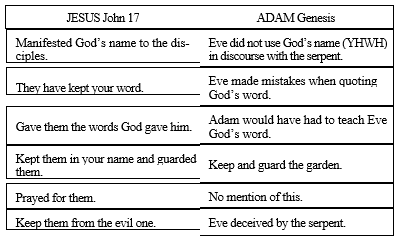
These references, plus others,7to Genesis 2 and 3 leave no doubt that the Lord Jesus is telling the disciples that he has fulfilled the mission his Father set before him. By implication, Adam failed in these very points. He did not manifest God’s name to Eve, for she did not use it when speaking with the serpent. John 17:12 quotes the two verbs of Adam’s charge, to keep and guard the garden. Jesus did this; Adam did not. Eve did not know God’s word well. Adam was not beside Eve when she needed him most, and when he came beside her, he partook of her sin as well.
Just as John 17 is a categorical statement of Jesus’ victory, Gen 3:12 is Adam’s catalogue of confession. The First Adam ruefully discloses how he failed in his service; the Second Adam reminds the Second Eve, the disciples, that he has fulfilled his mission to them. Adam’s statement, brief as it is in keeping with the sparseness of early Genesis, is an ideal confession. He not only admits the fact of his transgression, but outlines the manner in which the transgression came to pass. He’s not blaming Eve or God at all; quite the opposite, he’s acknowledging his failure to them in fulfilling the special relationship that God provided.
Eve’s Confession
After Adam’s contrition, God turns to Eve. He questions Eve indirectly, asking her an open-ended question, not a sharp yes-no question as He had asked Adam about his eating. Instead of asking her if she had eaten, He asks, “What have you done?” This opens the way for her to slide away, for He doesn’t pin her down. In view of her legalistic approach to the serpent’s guile we might expect God to ask something like, “Did you take of the fruit of the tree and eat it?” God is on a different track and is not going to work on that issue with her.
The open-ended question is a test of her relationship to God and her husband. Here is where the blame-shifting hypothesis capsizes and sinks completely. If she wanted to go for the blame, she would have immediately fingered Adam, not the serpent. It was Adam’s failure to adequately teach her what God spoke to him that led to her sin, or so she could have made it out to be. She could have easily, and quite truthfully said, “If Adam had kept the serpent out of the garden, and if he had been there with me, and if he had taught me better what God had told him, I would not have eaten.” All that would have been true.
God gave Eve the opportunity to blame Adam, and she didn’t take it. She resolutely stood by her own failure, and admitted that she was no match for the serpent. Eve admits the stark truth: her own inability to filter out deception. “It’s my fault, not his.” What an absolute heroine, this fine woman.
In admitting that the serpent deceived her, she is simply admitting what we know anyway, that the human heart is deceitful above all things and is not to be trusted. The simple acknowledgement of the serpent’s besting her lays open her contrition and awareness that in her vain attempt to become like God, she was utterly deceived. Deception, thy name is serpent.
Adam and Eve confess their sins, and much more. They protect each other, they stand up for each other, and trust in the mercy of their heavenly father. God, moved to compassion by their contrition, humility, and nobleness of character, forgives their sins. They live; they do not die then and there. Their answers to God, standing naked before him, put right on the spot, reveal that although they are flesh and blood humans, they know how to act when they fail.
With the defendants’ pleas of guilt in hand, the judge pardons them. There will be no immediate punishment, for that would mean immediate death. There will, however, be a different world for Adam and Eve.
- Martin Luther, Luther’s Works, vol. 1, Genesis 1-5. (ed. Jaroslav Pelikan; St. Louis: Concordia 1958), p. 177.
- H. P. Mansfield, Christadelphian Expositor, vol. 1. (West Beach, South Australia: Logos Publications, no date), pp. 75-76.
- Umberto Cassuto, A Commentary on the Book of Genesis. Translated by Israel Abraham. (Jerusalem: Magnes Press, 1961), p. 157 (italics his).
- Robert Alter, Genesis: Translation and Commentary. (New York: Norton, 1996), p. 13.
- William P. Brown, The Ethos of the Cosmos. (Grand Rapids: Eerdmans,1999), pp. 148-149.
- H.C. Leupold, Exposition of Genesis. (Columbus, Ohio: Wartburg Press, 1942), pp. 158,160.
- Other examples: granted authority (dominion), v. 2.; life/knowledge, v. 3. (cp. trees of life/ knowledge of good and evil); completed the work (ct. Adam and Eve expelled from garden, worked outside); they may be one, vv. 11, 23 (cp. Gen 2:24).
 The Origin of the Organic World – Part One