
The Bible records that the Flood began on the 17th day of the second month of the year (Gen 7: 11). During the weeks that followed, the earthquakes and storms continued. That kept the waters that covered the earth in a state of turmoil (Gen 7: 24–8: 3). But God kept Noah and those with him in the ark safe. Psalm 29 offers the assurance that God was in complete control of what was happening: “The LORD sitteth upon the flood; yea, the LORD sitteth King for ever” (Psa 29:10). This passage illustrates that there is no time or place that is outside of God’s dominion. That is a wonderful fact to keep in mind. There are going to be times when we are going to feel tossed and turned by life, just as Noah and the ark were heaved to and fro by the waves. But we need to remember that even though God’s steady and loving hand is unseen, it is always present. He remains in control of our lives even when it seems that the world around is falling apart. And if we place our trust in Him, we can rest assured that He will guide and protect us, just as He kept the ark safe as it bobbed among the waters that had engulfed the earth.
And God’s care extends beyond merely keeping us alive. He provides for our emotional needs as well. By itself, the ark probably would have been a pretty dreary place. So, God made provision. He had Noah bring lots of animals on board. Having them there to feed, to pet, and to play with would have made the ark a warmer and happier place. It would have made the many hours spent on the seas pass more quickly.
The welcome distraction the animals brought was certainly a practical benefit of having obeyed God’s command to bring them onboard (Gen 7:5). Our Heavenly Father is caring and wise, and His commands are given out of love. Doing what He requires often yields natural benefits — as in the case of bringing the animals into the ark — in addition to eternal reward.
“God remembered Noah”
Gen 8: 1 records that “God remembered Noah, and every living thing, and all the cattle that was with him in the ark”. The phrase “God remembered” should not be taken to mean that God had somehow forgotten them for a while. That would contradict the many other passages that testify that God is continually aware of even the minutest events of our lives. Instead, “God remembered” is a phrase that is used throughout the Bible to signal when God is about to intervene to change a situation. For example, the Bible records that God “remembered his covenant” with the Patriarchs before He acted to send Moses to deliver the children of Israel from the Egyptians: “And God heard their groaning, and God remembered his covenant with Abraham, with Isaac, and with Jacob. And God looked upon the children of Israel, and God had respect unto them” (Exod 2:24-25).1
Gen 8: 1 continues by describing the action that God took to change Noah’s situation. He caused “a wind to pass over the earth.” It had the effect of calming the environment (Gen 8: 2). The violent storms ceased, and the waters began to recede (Gen 8:3).
Nautical experts have estimated that the bottom of the ark would have been about 12 feet below the waterline.2That meant that it could come to a rest while the land around it was still completely covered in water. So, after God calmed the sea and the waters had receded enough, it was able to do exactly that.3The ark came to a rest several months before the highest mountain peaks appeared out of the water (cf. Gen 8:4, 5).
“In the seventh month, on the seventeenth day”
The Bible records that the ark ended its journey on the “mountains of Ararat” 150 days after the Flood began: “And the ark rested in the seventh month, on the seventeenth day of the month, upon the mountains of Ararat” (Gen 8:4). Note that the Bible uses the word “mountains” in this verse. The precise location of where it came to rest is not given. The Bible only provides the general region where the ark’s journey ended, which is the mountainous area where the borders of modern-day Iran, Turkey, and Armenia converge. In fact, the Hebrew word translated “Ararat” in Gen 8 is rendered “Armenia” in 2Kgs 19:37 and Isa 37:38. There is a mountain in that area that is nearly 17,000 feet high, which is known as Mount Ararat today. But there is no particular reason to regard it as the final resting place of the ark any more than any of the other mountains in the region.
It is remarkable that the Bible focuses so much attention on the day that the ark came to rest on the mountains of Ararat. It gives so little information about the five months during which the earth was covered in water, and almost the entire human population of the planet was extinguished. We are told that the Flood began on the 17th day of the second month (Gen 7:11). The ark came to a rest 150 days after that on the 17th day of the seventh month. That date is mentioned Genesis as “And the waters prevailed upon the earth an hundred and fifty days” (Gen 7:24). It is mentioned again in Gen 8:3 and Gen 8:4. So, it really seems to be a point of emphasis in the account.
And that is probably because of what happened many centuries later on that date. To see the connection, however, it is important to realize that a new calendar was introduced when the children of Israel came out of Egypt. At that time, God ordered that the calendar be re-calibrated so that Passover would occur in the first month of the year: “and the Lord spake unto Moses and Aaron in the land of Egypt, saying, This month shall be unto you the beginning of months: it shall be the first month of the year to you” (Exod 12:1-2). That meant that the seventh month of the old calendar became the first month of the new calendar. See Figure 1.
The dates of the feasts in the Bible, such as the Feast of Tabernacles, are given using the new calendar, which became the ecclesiastical or religious calendar. The old calendar was retained and became the civil, secular, or non-religious calendar. Both continue to be used today.4What the calendar change meant is that the seventh
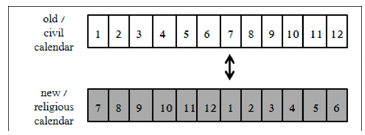
month of the old calendar — the month that the ark rested — is the same as the first month of the religious calendar.
So, let us consider what else happened in the first month of religious calendar, Abib. On the 14th day, Passover occurred: “In the fourteenth day of the first month at even is the Lord’s Passover” (Lev 23:5). That was the day that Christ died. On the 15th day of the first month, the first day of the feast of unleavened bread was observed: “And on the fifteenth day of the same month is the feast of unleavened bread unto the Lord: seven days ye must eat unleavened bread. In the first day ye shall have an holy convocation: ye shall do no servile work therein” (Lev 23:6-7). That was a Sabbath day. Then, on the week when Christ died, there was a weekly Sabbath on the 16th day of the month (Matt 28: 1) On the morrow after the weekly Sabbath, the first fruits offering was made. On that day, the priest took a male lamb and offered it as a burnt offering, and he took a sheaf of barley from the firstfruits of the harvest and waved it before God: “Speak unto the children of Israel, and say unto them, When ye be come into the land which I give unto you, and shall reap the harvest thereof, then ye shall bring a sheaf of the firstfruits of your harvest unto the priest: And he shall wave the sheaf before the LoRD, to be accepted for you: on the morrow after the sabbath the priest shall wave it. And ye shall offer that day when ye wave the sheaf an he lamb without blemish of the first year for a burnt offering unto the LoRD” (Lev 23:10-12).
The ceremonies of that day were very significant. A male lamb without blemish was offered, symbolizing perfectly the sacrifice of Christ. Then a single sheaf of barley that had been cut down and died was held aloft and waved. Paul tells us what that symbolizes. It represents the resurrection of Jesus: “But now is Christ risen from the dead, and become the firstfruits of them that slept” (1Cor 15:20). That ceremony took place “on the morrow after the Sabbath” following Passover. That was the first day of the week after Passover. That was the very day that Christ rose from the dead! And it was the 17th day of the first month of the religious calendar.5
That was the same day that the ark came to rest on the “mountains of Ararat.” See Figure 2.
This connection between Noah and Christ has important implications for us. God caused the details about the end of the ark’s journey to be preserved when so many other parts of the story are omitted. Remember that there was a huge amount of human drama associated with the Flood. Had it been recorded, it could have oc-
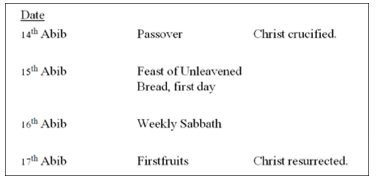
Figure 2 Events that occurred in the first month of the religious calendar
cupied thousands of pages of text. But God does not care for human drama, and He does not want us to be preoccupied by it. He wants us to focus our attention on following in the footsteps of Christ. That is probably why the aspects of Noah’s life that point forward to Christ are emphasized in the record. And when we see the Lord in the life of Noah, it is a reminder to us that people should be able to see the Lord in our lives as well. We will continue our consideration of Noah’s departure from the ark in the next article in this series.
- See also Genesis 30: 22 and Numbers 10: 9.
- Jack Glover. “Thoughts on Noah’s Ark.” The Testimony, August 1995.
- The LXX renders “and the waters asswaged” as “and the water stayed.”
- See, for example, Josephus, Antiquities 81. He states, “Moses…appointed Nisan…as the first month for the festivals…the commencement of the year for everything relating to divine worship, but for selling and buying and other ordinary affairs he preserved the ancient order (i.e. the year beginning with Tishrei).”
- Rob Hyndman. The Times: A Chronology of the Bible, (Victoria, Australia: Bethel, 2000). Available athttp://www.robjhyndman.com/bible/times/times.pdf
 The Origin of the Organic World – Part One