
In the previous article, we considered how David confronted some of the caves of his life, either in physical or mental peril and anguish. We continue this theme, considering more of David’s experiences.
3) Trust
In Psalm 57:1 David proclaims with confidence, “Be merciful unto me, O God, be merciful unto me: for my soul trusteth in Thee; yea in the shadow of thy wings will I make my refuge”. David trusted God with all his heart, soul and mind. He entrusted his entire life to God’s hands, and wholly believed God was by his side even during the direst of circumstances. Though he wandered for years in the wilderness and in “dens and caves of the earth” (Heb 11:38), often not knowing where he was going or what God was doing with him, he still saw the Father as a source of direction, stability, and confidence: “He only is my rock and my salvation: He is my defence; I shall not be moved. Trust in Him at all time; ye people… God is a refuge for us” (Psa 62:2,8).
‘Trust’ and ‘refuge’ are often translated from the same Hebrew word ‘chasah’, meaning to flee for protection or to confide in (e.g. Psa 57:1). Both cave Psalms emphasize David’s trust in God as a place of refuge to which he could flee for help. Though “there was no man that would know me: refuge failed me; and no man cared for my soul” (Psa 142:4), David found in God a reliable confidant and sympathetic source of relief: “Thou art my refuge and my portion in the land of the living” (Psa 142:5).
When we are experiencing troubles in our life, there is a temptation to place trust in a multitude of superficial solutions. The temptation grows stronger when it appears those around us are indifferent to our distress, and we cannot rely on their support to assist us with the trial. Prolonged trials can also test our resolve and erode our fortress of trust. After Joseph was thrown in a pit, transported to Egypt, placed in a prison, and ‘forgotten’ for two years after saving the butler, his trust in God must have been severely challenged (Gen 40:23; 41:1).
We must take heart and remind ourselves of the immoveable ‘refuge’ in which we can place complete trust. Joseph grew to trust, “the LORD was with him, and that which he did, the LORD made to prosper” (Gen 39:23). Likewise, David could confidently proclaim from the cave, “My heart is fixed, O God, my heart is fixed [steadfast]” (Psa 57:7). “They that know thy name will put their trust in thee: for thou, LORD, hast not forsaken them that seek thee” (Psa 9:10).
Trust, however, requires action. The cave may be dark, and the pit may be deep, but at some point we must force ourselves to ‘awake early in the morning’ (Psa 57:8), rise from our bed of sorrow and proactively seek the Father’s direction and protection. When we do, we will find, like David, that God’s “mercy is great unto the heavens, and His truth unto the clouds” (Psa 57:10).
At the beginning of Psalm 57 David alludes to a bird covering its young with its wings to protect when a bird of prey is near: “In the shadow of thy wings will I make my refuge, until these calamities be overpast” (Psa 57:1). It may also allude to the cherubim, whose wings overshadowed the mercy seat, between which the glory of God dwelt. Either way, it reminds us of Ruth and Naomi who, like their descendant David, demonstrated their sincere trust through action. They left the famine, loss and distress of Moab, and fled to the God of Israel “under whose wings” they had also come to trust (Ruth 2:12).
4) Past Assurance
It is difficult to stop and reflect on similar experiences we survived in the past, when consumed with current calamity. Typically, we are absorbed with the troubles directly in front of us and cannot see ‘beyond the troubles’, let alone ‘before the troubles’.
David approached his troubles from a different perspective. He affirms: “I will cry unto God most high; unto God that performeth all things for me” (Psa 57:2). To clarify what David is saying, it is helpful to understand that the Hebrew word ‘performeth’ means to end or to complete. The ESV translates this phrase “to God who fulfills His purpose for me”. In short, David is stating that it is the character of God to complete, perfect, and bring to a happy end all His plans. David could confidently declare this because he had already witnessed the perfecting of God’s plan many times in the past.
Past assurance was another way David dealt with his emotional turmoil while in the cave. He expresses a similar mindset in nearby Psalm 143. Amidst circumstances that appear to mirror those of the cave in Psalm 142, he proclaims, “I remember the days of old; I meditate on all thy works; I muse on the work of thy hands” (Psa 143:5). Evidently, David found great solace in memory, meditation, and musing on happier days, which are here highlighted as therapy for the depressed mind. Beyond our natural inclinations, however, David is not recalling the past as a means of bemoaning the present. Instead, he recognizes that he once had merry days, and days of deliverance with joy and thanksgiving — why not again?
Surely David drew strength by musing (Heb. pondering) on the help God provided to Noah, Abraham, Isaac, Jacob, Moses, Rahab, Joseph, Joshua, or even Gideon, Barak and Samson — all of whom are commended for their faith in Hebrews 11. Doubtless, he was also inspired by meditating on events from his personal life. There were numerous times when, with God’s help, he “stopped the mouths of lions” (Heb 11:33, cf. 1Sam 17:34-35) and “turned to flight the armies of the aliens” (Heb 11:34). Several miles from the Cave of Adullam lay the Valley of Elah where David slew the giant Goliath with a small stone and turned the Philistines on their heels (1Sam 17:2). “Out of weakness”, he was “made strong” as God guided him from a lowly shepherd boy to a mighty warrior “who waxed valiant in fight” (Heb 11:34, cf. 1Sam 18:7). Using song and instrument David had “quenched the violence of fire” as manifested in the blazing moods of King Saul (Heb 11:34, cf. 1Sam 16:23).
While in the cave, David knew his soul was once again “among lions”, and that he “lay even among them that are set on fire, even the sons of men, whose teeth are spears, and arrows, and their tongue a sharp sword” (Psa 57:4). But these circumstances were no different than the past, and God would surely save him again “from the reproach of him that would swallow me up” (Psa 57:3).
Our personal trials are helped if we likewise approach God with a confidence that is deeply rooted in our past experiences with the Father. If we are lacking in those experiences, we can take courage from the myriad of examples in Scripture. God has not brought us through previous trials simply to “let us die in the current wilderness” (Exod 14:11). Instead, God has helped us in the past, and this is solid reason to believe that God will help us emerge from the current cave.
5) Future Assurance
David declares, with great conviction, that “the righteous shall compass me about; for thou shalt deal bountifully with me” (Psa 142:7). Again, he proclaims with certainty: “He shall send from heaven, and save me from the reproach of him that would swallow me up. God shall send forth His mercy and His truth” (Psa 57:3).
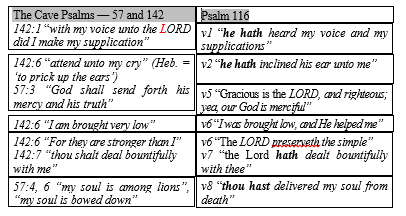
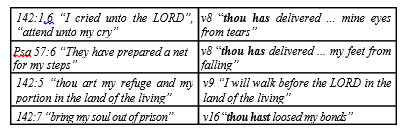
In each of these Psalms, David is assured of God’s future help, as evidenced in the words ‘shall’ and ‘shalt’. Future assurance helped David overcome the anguish he felt in the cave. His present circumstances were daunting, but the future was bursting with hope if he placed his trust in God. Despite ‘the net that been prepared for his steps’, ‘the pit that had been digged before him’, ‘the snare that had been hidden in his path’, and the sheer ‘strength of his persecutors’ (Psa 57:6; Psa 142:3), David was wholly confident that God would watch over his journey, and at some future point ‘the storms of destruction would pass by’ (Psa 57:1 ESV). “Thou knewest my path” (Psa 142:3) states David, fully recognizing that God could see the way he was treading, from beginning to end, with all its darkness and dangers.
It is interesting to compare Psalm 116 with those written from the cave. This Psalm was written during a far more joyous time in David’s life, when he was able to look back on his pilgrimage and count the numerous instances when God responded to the troubles he had “shewed before Him” (Psa 142:2). The expressions ‘he hath’ and ‘thou hast’ in Psalm 116 often correspond with his earlier troubles and pleas in Psalms 57 and 142.
While in the cave, David was assured God would help him in the future, and looking back, he could confidently see that God had been with him all along. There was no need to doubt the future: “Even though I walk through the valley of the shadow of death, I will fear no evil, for You are with me; Your rod and Your staff, they comfort me” (Psa 23:4 ESV).
Coupled, these Psalms demonstrate the reason why David could conclude Psalm 142 with such a strong expression of faith: “Thou shalt deal bountifully with me” (Psa 142:7). Psalm 116 also explains why he could speak so confidently of God’s future help: “I believed, even when I spoke, ‘I am greatly afflicted”(Psa 116:10). It was a deep-rooted conviction in God’s ability to rescue him someday, despite the calamity that filled his present circumstances. This faith compelled him to share his love, trust and faith in God, and to ‘proclaim among the peoples and nations’ (Psa 57:9): “Be thou exalted, O God, above the heavens: let Thy glory be above all the earth” (Psa 57:11). “Praise ye the Lord” (Psa 116:19).
David’s confidence in the future was not limited simply to God’s ability to respond to his personal troubles. Psalm 110 and 72 are Messianic and serve to illustrate David’s assurance that God would, in the future, establish his kingdom in Zion, and send a Savior to rescue ALL the needy and rule ALL the earth in justice and peace. Speaking ultimately of Christ, he says “The LORD shall send the rod of Thy strength out of Zion: rule thou in the midst of thine enemies” (Psa 110:2). Earlier, in Psalm 72, he ruminates on the glory of the saviour to come:
“He shall judge thy people with righteousness, and the poor with judgment … He shall come down like rain upon the mown grass: as showers that water the earth … He shall deliver the needy when he crieth … He shall redeem their soul from deceit and violence: and precious shall their blood be in His sight … His name shall endure for ever.” (Psa 72:2,6,12,14,17)
How inspired and refreshed David must have been to recognize, that beyond God’s current help in the cave, He would ultimately save through the Lord Jesus Christ. It is incredibly difficult to see both the past and the future when we are overwhelmed with the wanderings of the wilderness, and calamity of caves. Yet, David encourages us to look forward, to place confidence in the future, and to trust that God will ultimately ‘deal bountifully’ with us also (Psa 142:7).
 The Origin of the Organic World – Part One