
Christadelphian read the Bible through each year using the Bible Companion. The Bible Companion specifies a sequence of daily readings by which the Old Testament is read once and the New Testament is read twice each year. Similarly, since long before Jesus, Jews have read the Torah (Genesis, Exodus, Leviticus, Numbers, and Deuteronomy) through each year using a sequence of weekly sabbath readings. The Jews also have special readings for the annual holy days. In addition to the primary reading on the sabbath and holy days, there was a second reading taken from the historical or prophetic books. This amounted to a Jewish Bible Companion.
In our readings, we often notice parallels between different portions of the daily readings. In this series of articles we will study sequences of parallels that arise when specific books of the Bible are read side-by-side the Torah, or side-by-side the sequence of annual festival readings.
These parallels emphasize that the Scriptures are inspired– God is active in the history of the Bible and in the recording of that history. In particular, the parallels exhibit that the Law and the Prophets were fulfilled by the kings of Judah, by Jesus, and by the body of Christ.
Furthermore, the parallels give insight into the structure of the books that we will study. For example, observing parallels will help us to answer questions like:
- Why does 1 Chronicles begin with all those genealogies?
- Why did Matthew organize his gospel around Christ’s major speeches?
- What did Luke mean when he wrote that his gospel was written “in order?”
- Why do the clusters of allusions to particular prophets found in the book of Revelation occur where they do?
But before we can get to these specifics we must first have clearly before us the Jewish calendar and the system of readings that they used.
The lunar calendar
The Jewish calendar is a lunar calendar; that is, it is based on the moon (i.e. the
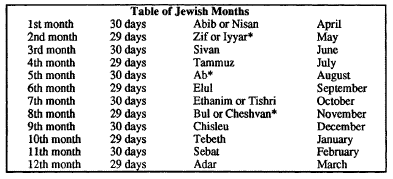
time it takes the moon to revolve around the earth). Each month of the Jewish year begins at a new moon. The time between new moons is 29 1/2 days. Consequently, a Jewish year is made up of 12 lunar months which alternate between 29 and 30 days.
The names of the 12 Jewish months, some of which picked up a second name after the Babylonian captivity, the length of these months, and the corresponding months in our calendar are given in the table below. An asterisk next to the name of a Jewish month indicates that the name does not appear in the Bible.
A lunar year is 354 days long in contrast to a solar year which is 365 1/4 days long. As a result, every year the Jewish lunar year falls 111/4 days behind the sun, causing the calendar and the seasons to get out of sync. To adjust for this gap, an extra “leap” month must be added about every third year (actually, 7 years in 19 have a month added). This month becomes a 13th month, called Veadar, which means “extra Adar.” By adding this month the barley will have time to ripen in time for Passover.
Scriptural calendars
The Scriptures contain five calendars, each having its own emphasis. These calendars are found in Exodus 23 and 34, Leviticus 23, Numbers 28-29, and Deuteronomy 16.
The three pilgrimage feasts
The calendars in Exodus 23 and 34, and Deuteronomy 16 describe the three pilgrimage feasts associated with the old covenant. “Three times in a year shall all thy males appear before the LORD thy God in the place which he shall choose; in the feast of unleavened bread, and in the feast of weeks, and in the feast of tabernacles” (Dt. 16:16 RV; cp. Exo. 23:14,17; 34:24-25).
The calendar in Exodus 23 states the pilgrimage requirements of the old covenant (Exo. 20-24). The calendar in Exodus 34 renews those requirements as conditions for the renewal of the covenant following the golden calf transgression (Exo. 32-34). In Deuteronomy 16, Moses reiterates the requirements in order to prepare the Jews to enter the land of Promise.
The holy convocations
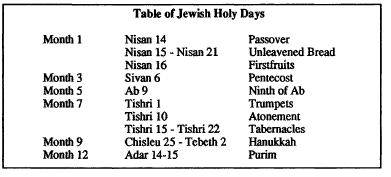
Leviticus 23 lists all holy convocations and sabbaths to be kept during the year. The set feasts were the Sabbath each seventh day of the week (23:3), Passover on Nisan 14 (v. 5), Unleavened Bread from Nisan 15 to Nisan 21 (vs. 6-8), Firstfruits (of the barley harvest) on Nisan 16 (vs. 9-14), Pentecost on the fiftieth day after Nisan 15 which is Sivan 6 (vs. 15-22), Trumpets on Tishri 1 which is the beginning of the seventh month (vs. 23-25), Day of Atonement on Tishri 10 (vs. 26-32), and Tabernacles from Tishri 15 to Tishri 22 (vs. 33-36,39-43).
The sacrifices
Numbers 28-29 lists all the sacrifices that were to be offered during the year. These chapters specify the daily morning and evening sacrifices (28:3-8), as well as the sacrifices for the sabbath (28:9-10), for the beginning of each month (28:11-15), for Passover and Unleavened Bread (28:16-25), for Pentecost (28:26-31), for Trumpets (29:1-6), for the Day of Atonement (29:7-11) and for each of the eight days of Tabernacles (29:12-38).
Additional Jewish holy days
In addition to the holy days listed in these five calendars, every year the Jews celebrate Purim (Heb. for Lots), Hanukkah (Heb. for dedication), and the Ninth of Ab (the fifth month). Purim, which memorializes the reversal of Haman’ s plan to kill the Jews in Persia, is celebrated on Adar 14 and 15 (Esth. 9:20-32). Hanukkah, which celebrates the cleansing of the temple by the Jews under Judas Maccabaeus three years after it had been profaned by the Syrians under Antioch us Epiphanies, is celebrated for the eight days from Chisleu 25 to Tebeth 2(1 Macc. 4:52-59,2 Macc. 1:18, 10:1-8; cp. Jn. 10:22). The Ninth of Ab, the most important of the four historical feasts, commemorates the burning of the temple by the Babylonians (Zech. 7:3-5, 8:19,2 Kgs. 25:8-9, Jer. 52:12-13).
Bible reading as an integral part of public worship
Bible readings have always been an integral part of Jewish worship services, even as they are of our own meetings.
The readings at gatherings of the children of Israel
In the establishment of the Old Covenant, Moses “took the book of the covenant, and read in the audience of the people: and they said, All that the LORD hath said will we do, and be obedient” (Exo. 24:7).
Israel was commanded to read the entire law at the gathering for every seventh Tabernacles. “Moses commanded them, saying, At the end of every seven years, in the solemnity of the year of release, in the feast of tabernacles, when all Israel is come to appear before the LORD thy God in the place which he shall choose, thou shalt read this law before all Israel in their hearing. Gather the people together, men, and women, and children, and thy stranger that is within thy gates, that they may hear, and that they may learn, and fear the LORD thy God, and observe to do all the words of this law: and that their children, which have not known any thing, may hear, and learn to fear the LORD your God, as long as ye live in the land whither ye go over Jordan to possess it” (Dt. 31:9-13).
This is exactly what Ezra did. “And Ezra the priest brought the law before the congregation both of men and women, and all that could hear with understanding, upon the first day of the seventh month…So they read in the book in the law of God distinctly, and gave the sense, and caused them to understand the reading…Also day by day, from the first day unto the last day, he read in the book of the law of God. And they kept the feast seven days; and on the eighth day was a solemn assembly, according unto the manner.” (Neh. 8:2,8,18).
After the destruction of Ai, Joshua built an altar unto the Lord God of Israel in mount Ebal. And after the people had been blessed, “he read all the words of the law, the blessings and the cursings, according to all that is written in the book of the law. There was not a word of all that Moses commanded, which Joshua read not before the congregation of Israel” (Josh. 8:34-35).
The readings at synagogue services
The readings are an important part of our weekly breaking of bread services. From Old Testament times, the Jews have had a similar policy. Every sabbath, as part of their synagogue service, they read from the Law and the Prophets.
Jesus read at a synagogue service in Nazareth. “And there was delivered unto him the book of the prophet Isaiah, And he opened the book, and found (Isa. 61:1- 2)…And he closed the book, and gave it back to the attendant, and sat down…And he began to say unto them, Today hath this scripture been fulfilled in your ears” (Lk. 4:16-17,20-21 RV).
Luke tells how “Paul and his company…came to Antioch of Pisidia; and they went into the synagogue on the sabbath day, and sat down. And after the reading of the law and the prophets the rulers of the synagogue sent unto them, saying, Brethren, if ye have any word of exhortation for the people, say on” (Acts 13:13-15). In the exhortation that follows, Paul said, “For they that dwell at Jerusalem, and their rulers, because they knew him not, nor yet the voices of the prophets which are read every sabbath day, have fulfilled them in condemning him” (Acts 13:27).
At the Jerusalem conference, James says, “For Moses of old time hath in every city them that preach him, being read in the synagogues every sabbath day” (Acts 15:21).
And Paul exhorts Timothy, “Till I come, give heed to reading, to exhortation, to teaching” (I Tim. 4:13 RV).
Paul’s epistles and Revelation to be read at meeting
New Testament books were also written to be read publicly as part of the ecclesial worship service. Paul tells those he was writing to that they should read his epistles at the memorial meeting. “I charge you by the Lord that this epistle be read unto all the holy brethren” (I Th. 5:27; see Col. 4:16 also). And there is a blessing for the (public) reader of Revelation. “Blessed is he that readeth, and they that hear the words of this prophecy, and keep those things which are written therein: for the time is at hand” (Rev. 1:3).
The next two articles
Lord willing, the next two installments in this series will discuss the particular sequence of readings from the Law that the Jews used for their sabbath services and the special readings that they used for each of the festival services. That is, the next two articles will discuss the Jewish Bible Companion.
 The Origin of the Organic World – Part One